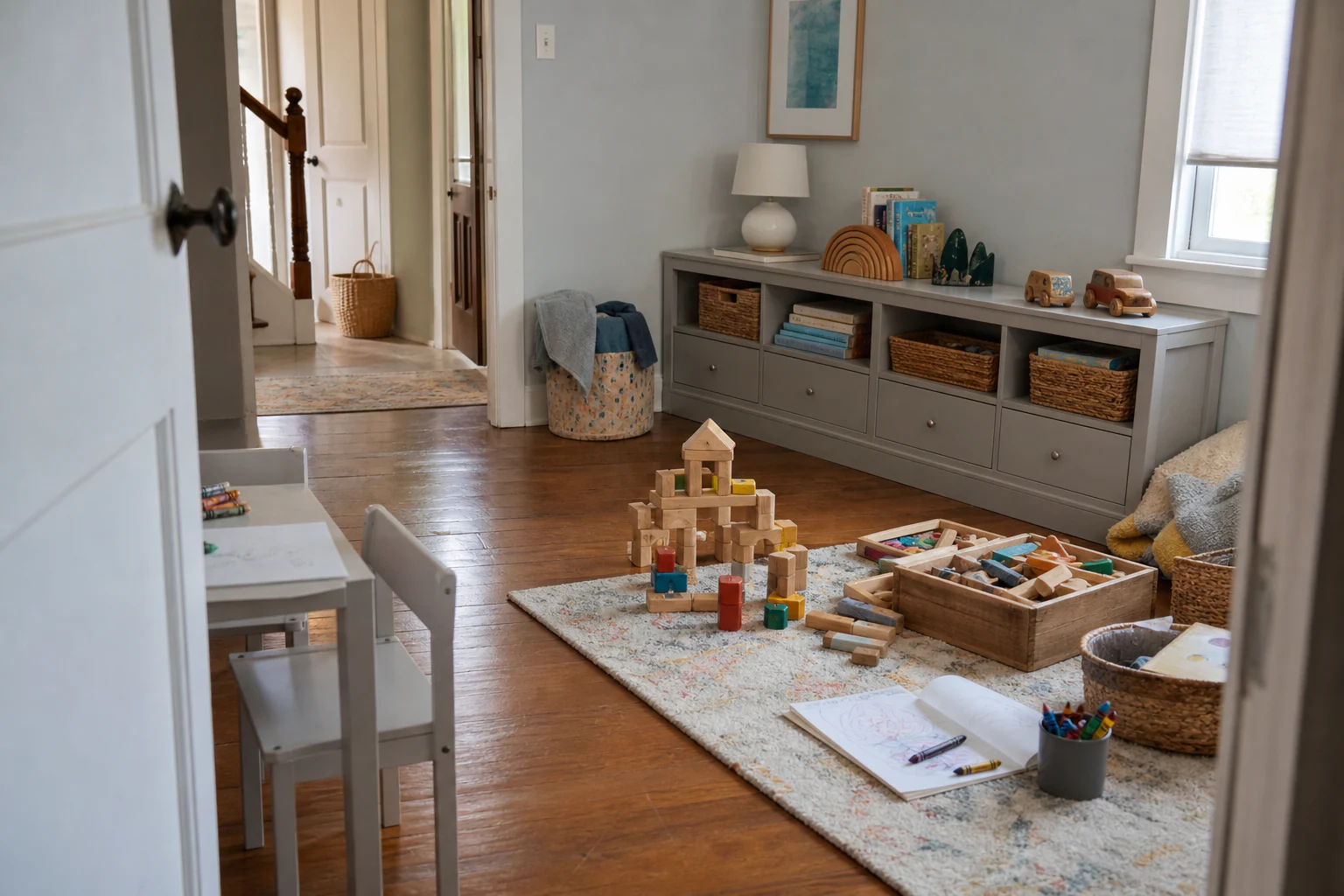
The room drawn as a play cycle
The reset begins before the first toy comes out.
Watch how play starts, spreads, changes, pauses, and returns. Storage is useful only when it supports the whole cycle.
- 01Choose
- 02Spread
- 03Change
- 04Return
Some playrooms are organised for the adult who photographs them. Every block is sorted, every label faces forward and the child needs a project manager to put anything away.
A useful playroom supports a cycle:
- choose;
- carry;
- spread;
- combine;
- pause;
- return—or protect a work in progress.
If the return stage requires sorting forty pieces into six categories, lifting a lid and reaching above the shoulder, the pile is not a character flaw. It is a system report.
Watch twenty minutes without tidying
Twenty-minute observation
Follow the play, not the storage labels
- ChooseWhere does the child look first?
- CarryHow far does the object travel?
- SpreadHow much floor does this kind of play need?
- CombineWhich categories naturally meet?
- PauseWhat must remain intact?
- ReturnHow many actions does putting away take?
Observe one ordinary play period. Record:
- what is chosen first;
- what moves across the room;
- where a body sits, kneels, climbs or lies;
- which toys combine;
- where pieces disappear;
- what an adult repeatedly carries;
- what is abandoned because setup is too difficult;
- where the route becomes unsafe.
Do not redesign from the total toy inventory. Redesign from the active play.
The clearest clue is migration. If drawing materials always move to the floor near daylight, the art zone is not where the cabinet says it is. If costumes travel to the hallway mirror, the room needs a safe mirror relationship or the costumes need a different home.
Calculate reset cost
Reset-cost equation
More decisions make a longer tidy
- ReachCan the child reach the home?
- RecognitionCan they identify the category quickly?
- ActionsOpen, sort, stack, close, carry?
- DistanceHow far from the place of play?
Reset cost is the number of decisions and actions required to put one play type away.
Blocks in an open low bin: gather, carry, drop—three actions.
Blocks sorted by colour into lidded boxes on a high shelf: gather, sort repeatedly, open, lift, close, return—many actions.
Lower reset cost with:
- broad categories children understand;
- open containers where safe and suitable;
- pictures or simple labels appropriate to the child;
- destinations near where the object is used;
- containers that are not too heavy when full;
- a protected “still building” place;
- fewer objects available at once.
The aim is not independent tidiness at every age. It is a system that asks for the next achievable action.
Build zones by behaviour
Zones by behaviour
The same toy may belong where the body uses it
- SpreadBlocks, tracks, puzzles; protect floor area.
- MakePaper, clay, tools; contain mess and works in progress.
- MoveDance, tumble, large construction; protect route and headroom.
- QuietBooks, small worlds, sensory breaks; lower traffic.
- PretendCostumes and props; easy transformation matters.
Spread zone
For blocks, trains, puzzles and loose parts. It needs a clear floor, an edge that does not become a trip hazard and storage close enough for return.
Making zone
For drawing, clay and craft. It needs a cleanable surface, appropriate seating, safe material storage and a clear rule for adult-supervised items.
Movement zone
For larger body play. It requires the strongest safety judgment: clearances, stable surfaces, age-appropriate equipment, window and furniture boundaries, and supervision.
Quiet zone
For books, audio, rest or solitary play. It should be reachable without crossing the most energetic activity.
Pretend zone
For costumes and role play. Avoid cords, unstable racks and mirrors not designed or installed safely. A small selection can prompt more invention than a packed rail.
Zones may overlap in time. They should not all occupy the centre permanently.
Protect sightlines and exits
Safety and sightline plan
Keep the grown-up view and the exit legible
- Exit
- Adult sightline
- Movement zone
An adult should be able to understand the room quickly. Tall storage used as a divider may hide children, narrow a route or create a tip-over risk.
Keep exits clear. Keep furniture away from windows where children could climb. CPSC says cordless window coverings are the safest option where young children are present and recommends moving beds, furniture and toys away from windows and covering cords.
Anchor top-heavy furniture according to manufacturer instructions with fixings suitable for the surface. Do not place tempting objects on top of climbable furniture.
Toy chests with heavy falling lids can create serious hazards. Prefer open bins, removable lightweight lids or products designed to current applicable safety requirements; follow manufacturer age and use guidance.
Review button batteries, magnets, cords, small parts and electrical toys according to the ages and abilities present—including visiting children.
Use an availability shelf, not a toy warehouse
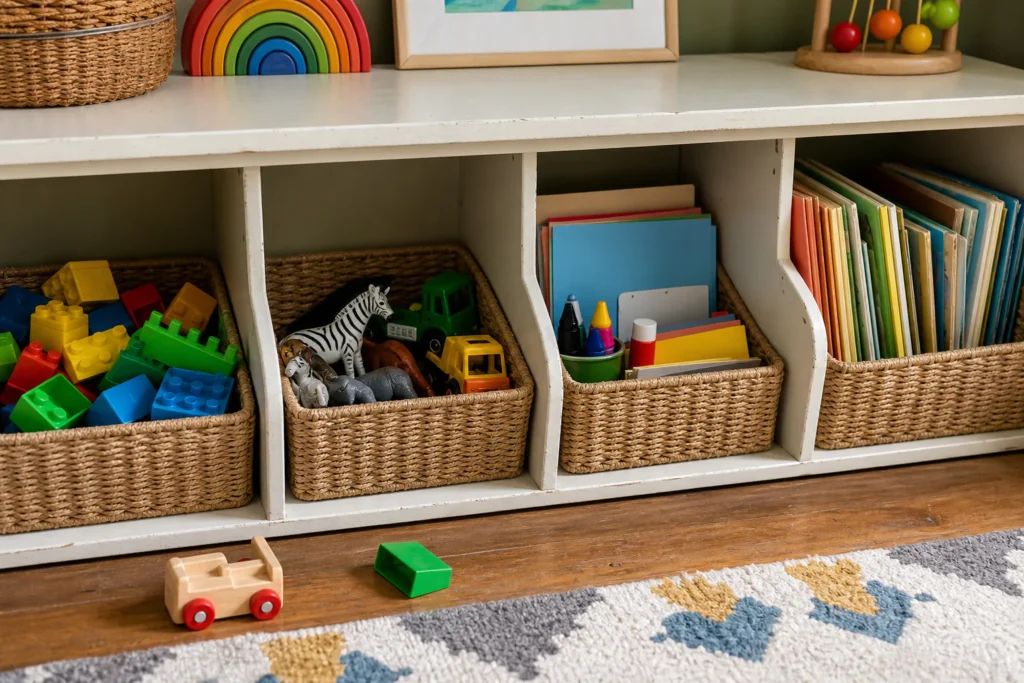
Keep a limited selection visible and move the rest to an adult-managed rotation if helpful.
A rotation is not a performance schedule. Change it when:
- play has become repetitive and frustrated;
- a new interest needs deeper materials;
- age/ability changes;
- the season changes the available movement;
- too many simultaneous choices prevent starting.
Do not rotate away a beloved regulating object for novelty. Familiarity can be the point.
Create one open-ended shelf with materials that combine: blocks, figures, fabric, vehicles, natural objects appropriate to age. Avoid prescribing the finished scene through excessive themed storage.
Give works in progress a legal address
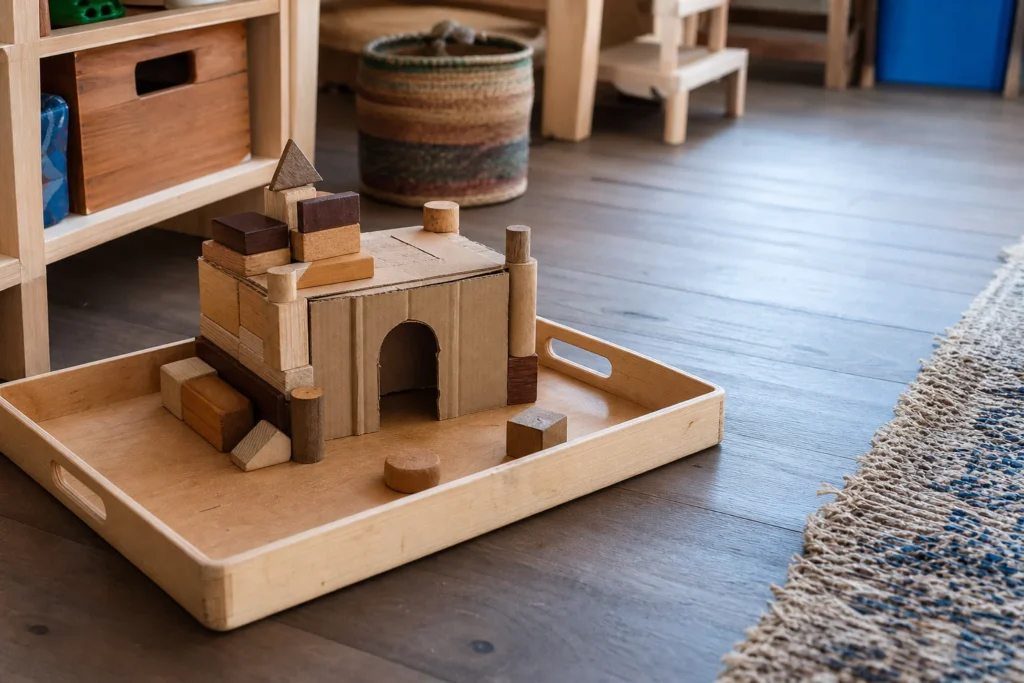
Destroying every construction at tidy time teaches children that tidiness competes with effort.
Offer:
- one tray that can move intact;
- one low shelf for a current project;
- a “keep until” marker;
- a photograph before dismantling;
- a limit on how many projects may remain.
The rule becomes fair: some play can pause, but the route and shared floor return.
A constructed example: 3 × 3.6 metres, ages four and eight
Constructed 3 × 3.6 metre room
The room becomes larger when fewer things are available
- Warehouse planEvery toy is visible; categories overlap; the middle becomes storage overflow.
- Play-cycle planA smaller availability shelf supports the current interests; the middle returns to play.
The room has a window on one wall, a door near the corner and tall cube storage opposite. Art materials live high; blocks live in six sorted bins; costumes hang near the window.
Observation shows:
- both children draw at the window-side floor;
- blocks combine across categories;
- the younger child climbs to reach costumes;
- the older child protects builds by placing them in the doorway.
Revised:
- art table moves beside but not against the window, leaving window access and safety clear;
- daily washable art materials move to a low adult-approved caddy;
- blocks become two broad open categories;
- costumes move to a low stable rail away from window cords;
- tall storage is anchored and holds adult-managed rotation above;
- a project tray lives on a low shelf;
- the central route from door remains empty;
- a small reading cushion occupies the quiet corner.
The visual result is less sorted. The children can complete more of the cycle.
The seven-minute family reset
Seven-minute family reset
Reset the room in the order that makes space reappear
0 of 5 complete
Use the same short sequence:
- Keep or photograph one project.
- Return large items.
- Sweep loose pieces into broad homes.
- Move books and costumes.
- Clear the door route.
- Remove cups, food and rubbish.
- Set out one invitation for next time.
An invitation might be two books face-out, paper beside crayons or blocks on a tray. It should not create a new adult-made scene that children are afraid to disturb.
Let the room grow by subtracting
Every few months ask:
- Which action has become too easy or too hard?
- Which storage is now unsafe to climb or too small to use?
- What is no longer played with?
- Which zone has migrated?
- Does the room support a visiting younger child?
- Can the child help choose categories?
The playroom should not preserve an age. It should release equipment and layouts that the household has outgrown.
Design for the child who is here today
Development, height, interests, sensory needs and supervision change. Treat the room as an adjustable environment rather than a completed identity. A low shelf that is reachable for one child may become a climbing temptation for another; a quiet tent may block the adult sightline; a small-parts activity may be inappropriate around a younger sibling.
Use the product age guidance, inspect toys for damage, and keep known hazards outside the reach of children for whom they are unsuitable. Furniture anchoring, window-covering cords, toy-chest lids, doors, exits and electrical access are not styling details. Recheck them whenever the furniture or age mix changes.
Mixed-age rooms benefit from controlled availability. Put shared, broadly suitable materials in the easiest reach. Give older-child projects a higher or supervised address rather than expecting one open bin system to serve everyone.
Make the reset emotionally legible
A child may resist tidying because the instruction “put everything away” erases a world they were still using. Begin by naming what can continue: the block city stays on the project tray; the drawing goes in the drying place; the costume returns but the story can resume tomorrow.
Then give the room a visible finish line. It might be the centre rug reappearing, the route to the door becoming open, or all pieces returning below one shelf height. A finish line is easier to recognise than adult-level visual perfection.
Rotate gently. Photograph a complex build before dismantling it. Let the child choose one category to rest and one to return. A rotation that feels like disappearance will create guarding; a rotation that creates space for a new kind of play can feel generous. The room is not successful when it looks untouched. It is successful when starting and stopping both feel possible.
Useful next action
Observe twenty minutes and count the actions required to put away the most-used toy. Remove one decision from that reset before buying a container.
About the visuals in this guide
These are original Dealsmaster editorial illustrations produced with AI assistance for explanation and inspiration. They do not document a real household, tested installation, reader result, or professional inspection.
Sources and limits
Useful advice should show its working
Material claims were checked against the primary guidance below. Dealsmaster dimensions and layouts are editorial planning starting points, not universal codes, professional assessments, or product instructions. Local rules, tenancy terms, building conditions, user needs, and manufacturer guidance control.
- U.S. Consumer Product Safety Commission — Anchor ItFurniture tip-over prevention.
- U.S. CPSC — Toy Chest Lid SafetyHazards associated with falling or trapping lids.
- U.S. CPSC — Go CordlessWindow-covering cord safety context for rooms used by children.
Disclosure: This guide contains no affiliate links, sponsorship, or claimed product testing. Constructed examples are planning examples, not reported Dealsmaster households.