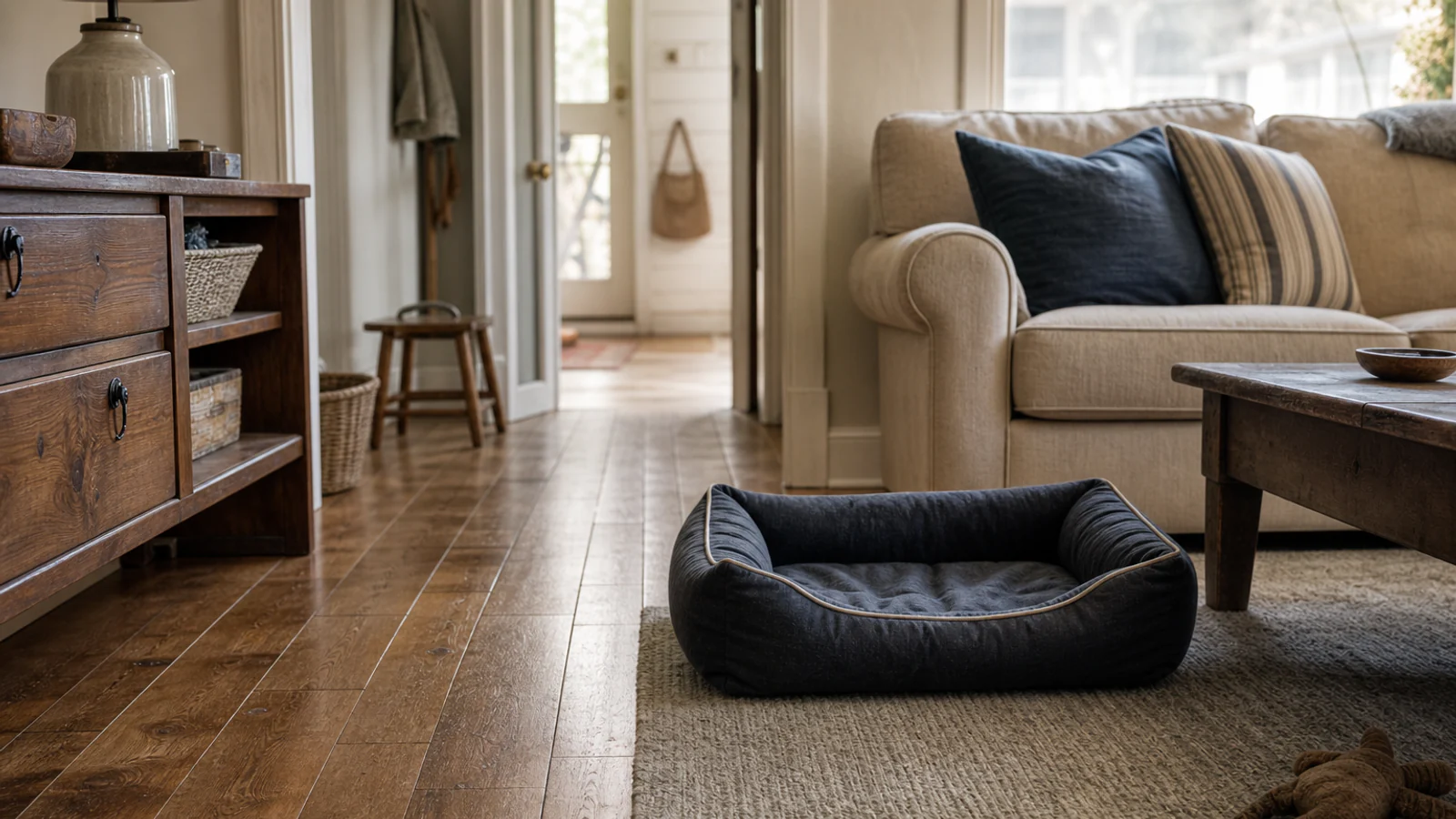
A field notebook for the lowest metre of the room
Observe routes, resting places, reachable objects and the mess that actually happens before choosing a sofa cover, rug or decorative pet station.
The answer before shopping: observe one ordinary evening without rearranging the room. Draw the animal’s repeated routes, places used for rest or watching, relevant resources and physical friction. Make one reversible household-design change at a time. A bed, rug or fabric is useful only when it fits the observed room and its exact care instructions.
The pet bed in a catalogue occupies the corner the animal was always going to choose. Real rooms are less obedient. A dog lies across the strip of sun that also happens to be the route to the balcony. A cat watches from the chair everyone thought would remain decorative. A toy migrates under the coffee table. The rug that hides dark fur beautifully also hides the dirt that needs cleaning.
This is not evidence that an animal is stubborn, anxious, dominant, happy or seeking a den. It is evidence that a body was in a place at a time.
Field note 01
Watch before you improve
One ordinary evening supplies a better starting point than a staged pet corner.
- where the animal enters, exits, pauses and turns;
- which places are used for rest or watching, with time noted;
- where people step around a bed, bowl, toy or animal;
- where fur, mud, drool, litter or toy debris lands;
- which surfaces are scratched, dug, licked or avoided;
- what doors, cords, plants, hot surfaces or unstable objects are reachable;
- which human route must also remain workable.
Write what happened without explaining why. “Lay under the side table from 7:10 until 8:00” is an observation. “The table feels like a secure den” is an interpretation. The interpretation may eventually guide a cautious comparison, but it should not be smuggled into the first note as fact.
Include ordinary interruptions. The delivery arrives. Someone opens the patio door. The vacuum is brought out. A child looks for a toy. Another animal enters the room. A plan that works only in a silent house is a photograph, not a shared living room.
Visual tool 1 · keep observation separate from inference
- “Rested half on the bed and half in the route.”
- “Avoided the loose rug edge twice.”
- “Moved to the sun patch after the curtain opened.”
- “Water splashed beside the bowl.”
- Was the bed position, temperature, view or company relevant?
- Was the rug avoided, or was another destination preferred?
- Would the choice repeat on a cloudy day?
- Does a physical or behavior change need professional attention?
Draw four layers on one honest plan
Use a basic room outline with furniture footprints and door movements. Do not decorate it with breed silhouettes or paw-print borders. It needs to show where bodies and objects meet.
Visual tool 2 · the four-layer floor map
Observed rest or watch position
Relevant resource or care storage
Door and full movement
Repeated animal and human travel
This is an example key, not a universal pet-room layout or dimensional rule. Draw the actual household and equipment.
If the broader furniture arrangement is forcing every body through one narrow turn, use the guide to small living-room layout mistakes before buying a new pet object. Pet-sharing does not remove the human route; it adds another route to observe.
Add the caregiver route in a fifth, temporary colour
The animal is not the only body working at floor level. Someone fills water, lifts bedding, reaches a toy under the sofa, wipes a spill, carries a litter mat or opens the door with full hands. Trace that care route separately. It may reveal that a beautifully hidden supply basket is on the wrong side of the room or that a washable cover cannot be removed without moving a heavy table.
Record the complete cleanup sequence: where the cleaning item is stored, how it reaches the spill, where debris goes, where a damp cloth or cover dries, and how the route returns to normal. This is not permission to recommend a cleaner. Follow the surface, textile and cleaning-product instructions, protect household members, and keep products stored as directed.
A maintenance plan should fit the caregiver’s reach, strength, time and mobility. A giant bed cover that technically enters the washing machine may still be unrealistic to remove and refit. A storage bench that hides supplies may create an awkward lift or become blocked by the pet bed. “Washable” and “easy access” are product and household questions, not visual adjectives.
Give recurring items one bounded address near the part of the route where they are used, without placing chemicals, medication, food or small objects where they become accessible. If the room needs several overflowing pet baskets, audit the inventory before buying furniture to hold it. The goal is not to make care invisible; it is to make the next ordinary care action possible.
Read the five kinds of friction
1. Route friction
Look for narrow turns, rug transitions, sharp furniture corners and people stepping across a resting place. Do not prescribe one clearance for every home or animal. Household bodies, mobility aids, animal size, age, health, door operation and property geometry differ.
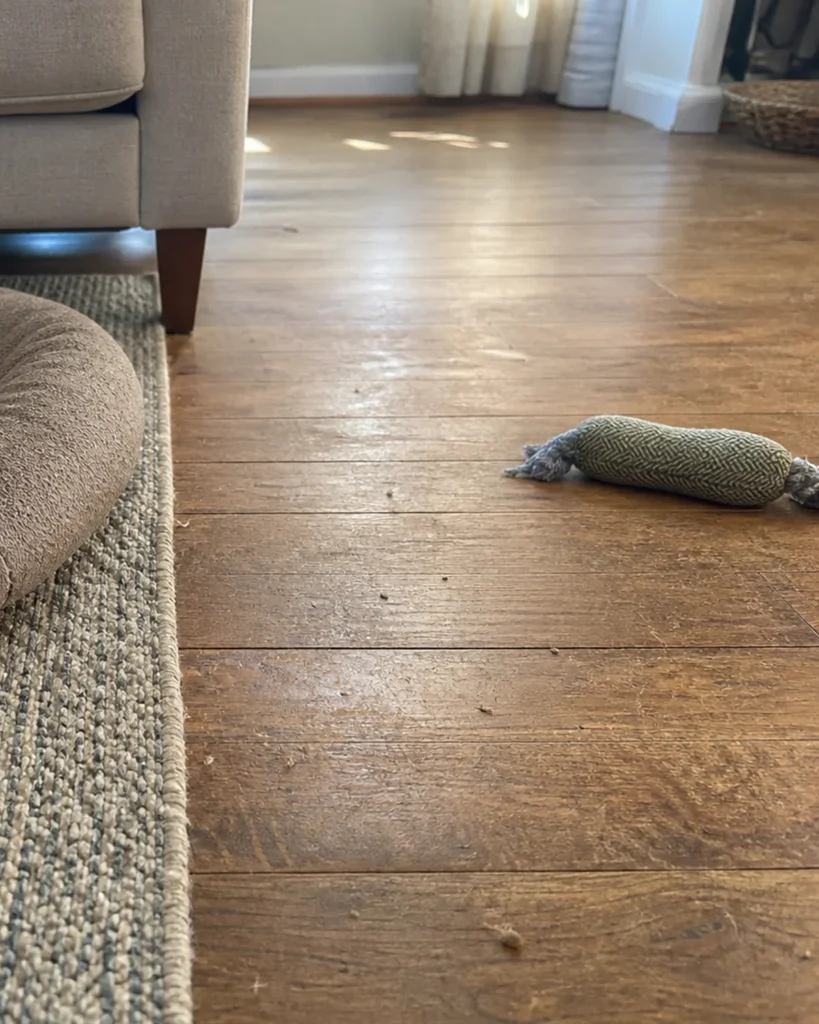
A reversible first comparison might shift a light side table, turn the bed so its longest edge leaves the route, or move a toy basket away from the line between sofa and door. Keep doors and household escape routes usable. If an animal’s movement has changed, especially suddenly, do not assume furniture is the cause.
Rugs require two separate decisions: whether the size supports the human furniture plan and whether the edge, backing, care method and surface transition work for this household. The living-room rug sizing guide handles the first question. Exact product instructions and the observed floor-level route handle the second.
2. Rest and watch friction
A chosen resting place may also be where a door opens, a robot vacuum docks, a speaker vibrates, a heater needs clearance or people reach a cabinet. Record the overlap. Do not declare that the animal “needs a den” because it used the side-table shadow once.
Compare a second location that preserves any observable benefit without taking over the route. If the existing place has a sun patch and view into the room, a nearby bed position may retain both. If it does not, that result is useful. Multi-pet homes may need several options, and resource arrangements can carry behavior and welfare implications beyond a decor guide. Seek qualified guidance for conflict, fear or guarding rather than styling a compulsory shared corner.
Visual tool 3 · compare without pretending to know why
Observed overlap
Resting place enters the route
Record time, light, nearby people and door use. Do not label the choice good or bad before checking the physical conflict.
Reversible comparison
Nearby option leaves the route
Preserve the observable features you can, then watch whether and when the option is used. No emotional outcome is promised.
3. Material friction
“Pet-proof” is not a useful specification. Record the exact maker’s cleaning instructions, whether a cover is removable, how the weave or loops interact with the household, how seams and zips are accessed, how long the item takes to dry, how visible fur and spills are, and whether the household can move the piece for cleaning.
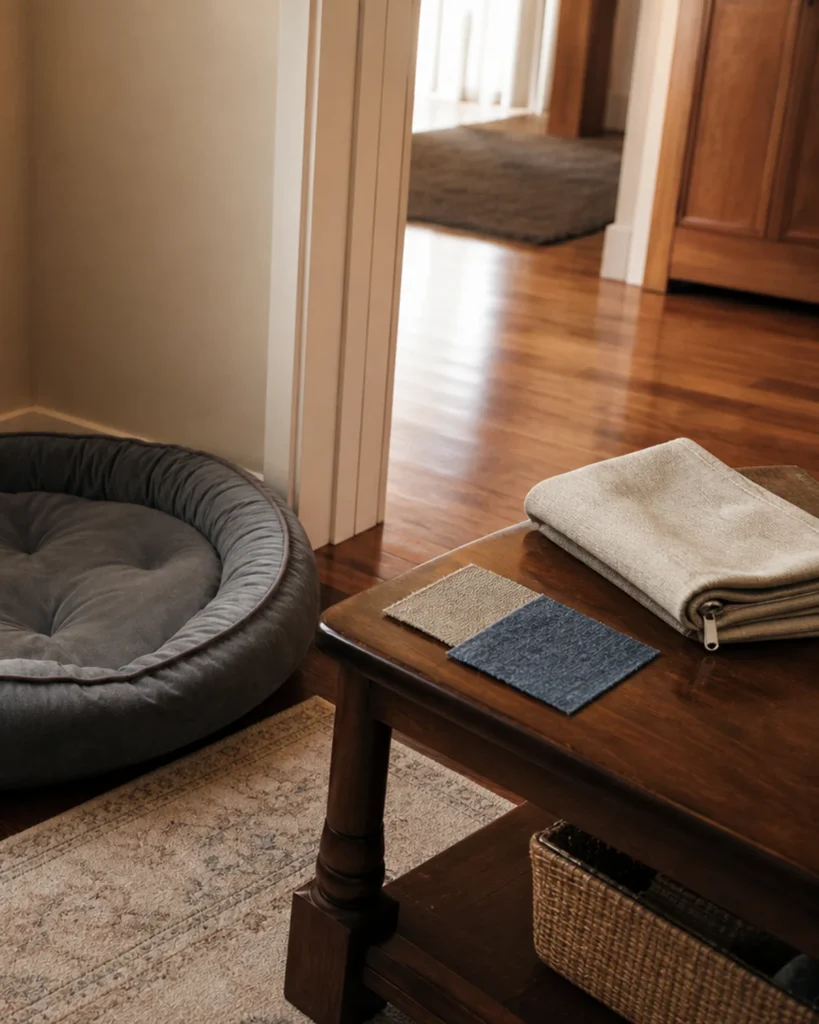
If a manufacturer allows samples to be cleaned, follow the current instructions on a labelled household sample. Do not scratch it, soak it or invent a dramatic stain trial. A small sample cannot prove long-term performance, animal behavior or how a full upholstered object will age.
Colour is maintenance information. A pale cover may make dark mud obvious enough to clean promptly. A mid-tone texture may make light and dark fur less visually dominant between routine cleaning. Neither is automatically more hygienic. Choose the surface whose permitted care fits the household’s actual tools, laundry capacity and drying time.
Rehearse the bad weather version
A room that works on a dry evening may acquire a very different floor after rain, shedding season or a muddy walk. Without manufacturing a mess, trace where wet paws, a damp lead, towels and outdoor shoes actually travel. The answer may be a washable layer near the entry, a towel stored where the door is opened, or simply keeping the sofa route clear enough to clean promptly.
Do not add a rug solely to catch dirt without checking its exact backing, edge, care method and compatibility with the floor. Do not stack absorbent layers that remain damp or create another unstable transition. The successful material is not the one with the strongest marketing language. It is the one whose permitted cleaning and drying cycle the household can complete.
Seasonal evidence also prevents overfitting the room to one week. A sun patch moves. A door may be opened more often. A thick bed may be used differently when the room is warm. Record the change without diagnosing it, keep basic routes flexible, and ask a veterinarian about concerning physical or behavioral change.
Visual tool 4 · material maintenance scorecard
| Question | Evidence to record | Your score |
|---|---|---|
| Can it be cleaned as permitted? | Exact maker instructions and products already available. | 0 / 1 / 2 |
| Can it dry before it is needed? | Real laundry space, weather and turnaround. | 0 / 1 / 2 |
| Can seams and debris be reached? | Cover, zip, cushions and underside access. | 0 / 1 / 2 |
| Does it fit the floor-level route? | Edges, loops, backing, stability and movement. | 0 / 1 / 2 |
| Can the household repair or replace it? | Return policy, spare cover or realistic cost. | 0 / 1 / 2 |
The scorecard is a decision tool, not a laboratory test or product endorsement.
4. Object friction
Sit or kneel only if it is physically appropriate for you; otherwise use a phone camera or mirror to inspect below normal eye level without placing yourself at risk. Look for cords, window-covering loops, unstable lamps, small chewable objects, sharp supports, accessible hot surfaces and furniture that could tip. Follow current product instructions and recall information.
If children also use the room, CPSC furniture and television tip-over guidance remains relevant regardless of the pet layout. A decorative cable box should not create a chew route, trap heat or conceal a connection that needs service. A tall basket should not become a reason to place tempting objects higher on unstable furniture.
Do not infer safety from a generated or editorial image. Every cord-management product, lamp, piece of furniture, television and restraint must be used for its intended purpose and exact environment.
One room can contain several incompatible routines
A toddler, an older adult, a visitor using a mobility aid, a cat and a dog may all approach the same sofa corner differently. Do not solve this complexity by assigning every animal one shared “pet zone.” Keep the map layered. Mark when the room is busiest and which conflicts happen at the same time rather than combining every route into one frightening tangle.
Where an interaction raises child safety, animal welfare, resource conflict or household-access questions, use the qualified route for that question. Interior styling cannot certify that supervision, resource placement or an inter-animal arrangement is appropriate.
5. Plant friction
Identify every reachable plant by a reliable label or credible horticultural source, then check an authoritative toxicity resource for the exact species and animal. Do not identify a plant from this article’s imagery. The ASPCA says its plant list is not all-inclusive and notes that individual plants can differ in appearance. Plants listed as non-toxic may still cause gastrointestinal upset if consumed.
Moving an unknown plant onto a decorative stand does not resolve uncertainty. Leaves fall. Animals climb. Pots tip. Water drips. Care becomes harder. Remove the unknown from access while identity and household risk are resolved, and use prompt veterinary or poison-service guidance for suspected exposure.
Visual tool 5 · plant stop card
- Name: verify the exact species from a reliable source, not a photograph alone.
- Check: consult the authoritative toxicity information for the actual animal.
- Access: include fallen leaves, climbing, pot stability and watering.
- Stop: remove uncertainty from reach and seek appropriate help for suspected exposure.
Worked example: the sunny shortcut
Consider a hypothetical dog who repeatedly travels from the hall to a balcony door along the front of the sofa. The household places a new bed in the sunny corner beside that line. During one evening, the dog rests partly on the bed and partly in the route. People step around the occupied space. The water bowl is behind the bed, and a loose rug edge sits near the turn.
The catalogue answer is a larger matching bed. The field map suggests three smaller comparisons: move the bed fully beside the route while keeping as much of the observed sun position as practical; review whether the water location can be reached without crossing the resting place within the household’s care plan; and resolve the rug edge according to exact product and floor guidance rather than adding another mat.
Visual tool 6 · identical room, one reversible move
Plan A · observed
Bed overlaps the shortcut
Sun, door destination, water route and rug edge all appear in the same floor-level zone.
Plan B · compare
Bed sits beside the shortcut
The route remains clearer while the nearby sun and room view are preserved as far as the actual geometry allows.
The plans are illustrative and use no universal distance. They do not predict whether the animal will use the second position.
Observe again. If the original route remains the chosen place, the sun, temperature, view, surface or social position may be relevant; that is still an inference. If the pattern is linked to distress, conflict or mobility difficulty, move the question out of the decor lane.
Change one thing, then keep a humble log
Multiple purchases make the room harder to read. Change one high-friction point for a reasonable observation period that does not delay needed care: move a basket, compare a bed position, remove an unknown plant from access, trial a permitted cover sample, or address a cord using a product-approved method.
The no-buy version is often best. The guide to a no-buy home reset can help expose what the room already owns before another pet station arrives. If pet supplies have become several unlabeled queues, the guide to decluttering and organising mistakes can help assign a usable home without hiding everyday care items.
Visual tool 7 · one-change field log
Style the evidence, not a pet stereotype
Once the floor plan works, choose colours and materials that support the maintenance routine. Repeat one practical texture rather than buying a coordinated “pet collection.” Keep supplies in containers the caregiver can operate easily. Leave room for honest wear. Photograph beds and routes at their real scale.
A pet-sharing living room can contain beautiful textiles, plants, books and collected objects. It does not need novelty signs, paw-print upholstery or a throne in a dead corner. Each object simply has to coexist with the route, cleaning and access evidence, or live somewhere more suitable.
Editorial judgment: a photogenic pet corner that the animal does not use is not a kindness. A slightly worn bed beside the right route may be doing far more useful work.
Your next ordinary evening
Do not rearrange. Mark the repeated travel line, one place used for rest or watching, relevant resources and the first physical friction point. Write one observation without explaining it. If a health or behavior concern appears, stop the room experiment and seek appropriate help.
Sources and limits
- ASPCA, Toxic and Non-Toxic Plants — plant-database limits, exact-species checking and the warning that even non-toxic plants may cause gastrointestinal upset.
- ASPCA Animal Poison Control — poison-information boundary and route to appropriate help; local veterinary and emergency options may differ globally.
- American Veterinary Medical Association, Pet Care resources — veterinary-care boundary for health questions; this article does not diagnose or treat.
- U.S. Consumer Product Safety Commission, Anchor It and CPSC Recalls — television/furniture tip-over and current product-recall boundaries.
- U.S. Consumer Product Safety Commission, Window Covering Cords — current cord-hazard guidance. The page is written around child safety; this guide uses it only as a reason to notice and resolve accessible loops through current product guidance, not as a pet-behaviour claim.
- The current manufacturer instructions for upholstery, rugs, covers, cords, furniture, plants, containers and cleaning products remain controlling for use, care, compatibility and safety.
U.S. sources define boundaries for their scope and do not replace local veterinary, poison, product, property or legal requirements.
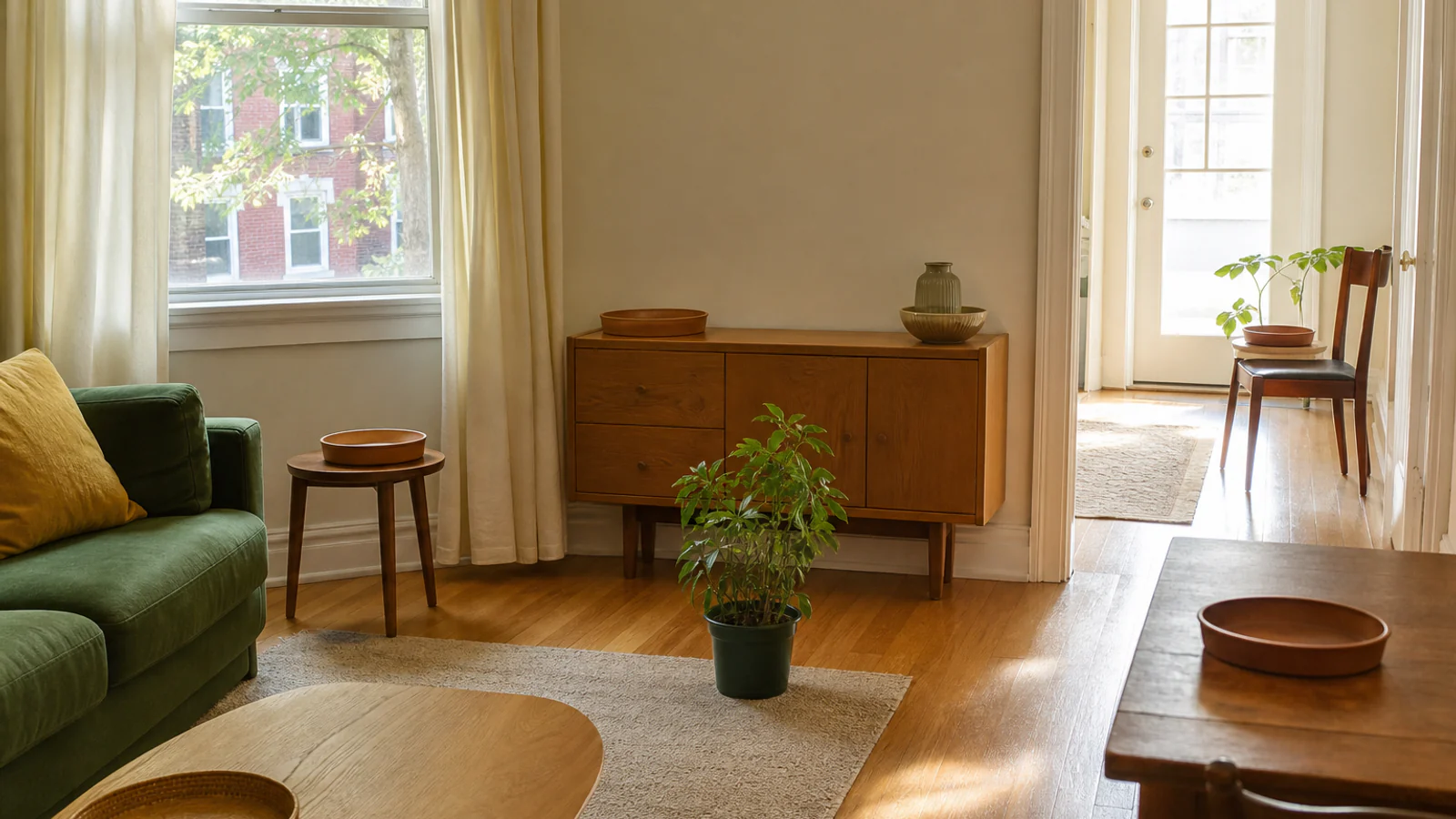
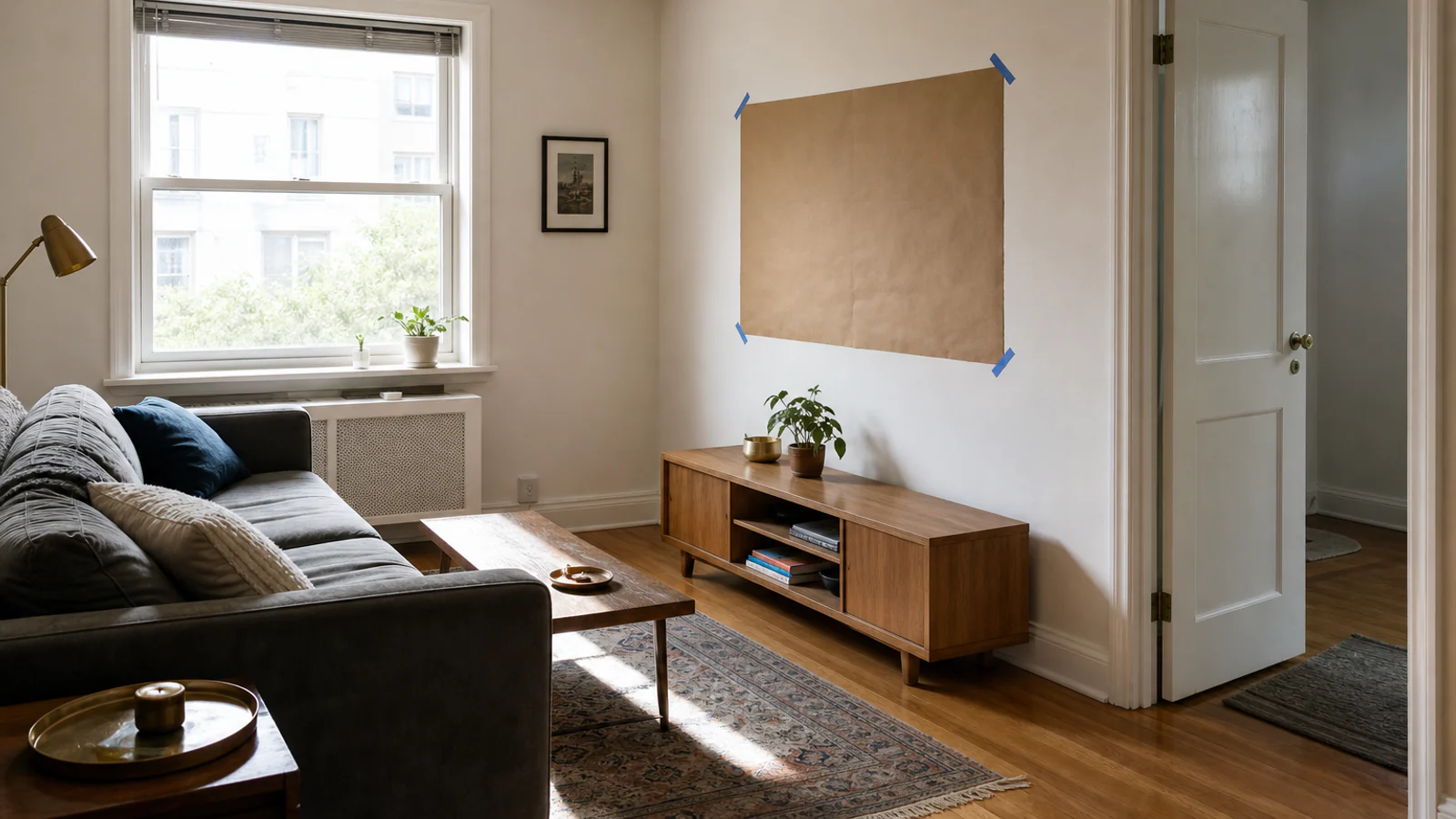
Visual and editorial disclosure: Dealsmaster created this guide with AI-assisted editorial and visual production under human review. The three raster scenes are explanatory editorial images, not documentation of an animal’s preference, emotional state, medical condition, a tested room, plant identification or product performance. No veterinary, behavior, toxicity, claw, stain or cleaning test was performed. Semantic maps and scorecards contain the accessible instructional content and make no universal dimensional or welfare claim.