The finish field lab
A room chart can suggest a starting point. Your wall’s side-light, surface, touch traffic and honest cleaning routine should decide what happens next.
Answer first: choose the lowest sheen in the exact product line that survives your permitted cleaning method and still looks acceptable in the wall’s least forgiving light. If the surface is unsound, damp or unsafe to prepare, stop there; a finish choice cannot repair the underlying problem.
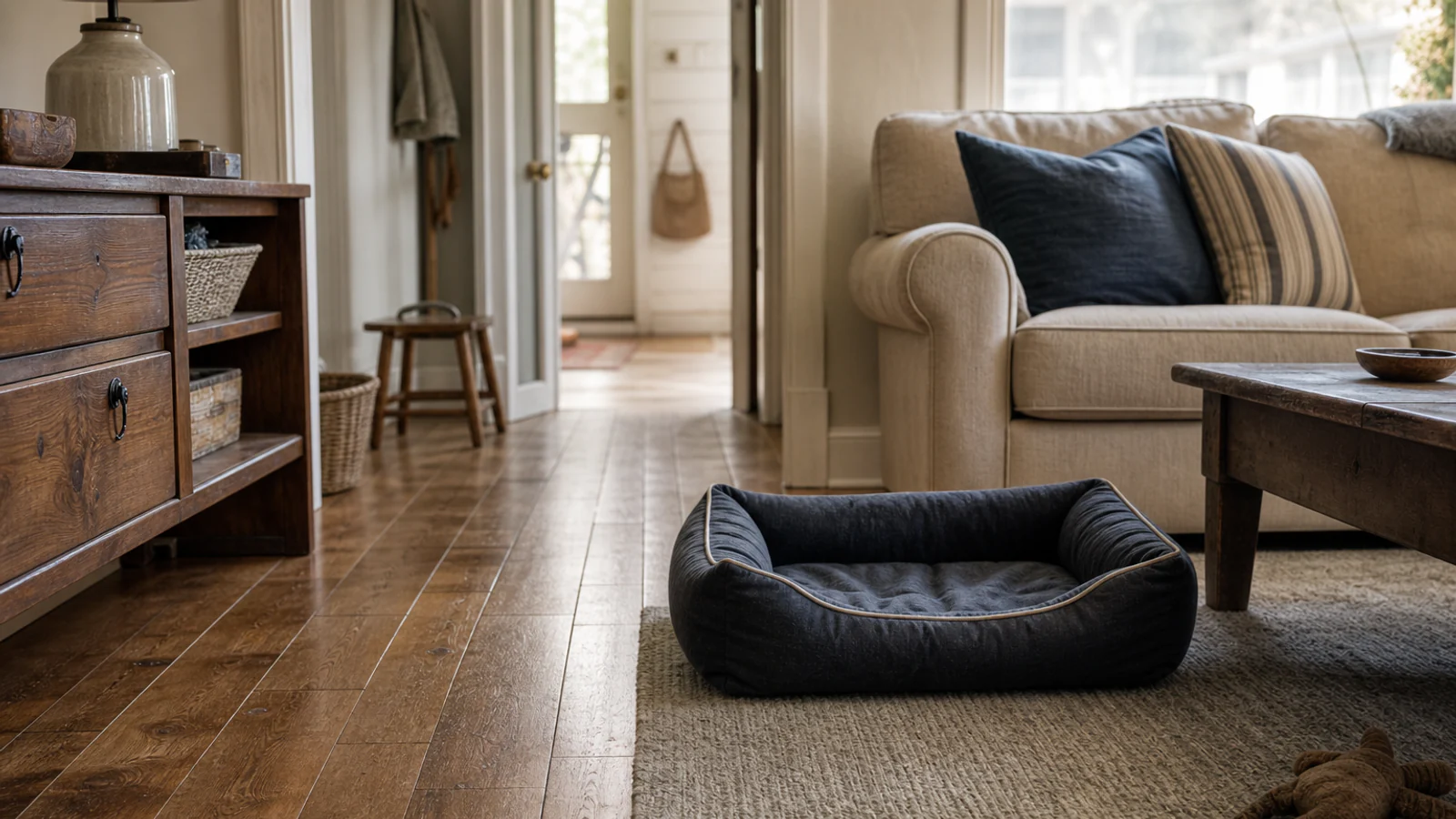
Paint advice becomes oddly confident around room names. “Use eggshell in the living room.” “Choose satin for the hall.” The chart feels decisive because a room is a neat noun. A wall is a record of much messier verbs: coats brush, chairs scrape, steam condenses, bags swing, children reach, lamps rake across old filler and somebody eventually wipes a mark with the cloth that happens to be nearby.
That is why two walls in rooms with the same label can need different answers. It is also why two cans labelled with the same broad sheen name should not be assumed to behave identically. Product lines have their own preparation, application, cure and cleaning instructions. The name on the front is not a substitute for the technical data and label on the product you are actually considering.
This guide does not rank every finish from “bad” to “best.” It gives you a small evidence system: write a useful wall brief, inspect the surface under real light, prepare portable labelled samples, rehearse ordinary touch and cleaning, and leave the shop with a specification rather than a room-name guess.
Visual 2 · printable tool
Write the wall brief before you open a colour fan
Describe one wall, not the whole room. Fill these four boxes with what happens in an ordinary week. A useful answer is specific enough that another person could recognise the problem without seeing the room.
- TouchWhat contacts the wall: hands, chair backs, coats, bags, a vacuum hose, almost nothing?Your note
- MessWhat mark is likely: water, cooking film, make-up, mud, shoe scuff, dust, food?Your note
- CleaningWhat approved cloth or cleaner will you honestly use, and how frequently?Your note
- LightWhen does daylight or a lamp travel across the surface and expose texture?Your note
Add two boundaries beneath the boxes: whether you rent, and whether the surface is peeling, chalky, damp, cracked or old enough to require a lead-safe decision before it is disturbed.
Read the wall when it is least flattering
Stand at the doorway first. Then walk to the place from which you most often see the wall: the end of the sofa, the dining chair, the bottom of the stairs. Look straight at it, then look along it. Repeat during the strongest daylight and with the evening lamp switched on. You are not hunting for a perfect surface. You are learning which condition has the power to annoy you after the room is finished.
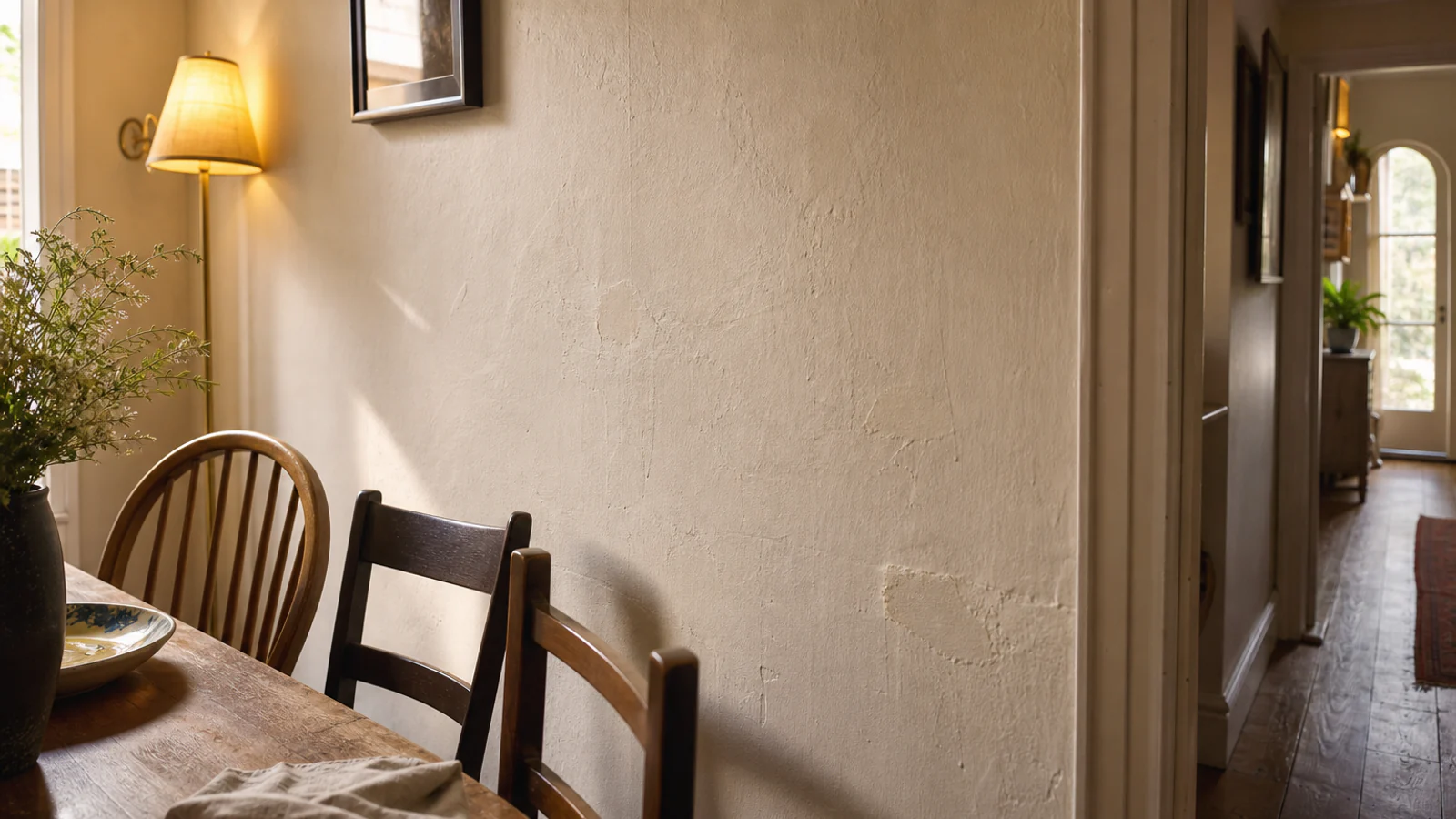
Light that travels nearly parallel to a wall tends to make small changes in its surface easier to notice. Filled holes, roller texture and old repair edges may appear calm from the front but become prominent from the side. A more reflective finish can make those differences more noticeable. That does not mean “flat hides everything,” nor does it mean the wall needs to be rebuilt. It means appearance belongs in the decision alongside cleaning.
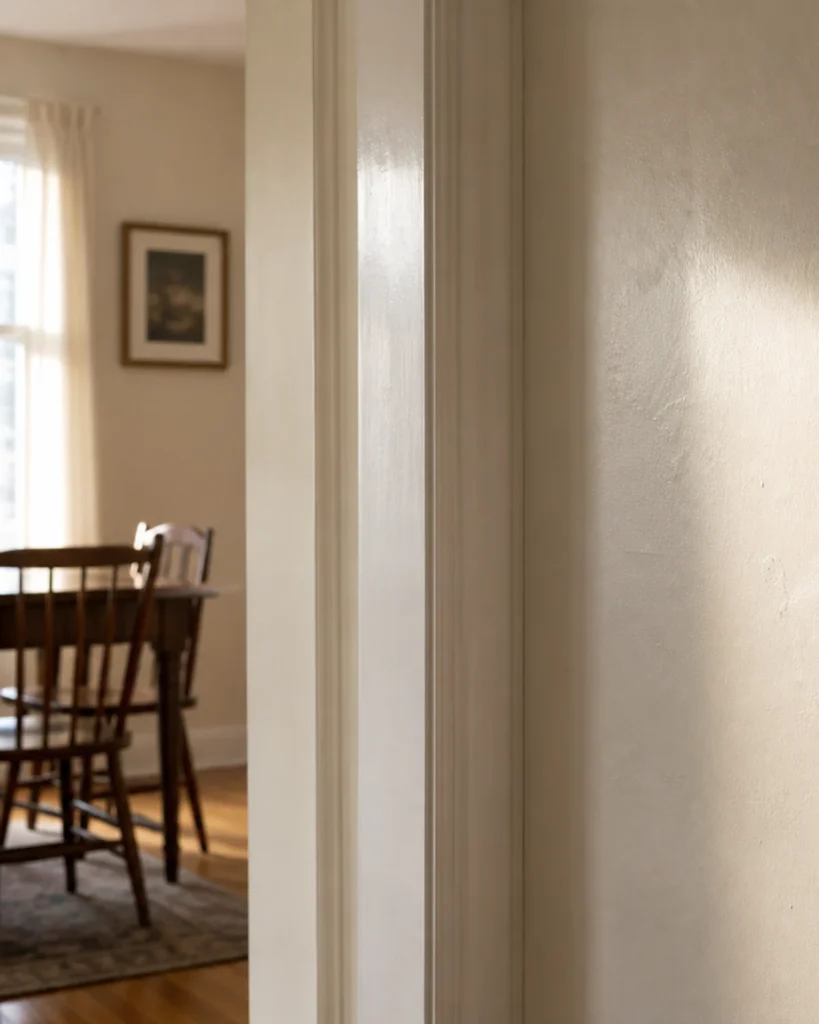
Visual 4 · light-path diagram
Front light and grazing light ask different questions
Useful for overall colour impression and large areas of coverage.
More likely to draw attention to ridges, repairs and changes in reflection.
Record what you see; do not convert the diagram into a promise that one sheen will hide a damaged wall.
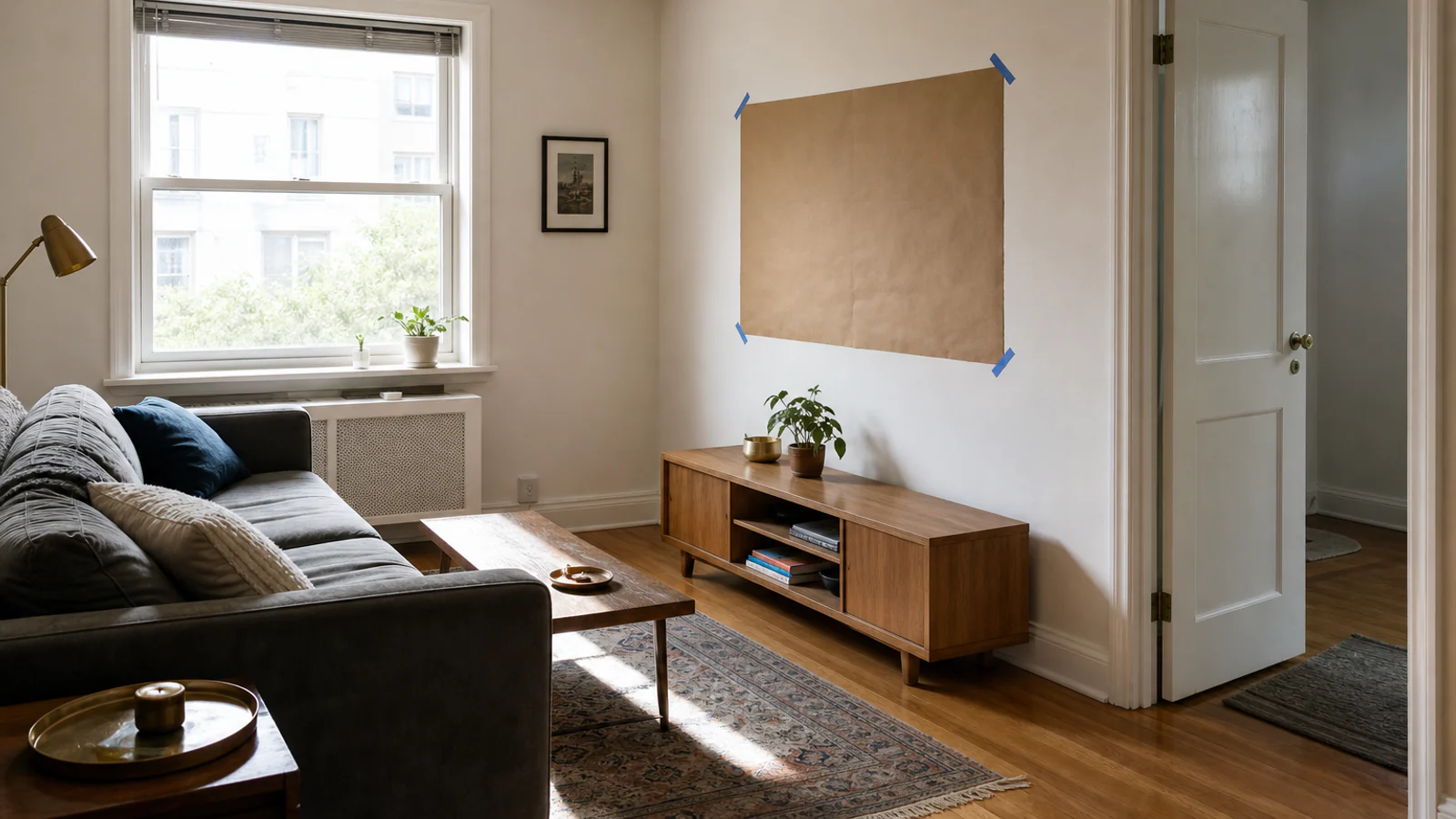
Use removable paper flags to name the evidence: high touch, frequent splash, grazing light, repair before colour, or low contact. If you find active dampness, soft material, persistent peeling or a powdery surface, move the job out of the decorating lane. The next decision is investigation and safe preparation, not a glossier topcoat.
Build a portable sample-board lab
A tiny patch painted directly onto a busy wall is difficult to compare. Its edges affect what you see, it may sit over an unrepresentative repair, and you cannot move it between morning daylight and evening lamplight. A stable portable board lets you compare options in the same positions without peppering the room with unrelated rectangles.
Use a paintable board or sample substrate approved for the product and prime it as directed. This is important: a board is not automatically the same as plaster, drywall, masonry or an existing coated surface. Its job is to help compare appearance and permitted handling, not to certify long-term performance on the wall.
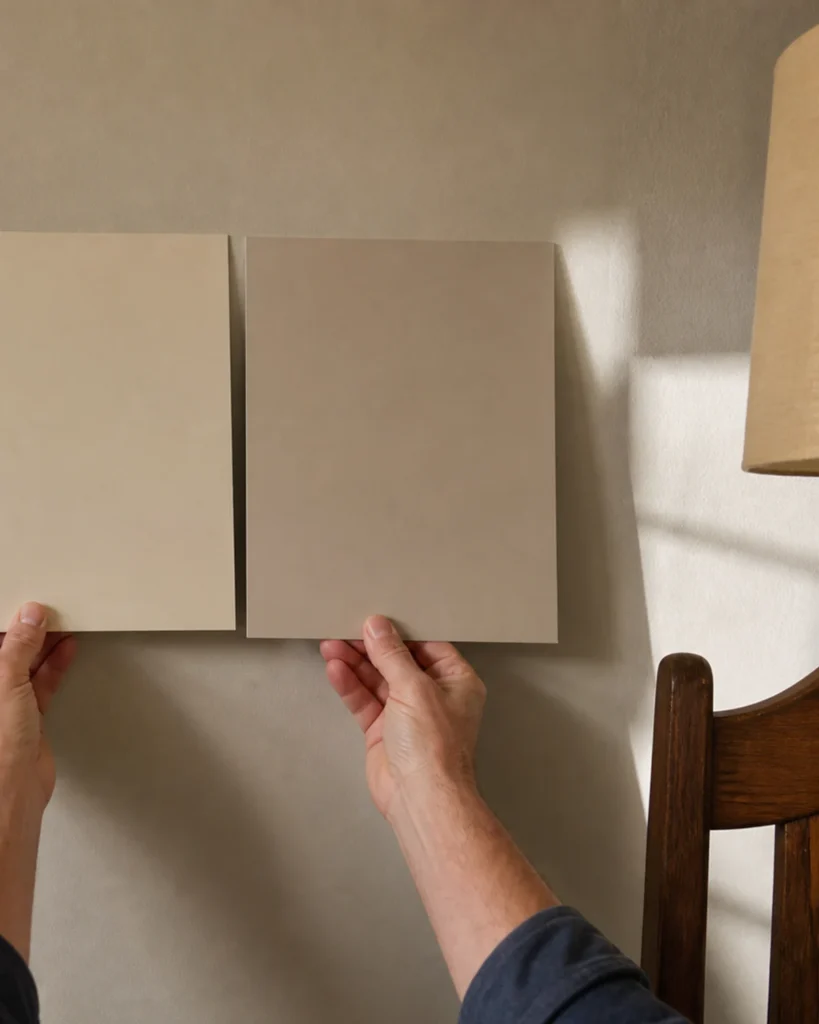
Label each board before painting. Include the manufacturer, exact product line, colour, named finish, batch or purchase date, primer or preparation, coat count and application date. Keep the product’s label, Technical Data Sheet and Safety Data Sheet available. Follow the specified recoat time, ventilation direction and cure or cleaning restrictions. “Dry to touch” does not automatically mean ready to wash.
Two or three candidates are enough. Testing six near-identical finishes often produces more hesitation than information. Begin with the lowest sheen in the chosen product line that the manufacturer describes as compatible with your surface and likely cleaning demand. Add the next plausible finish. A third board is useful only if it represents a genuine trade-off, such as a markedly calmer appearance or a different approved maintenance path.
Run three rehearsals, then judge the failure
The point is not to make one board “win” in every category. Paint is a compromise between appearance, maintenance, preparation and household behaviour. A board may look beautifully calm in side-light but change when wiped. Another may tolerate the approved cleaning method but announce every repaired patch. Your decision comes from which shortcoming matters in this particular place.
Rehearsal one: the least forgiving light
Hold each board vertically in the proposed position. View it from the doorway, from the usual seated or standing position, and along the wall. Repeat in strong ordinary daylight and with the evening practical light. Do not shine an extreme work lamp across it unless that lamp is part of normal life; the task is to reproduce the room, not manufacture a dramatic defect.
Record plain observations: reflection calm or distracting; repaired texture quiet or prominent; colour stable enough or surprisingly shifted. Avoid “premium,” “rich” and “luxurious.” Those words do not tell you what happened.
Rehearsal two: ordinary touch
Only after the sample has reached the product maker’s stated handling stage, place it where ordinary contact would occur without creating an obstruction. The aim is not to scrape it with a bag or grind a chair into the coating. Notice whether routine touch changes the appearance enough to matter and whether the location itself needs a non-paint solution.
A chair rail, a few centimetres of furniture clearance, a bag hook or a changed route can remove the source of repeated damage. When paint is being asked to compensate for a layout problem, visit the no-buy home reset before buying a supposedly tougher finish.
Rehearsal three: the next realistic cleaning
Read the product directions first. Wait through the required cure or cleaning period. On a separately designated part of the labelled sample, use a mild representative mark and only the cleaning method the manufacturer permits. Do not use a harsh improvised stain, mix cleaners, or scrub until one option fails. That would be theatre, not useful evidence.
Record the result in four parts: whether the mark remained, whether colour transferred to the cloth, whether the surface became shinier or duller, and whether the permitted process was realistic enough to repeat. A finish described as washable is not a good household match if the exact allowed method is unlikely to happen.
| Evidence | Board A | Board B | What would change the answer? |
|---|---|---|---|
| Worst ordinary light | Record reflection and visible texture. | Record reflection and visible texture. | A repaired surface, different lamp position or preparation plan. |
| Routine touch | Record any visible change without deliberate damage. | Record any visible change without deliberate damage. | Reducing contact through furniture or route changes. |
| Permitted cleaning | Mark, transfer, burnish and effort. | Mark, transfer, burnish and effort. | A different exact product, cleaner, cure period or maintenance routine. |
| Household fit | Can this care instruction happen repeatedly? | Can this care instruction happen repeatedly? | Budget, rental permission, ventilation, access or time. |
Do not average the columns into an invented score. A single stop condition can outweigh three attractive qualities. If one board looks beautiful but cannot be cleaned as the wall requires, it is not a fit. If another cleans acceptably but makes the surface unlivable in evening light, it is not a fit either. The useful answer may be preparation, a layout change or a different product line.
Visual 7 · worked-room plan
The narrow dining passage
and coat route
Suppose chair backs and coats touch the wall, food marks appear occasionally, and a low lamp exposes old sound repairs.
- A higher-sheen candidate may clean with less visible marking under its permitted method yet make every repair more obvious.
- A lower-sheen candidate may look calmer but demand a cleaning routine the household will not sustain.
- Moving the chairs or protecting the contact zone may reduce the demand enough to choose the visually quieter option.
The plan does not select a sheen. It shows why furniture and light belong in the finish decision.
Use the decision order when the evidence conflicts
Most comparisons end with an imperfect pair. That is normal. Run the decision in an order that gives safety and actual maintenance more weight than a marketing ladder.
-
Surface first. Is it sound, dry and safe to prepare? If not, stop the finish comparison.
-
Product instructions. Is the exact paint intended for the substrate and indoor use, with preparation and ventilation you can follow?
-
Cleaning reality. Does the permitted method handle the likely mess without an unacceptable visible change?
-
Worst light. Can you accept the reflection and surface emphasis at the room’s least flattering hour?
-
Household fit. Do budget, rental permission, access, occupants and maintenance support the work?
If two boards remain, choose the quieter compromise rather than the one with the grander product claim. “More sheen” is not an upgrade by itself. If neither remains, change the product line, improve the preparation plan or reduce the wall’s contact problem. Do not force a winner because samples cost money.
Colour comes after this finish brief, although colour and sheen must still be viewed together. When you are ready, build a whole-room palette from one object you already love. That keeps the finish decision attached to the room instead of turning it into another isolated swatch.
Five shortcuts that remove the evidence you need
A shortcut is only useful when it removes work without removing the decision. These five remove the wrong thing.
“The room chart already chose for me”
A chart can narrow the starting field. It cannot see the patched wall, the chair route, the wet towels, the child’s reach or the exact product instructions. If the chart says satin and the sample shows distracting side-light, do not assume the wall has failed the chart. The chart has reached the limit of what a room label can tell it.
Use the chart to select the first two labelled candidates, then let the wall brief remove one. That preserves the speed of a chart without pretending it is a specification.
“It feels dry, so I can test the cleaner”
Surface dryness, recoat readiness, cure and readiness for cleaning are not interchangeable stages. The current label or Technical Data Sheet for the exact product controls. Cleaning too early can produce a result that says more about timing than the finish. Record the application date and the earliest permitted handling or cleaning date on the back of every board. If you cannot wait through the stated interval, you do not have usable cleaning evidence yet.
“I will test directly over the worst patch”
A direct wall patch may be useful later, when preparation and product compatibility are settled. As the first comparison, painting one candidate over a repair and another over a smooth area confuses finish with substrate. Portable boards let the candidates share a comparable sample surface and move through the same light. They do not prove wall performance, but they keep the appearance comparison from being decided by two different pieces of wall.
“The highest sheen must be the safest purchase”
Higher reflection is not a badge of quality, and a broad sheen name does not guarantee a particular level of durability across every product line. The safest purchase is the one whose current instructions match the substrate and maintenance, whose sample remains acceptable under real light, and whose preparation can be completed safely. Sometimes that is the more reflective candidate. Sometimes reducing chair contact makes the quieter finish viable. Sometimes neither product belongs on the wall.
“A flatter finish will hide preparation”
A visually quieter finish may draw less attention to small sound variations. It does not stabilise loose material, stop a leak, remove contamination or make incompatible coatings adhere. If the sample makes a sound repair less prominent, record that as appearance evidence. Do not convert it into permission to skip the preparation required by the exact system.
“A premium label means I can stop reading”
Marketing tiers cannot answer whether the product is intended for your surface, whether the rental permits it, when cleaning can begin or how occupants must be protected. Ask the retailer or decorator questions that can be answered with current documentation: Which exact primer is specified for this prepared substrate? What does the current data sheet say about recoat, cure and cleaning? Is this product intended for interior use in this condition? Which claim appears in writing?
If the answer depends on a remembered rule rather than the exact product, keep the question open. A slightly slower purchase is cheaper than a full room bought on a finish name alone.
Visual 8 · stop / proceed boundary
Stop before preparation creates a bigger problem
Stop and investigate
- Peeling, chalking, soft or persistently damp material.
- Suspected lead paint or an unknown old coating that may be disturbed.
- Unresolved leaks, condensation or substrate damage.
- No safe way to protect occupants or ventilate as directed.
Proceed only within the brief
- Follow the exact product label, TDS and SDS.
- Obtain rental or property permission where required.
- Use qualified help for hazards or work outside your competence.
- Keep preparation decisions separate from décor enthusiasm.
In the United States, work that disturbs paint in pre-1978 housing may create lead-contaminated dust and can fall under lead-safe requirements. Dates and rules differ elsewhere. Do not sand or scrape first and research later. The DIY measure, test and safety checklist is the appropriate next read before tool work.
Leave the shop with a specification
A useful paint note can be read in the aisle without reopening twenty screenshots. It names the wall, the likely failure, the required maintenance, the light condition and the unresolved limits. It does not say “best paint for dining room.”
Visual 9 · purchase brief
Copy this structure, then replace every detail
Narrow passage behind dining chairs; regular chair and coat contact; occasional food marks; approved damp-cloth cleaning must be realistic; strong evening grazing light; visibly patched but currently sound surface; prefer the lowest sheen in the chosen product line that passes the labelled cleaning rehearsal and remains acceptable under that lamp; preparation, cure and ventilation only as the manufacturer directs; no old-paint disturbance until its safety status is resolved.
That note gives a paint retailer or qualified decorator something concrete to question. It also protects you from a common shopping failure: changing product line, finish and preparation all at once because one sample looked attractive on a phone.
For renters, add the agreed colour, restoration expectation and written permission. For a tight budget, price the complete system rather than the can alone: appropriate preparation, primer if specified, applicators, protection, ventilation needs and safe disposal. A finish that requires work the household cannot complete is not cheaper because its litre price is lower.
The next action is deliberately small. Write the four-line wall brief, then wait until the wall’s least flattering hour. You may discover that paint is only half the answer. That is useful evidence, not a failed decorating project.
Official source notes and limits
- U.S. Environmental Protection Agency: Best Practices for Indoor Air Quality When Remodeling supports the ventilation, occupant-protection and manufacturer-instruction boundaries.
- U.S. Environmental Protection Agency: Addressing Indoor Environmental Concerns During Remodeling provides painting and indoor-environment cautions; “low odour” or a VOC label does not replace product directions.
- U.S. Environmental Protection Agency: purpose of the Renovation, Repair and Painting Rule supports the U.S. lead-dust stop condition. Local law, property age and project scope still control.
- Dry, recoat, cure, cleaning, substrate, ventilation and disposal instructions must come from the current label, Technical Data Sheet and Safety Data Sheet for the exact paint and primer used. This guide does not compare branded performance.