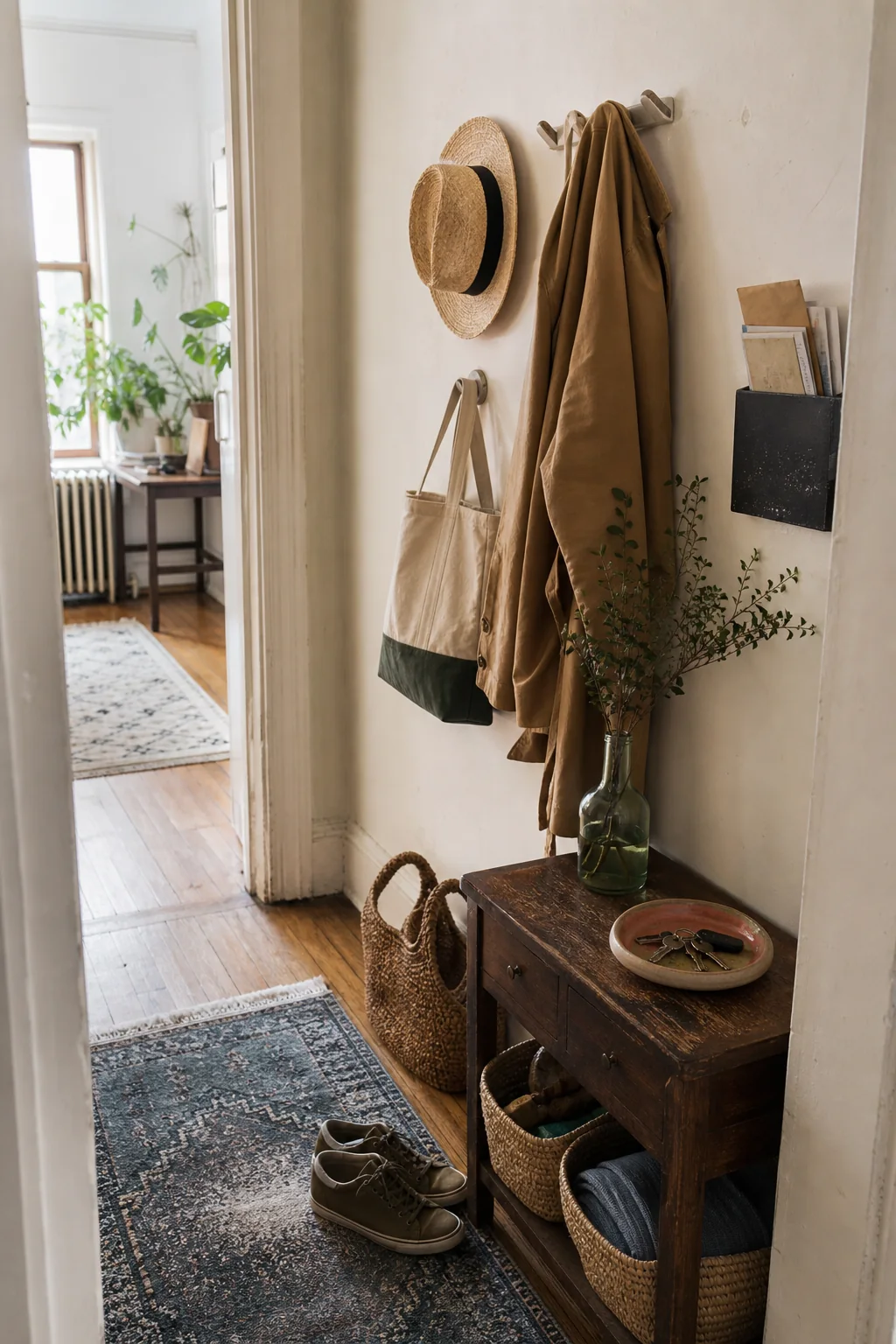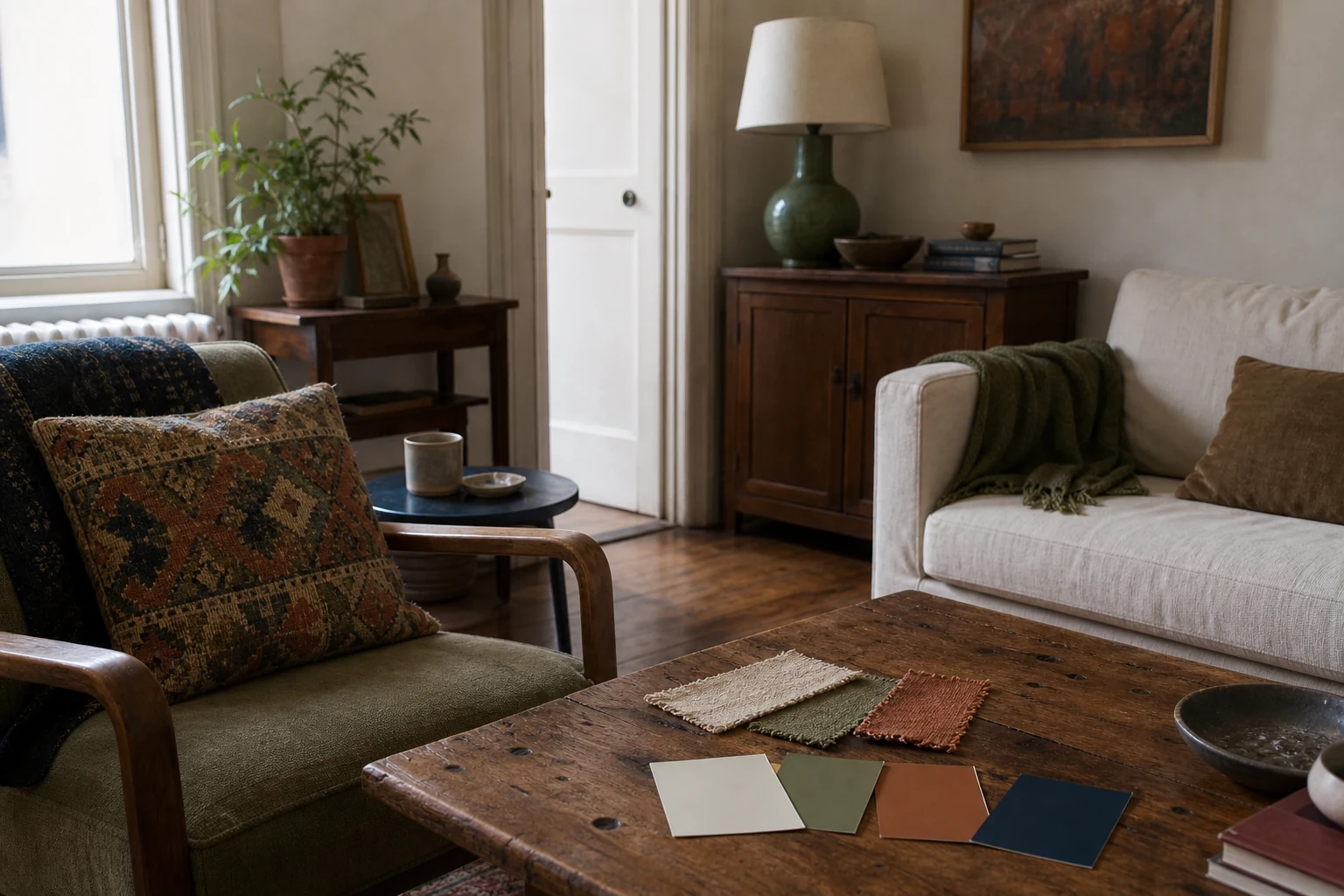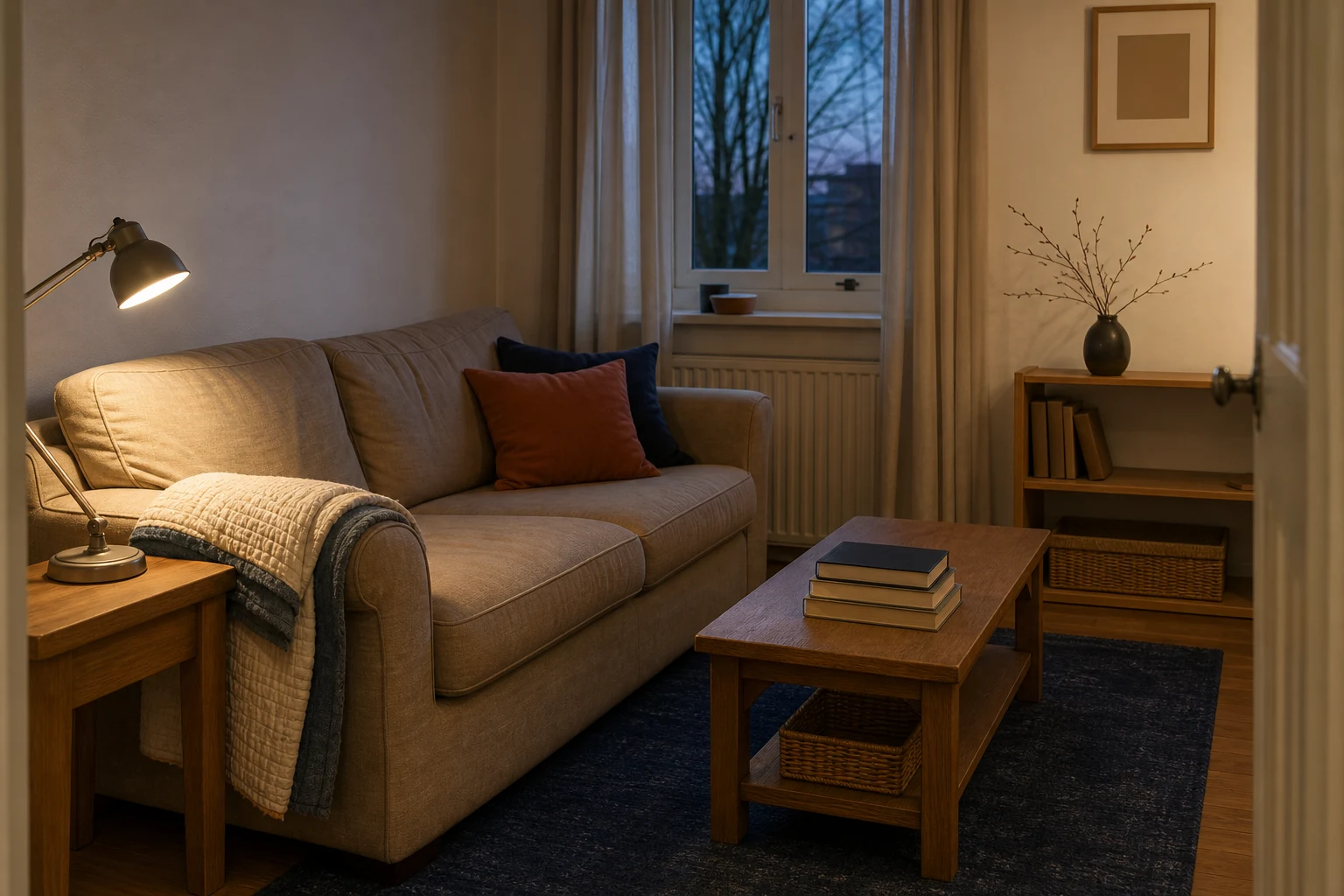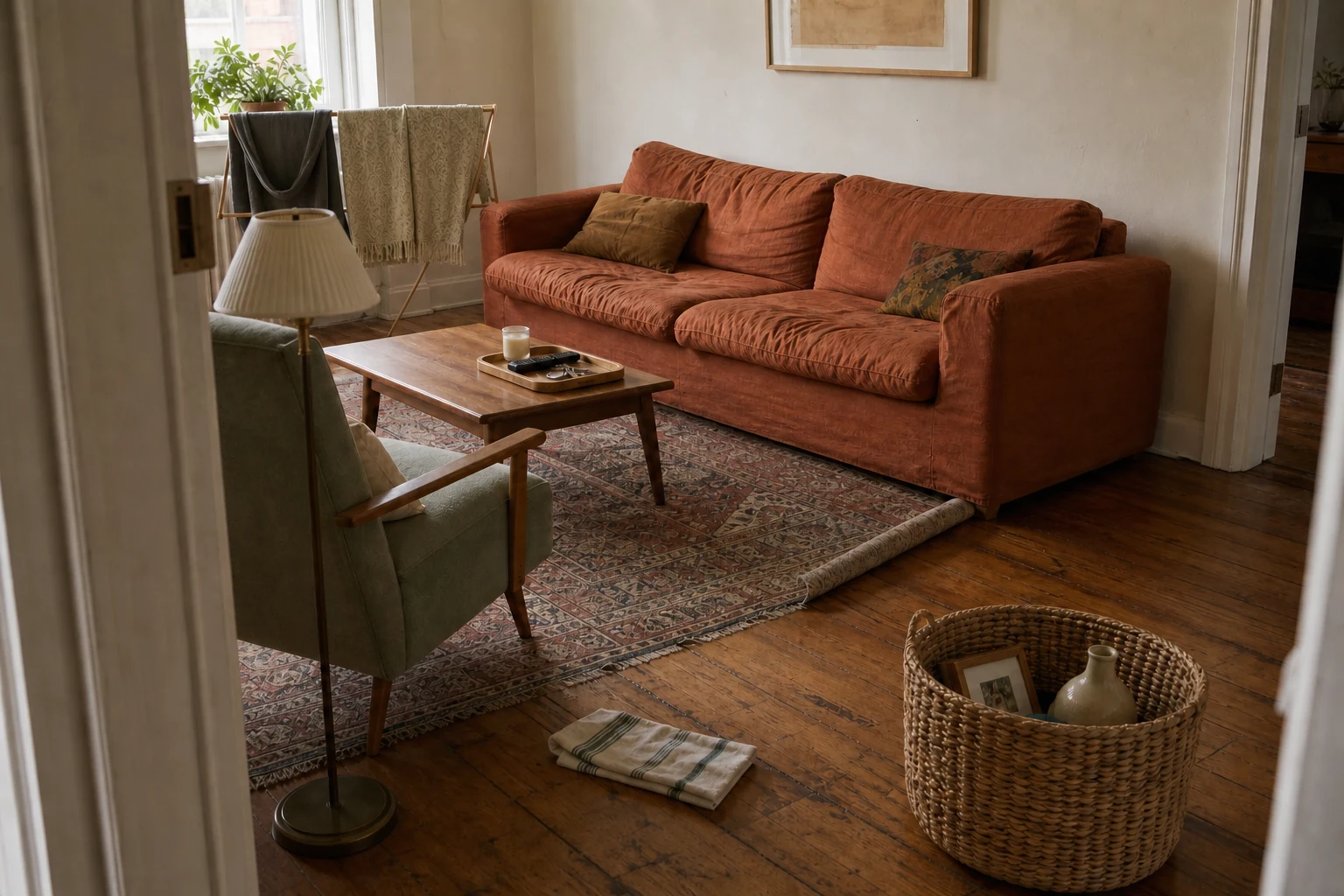
A home can feel noticeably better before anything new crosses the door. Clear one route, move a lamp into the darkest corner, let a useful surface breathe and place the things you already love where you can actually see them. Those changes are not placeholders for a future makeover. They are design.
A no-buy reset is a short period in which you improve the home only with what is already there. You can clean, repair safely, rearrange, rehome and make a list—but you pause non-essential decorating and storage purchases until the room has revealed its real problem.
This guide gives you a full-room sequence, a 20-minute low-energy version and a room-by-room plan. The goal is not to create a perfect house for free. It is to remove friction, recover atmosphere and stop small purchases from distracting you from the relationships that matter.
The no-buy home reset: quick summary
| The room feels | Often caused by | Test this first |
|---|---|---|
| Cramped | A blocked route or furniture using more clearance than expected | Protect one direct path and remove the weakest piece from it |
| Flat | One overhead light and no contrast in height | Move a lamp low into a dark corner |
| Chaotic | Unfinished actions and too many visible small objects | Complete one landing zone and group related items |
| Impersonal | Generic decor has the best positions | Replace one display with books, art or objects connected to your life |
| Disconnected | Colours, woods or shapes appear only once | Repeat one existing colour or material across the room |
| Hard to maintain | Storage is far from the point of use or packed to capacity | Move the container to where the object naturally lands |
1. Choose a finish line small enough to reach
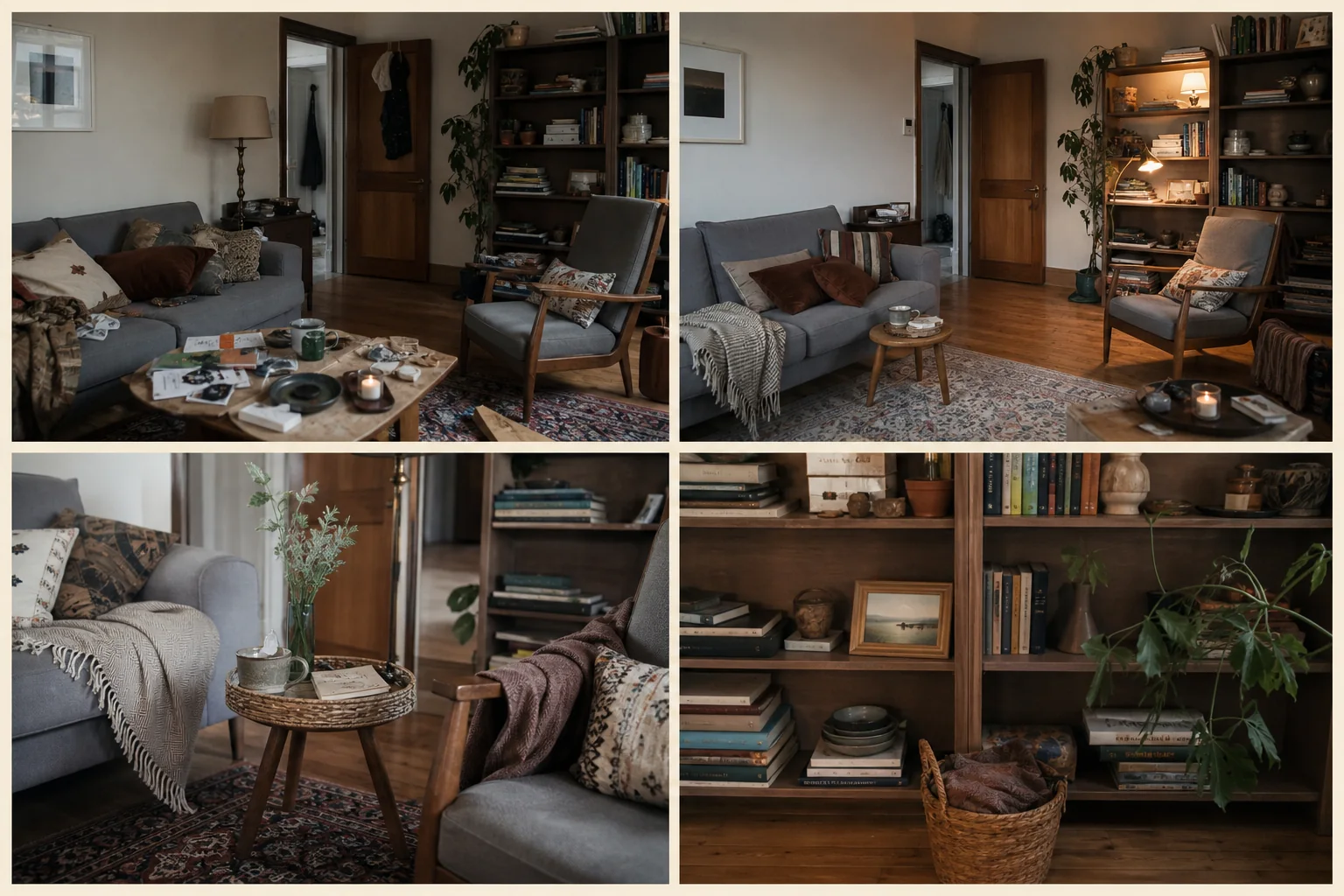
- 01Before the edit
- 02After moving, not buying
- 03Reuse a landing surface
- 04Edit the shelf + contain textiles
“Reset the whole house” is an inspiring phrase and a poor afternoon plan. Choose one room or one connected route through two spaces. Write the finish line as something you can verify:
- “The entry opens fully and every daily bag has a home.”
- “We can sit, put down a drink and walk through the living room without moving anything.”
- “The bedroom route is clear and every drawer opens.”
- “The kitchen worktop has one uninterrupted preparation zone.”
Gather only simple tools: a laundry basket for objects that belong elsewhere, a bag or box for outgoing items, cleaning supplies suitable for the surfaces, a tape measure, removable painter’s tape and a phone camera. Do not begin by emptying every cupboard.
Take four photographs: from the doorway, from the opposite corner, of the busiest surface and of the darkest area at night. Photos flatten the scene and make blocked routes, isolated colours and crowded edges easier to notice.
2. Clear friction before you style anything
Start with the things that make the room harder to use. Remove rubbish, return food and dishes, collect laundry, deal with anything blocking a door or heater and move items that belong in another room into one basket.
Do not wander away with each object. That turns one reset into ten half-started tasks. Complete the original room, then empty the “elsewhere” basket in one circuit.
Look for unfinished actions
Most persistent piles are waiting for a next step:
- post needs recycling, filing or action;
- a bag needs a hook or shelf near the door;
- clothes need a “wear again” place between wardrobe and laundry;
- chargers need one reachable point, not several loose cables;
- items to donate need an actual departure date.
Finish the action or create the easiest acceptable next step. A simple tray where keys already land is more valuable than an elaborate organiser hidden in a cupboard.
Safety takes priority over appearance. Keep entrances, stairs, required exits, operable escape windows, heaters, vents and electrical equipment unobstructed. If clutter creates an immediate hazard, restore safe movement first and seek practical help if the volume is too difficult to manage alone.
3. Reset the relationships between the furniture
A room is not a line of objects around its walls. It is a set of distances: the route from door to sofa, the reach from chair to light, the conversation gap between seats and the clearance required to open storage.
Remove one small piece that contributes little—an extra table, unused chair or empty basket—and place it temporarily in another room. Then test:
- Pull the sofa or bed just 3–6 inches (8–15 cm) from the wall if the route allows. The shadow line may add depth.
- Angle one chair toward another seat rather than toward the television or wall.
- Move the coffee table out of the main path and check whether the room still needs it.
- Centre the rug on the furniture group rather than automatically on the room.
- Give storage enough space to open fully.
These are experiments, not rules. A sofa against the wall or a bed in the corner may be the most useful small-room solution. Keep the version that protects movement and supports the room’s main activity.
For a more detailed circulation test, use the measurements in our small living room layout reset.
4. Shop the rest of your home
The lamp that feels too small in the living room may be perfect beside a bed. A bedroom stool may become a drinks table. A dining tray can create order on an entry console. Moving one object can solve two rooms when the original location did not need it.
Look for functions before decor:
- a stable surface at the height where someone reaches for it;
- a lamp where an activity happens;
- a basket near the category it can realistically contain;
- a chair that improves conversation or dressing;
- a textile that repeats a colour already in the room;
- a framed item with personal meaning that can replace generic wall decor.
Do not create a new problem elsewhere. Photograph the original spot before moving the item, then leave it empty for a day. You may discover that the old room benefits from the breathing space.
If you are combining unlike pieces, use the hierarchy and connector method in our guide to mixing interior styles without randomness.
5. Change the light before blaming the colour
Seven-day diary
Change one relationship, then give it ordinary life.
Do not stack five experiments on the same day.
- Day 1Name frictionWhat keeps interrupting the room?
- Day 2Move one thingUse only what is already there.
- Days 3–6ObserveNotice routes, light, and maintenance.
- Day 7Keep or reverseRecord the evidence.
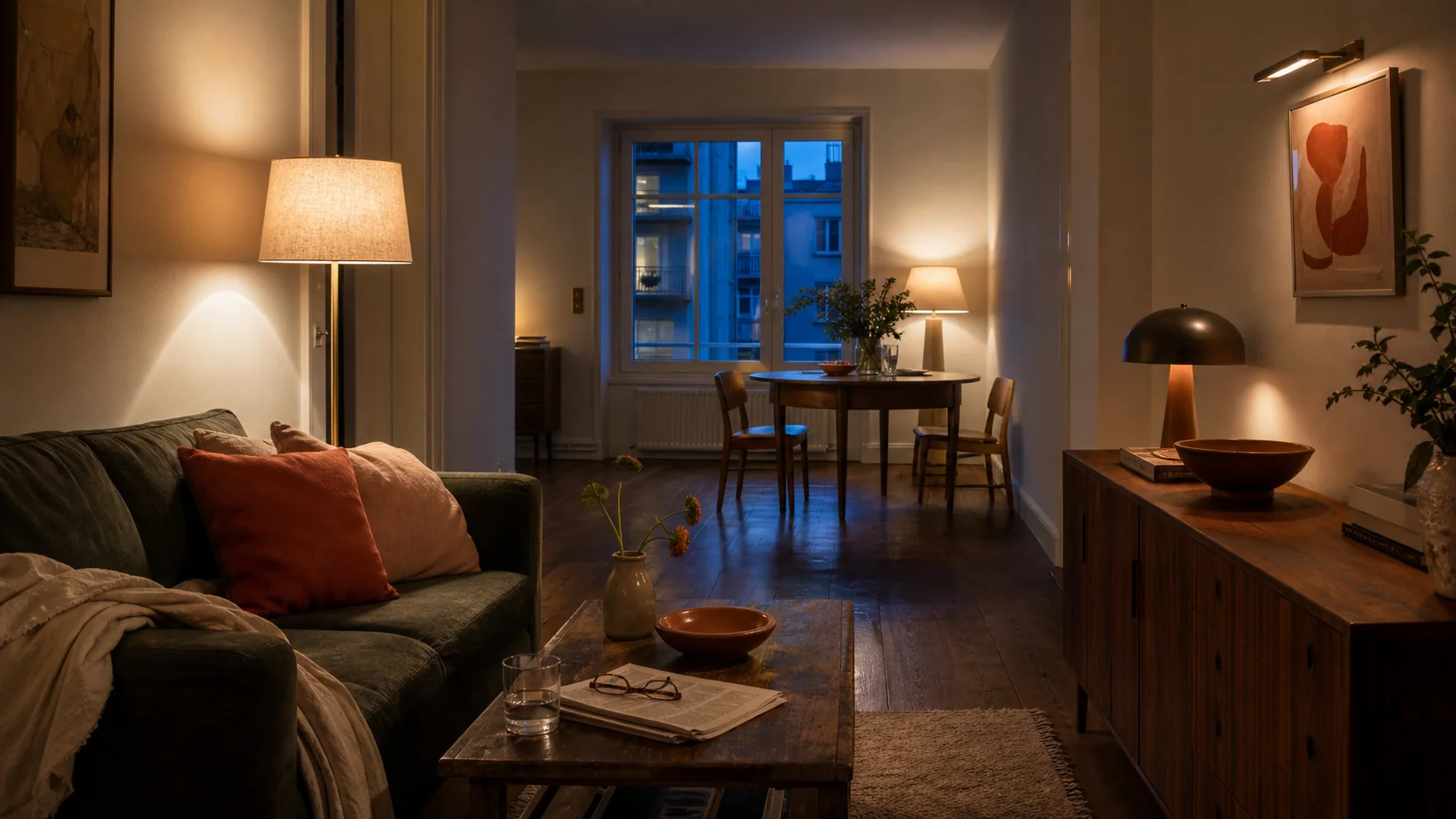
A single ceiling fixture can make a room look flat, especially at night. Move existing lamps before buying bulbs or repainting.
Try one lamp at each useful level:
- overall light for moving safely and general tasks;
- task light beside reading, work or food preparation;
- low ambient light on a shelf or side table to soften a dark edge.
Switch off the overhead light and move one portable lamp into the darkest corner. Turn it toward a wall if the shade and product are suitable; reflected light can create a softer field. Keep lamps away from curtains, bedding and water, and follow the fitting’s clearance and bulb instructions.
Check that cords do not cross a route, sit beneath a rug or create a loop where a child or pet can pull the lamp. Do not overload outlets or use an extension product for a purpose the manufacturer does not allow.
Finally, turn on every lamp used together. If one is much bluer or yellower, swap existing compatible bulbs between rooms to test a more consistent effect before purchasing. Always follow fixture wattage, base, enclosure and dimmer requirements.
6. Refresh the textiles you already have
Textiles hold scent, dust, wrinkles and the visual memory of where they have always been. Cleaning, airing or moving them can make a room feel more changed than a new ornament.
Read the care label before washing, steaming or treating anything. Vacuum suitable upholstery and rugs using the manufacturer’s guidance. Air bedding and washable throws appropriately. Rotate cushions and rugs if their construction allows, and move a textile to another room where its colour solves a real gap.
Do not improvise cleaning mixtures. The U.S. Centers for Disease Control and Prevention advises following product labels and not mixing cleaning or disinfecting products with one another. Use good ventilation when instructed and store products away from children and pets.
Restyle without adding volume
- Fold one throw where it is used rather than stacking several for display.
- Use cushion covers from another room to repeat the palette.
- Remove a rug temporarily if it fragments a furniture group or catches the route.
- Rehang curtains so they clear more glass only where the existing hardware safely allows.
- Turn a decorative textile into the palette anchor instead of buying matching accessories.
7. Give shelves and surfaces a rhythm
A useful surface needs spare capacity. If a console is styled edge to edge, daily post and keys will either cover the display or move to another pile.
Clear one surface completely, clean it appropriately and return objects in this order:
- the functional item: lamp, tray, mirror or charging point;
- one object with a strong personal story;
- one natural, tactile or contrasting element if the surface still needs it;
- nothing else until the surface has worked through an ordinary week.
Group small pieces rather than spacing them evenly in a row. Vary height and shape, but repeat one material or colour. Leave a deliberate empty section large enough for the real activity: setting down a bag, preparing food, folding laundry or opening a book.
On shelves, store visually noisy necessities behind doors or in plain containers you already own. Display books you use, photographs, art and objects whose origins you understand. Ten meaningful pieces shown well carry more personality than a shelf full of generic filler.
8. Make existing storage easier than the pile
Before buying a container, ask where the category is used and where it naturally lands. Move the existing basket, tray or box closer to that point.
Then edit the category until the container can do its job. A basket filled to the rim cannot accept tonight’s blanket. A drawer that must be rearranged every time will lose to the nearby chair.
Temporary storage is useful evidence
Use a clean delivery box, jar, shoebox or tray to test a category for one week. Label it clearly if other household members use the space. If the arrangement survives ordinary life, record the exact internal dimensions and decide whether a more durable container would improve cleaning, access or safety.
The U.S. Environmental Protection Agency recommends reducing, reusing and repairing before creating new waste. That does not mean keeping every container forever. Recycle or dispose of materials according to local rules, and do not reuse packaging in ways that are unsafe for food, chemicals or children.
For a deeper category edit, use our eight practical organising fixes.
9. A room-by-room no-buy reset plan
Entryway: finish the arrival
Open the door fully and clear the route. Keep only the shoes, coats and bags in current use at the easiest level. Give keys and post one visible next step. Move seasonal or occasional items elsewhere and confirm that nothing interferes with the exit.
Living room: reconnect the seats
Protect the main route, angle one seat toward the group, move a lamp beside the activity and remove one weak table or basket. Restyle one surface with the functional-first order. Leave enough space for a drink and daily life.
Bedroom: protect the night route
Clear the floor between door and bed, open every drawer, route charging cables safely and place the bedside essentials within reach. Remove anything stored temporarily on a chair and create one realistic “wear again” point. If the furniture itself is the problem, use the small-bedroom layout test before moving or replacing it.
Kitchen: recover one preparation zone
Move items to the part of the kitchen where they are used, clear flammable packaging and textiles away from the stovetop, and return only the tools used in the current cooking routine. Do not sacrifice food-safety separation for a prettier cupboard.
If the cleared surface does not stay clear, organise the small kitchen around how you actually cook so tools and ingredients follow the meal rather than returning to the worktop.
Bathroom: make daily care easy to return
Remove empty packaging and products that do not belong there. Keep frequently used items reachable and store medicines, cleaners, razors and other hazards according to their labels and away from children. Do not decant chemicals into food or drink containers.
Dining or work surface: close one activity before opening another
Create one portable project tray or file so the table can change roles without losing work. Store the tray where it can be returned in one movement. A multi-use room succeeds when transitions are easy.
10. Build an honest buy-later list
The honest buy-later test
A purchase earns its place by solving repeated evidence.
Safety, accessibility, and essential repair needs do not belong in a decorative waiting game.
- Problem disappearedDo not buyThe relationship was the issue.
- Problem changedTest againThe first diagnosis was incomplete.
- Problem repeated all weekSpecify the needWrite function, size, and limit.
During the reset, write each possible purchase instead of ordering it. Use four fields:
- Problem: what repeatedly fails?
- Location: exactly where would the item live?
- Maximum dimensions: including doors, drawers, routes and nearby fittings.
- Success test: what will become easier if it works?
“Pretty basket for blankets” becomes: “An open, washable container no wider than 40 cm (16 in), beside the sofa, that holds the two throws used each evening with spare room to return them.” The second description can guide a useful purchase—or reveal that an existing container already works.
Wait seven ordinary days. Notice what migrates, what is hard to reach and what remains untouched. Remove any list item whose problem disappeared after the layout, light or storage changed.
When you do buy, prefer the item that fits the measured job, can be cleaned or repaired and still makes sense if the room changes. A no-buy reset is not anti-shopping; it is pro-evidence.
The 20-minute low-energy reset
- Minutes 0–5: remove rubbish, dishes and anything unsafe from one visible zone.
- Minutes 5–10: collect items that belong elsewhere into one basket.
- Minutes 10–15: clear a route or one functional surface; do not open new cupboards.
- Minutes 15–18: move one lamp, chair or useful container to a better position.
- Minutes 18–20: empty the elsewhere basket or schedule its next step.
Stop with a finished micro-zone. A calm square metre or a few square feet is more useful than a room full of new decisions you cannot complete today.
The no-buy home reset checklist
- Choose one room and one visible finish line.
- Photograph the room from the doorway and at night.
- Clear entrances, exits, heaters, vents and main routes first.
- Complete unfinished actions instead of relocating their piles.
- Remove one weak furniture piece before adding another.
- Move a lamp to the activity or dark corner that needs it.
- Borrow one useful object from another room.
- Refresh textiles according to their care labels.
- Do not mix cleaning or disinfecting products.
- Return functional objects to surfaces before decor.
- Move storage to the point of use and leave spare capacity.
- Write and measure a buy-later need, then wait seven days.
Frequently asked questions
How long should a no-buy home reset last?
A weekend reset followed by a seven-day buying pause is long enough to expose many routine problems. You can extend the pause for non-essential decor, but do not delay safety repairs, accessibility needs or genuine essentials.
What if I genuinely need more storage?
Edit, group, choose the location and test the category in a temporary container first. If it still needs storage, record the internal and external dimensions, access method and capacity before buying.
How can I make the room feel different without moving heavy furniture?
Move lamps, textiles, art and small tables; clear part of a surface; repeat one colour; and change the chair angle if possible. Use tape to test a future heavy-furniture layout and arrange safe help later.
Is repainting allowed in a no-buy reset?
If you already own suitable paint and the property agreement allows it, you can include painting. However, test the layout and lighting first. Colour often looks wrong because the room’s light and visual weight are unbalanced.
What should I do with unwanted items?
Choose realistic local routes for reuse, donation, resale, repair, recycling or disposal. Check what each service accepts. Chemicals, batteries, electronics and medicines may require specialist routes; follow labels and current local guidance.
How do I reset a shared home when other people are not interested?
Start with your belongings and agreed functional needs: a clear exit, usable table or shared landing zone. Do not discard or relocate another person’s possessions without agreement. Ask what would make one routine easier rather than demanding a complete aesthetic change.
Will a no-buy reset make a mismatched room look coherent?
Often. Repeating an existing colour, wood tone or shape and removing a few isolated accessories can reveal a clear story. If the pieces still compete, decide which one should anchor the room before adding anything.
Let the room tell you what it needs
The first version of a better room is often already inside the current one. It is hidden by an awkward route, a lamp in the wrong place, a surface without spare capacity or objects that have never been given a useful relationship.
Reset those foundations, live with the change and take notes. If a real gap remains, you can fill it with far more confidence. If it disappears, you have gained something better than a bargain: a home that works more easily without asking for more.
About the visuals in this guide
These are original Dealsmaster editorial illustrations produced with AI assistance for explanation and inspiration. They do not document a real household, tested installation, reader result, or professional inspection.
Sources and further guidance
- U.S. Environmental Protection Agency: Refuse, Reduce, Reuse, Repair, Recycle
- U.S. Environmental Protection Agency: What You Can Do
- U.S. Centers for Disease Control and Prevention: When and How to Clean and Disinfect Your Home
- U.S. Fire Administration: Home Fire Escape Plans
- U.S. Consumer Product Safety Commission: Anchor It! furniture and television safety
Editorial note: Cleaning products, waste routes, rental permissions and fire requirements vary. Follow product labels and current local guidance.