The room does not need a delivery of miniature pumpkins. It needs a change in emphasis.
Clear the surface you see first. Repeat two or three colours that already belong. Move one useful lamp to where the evening actually happens. Bring forward a textile only if someone will reach for it. Keep the seasonal gesture to one arrival view and one after-dark activity area.
That is enough to make a room feel different without creating a storage problem in three months.
This is a mostly use-what-you-own method, not a promise that every home should spend nothing. A failed lamp, damaged cord, missing practical layer or necessary repair may call for a purchase. The point is to diagnose the room before buying decorations, then spend only on a real gap.
“Fall” or “autumn” does not arrive at the same time—or feel the same—everywhere. If the days where you live are becoming hotter, wetter or longer, use the visual edit and evening-light test but leave the heavy layers in storage. Follow local weather and household routines, not somebody else's calendar.
The reset in one glance
Use this order:
- Name what has changed: temperature, daylight, rain, routine or simply the need for a calmer room.
- Remove enough small objects to see useful furniture and surfaces again.
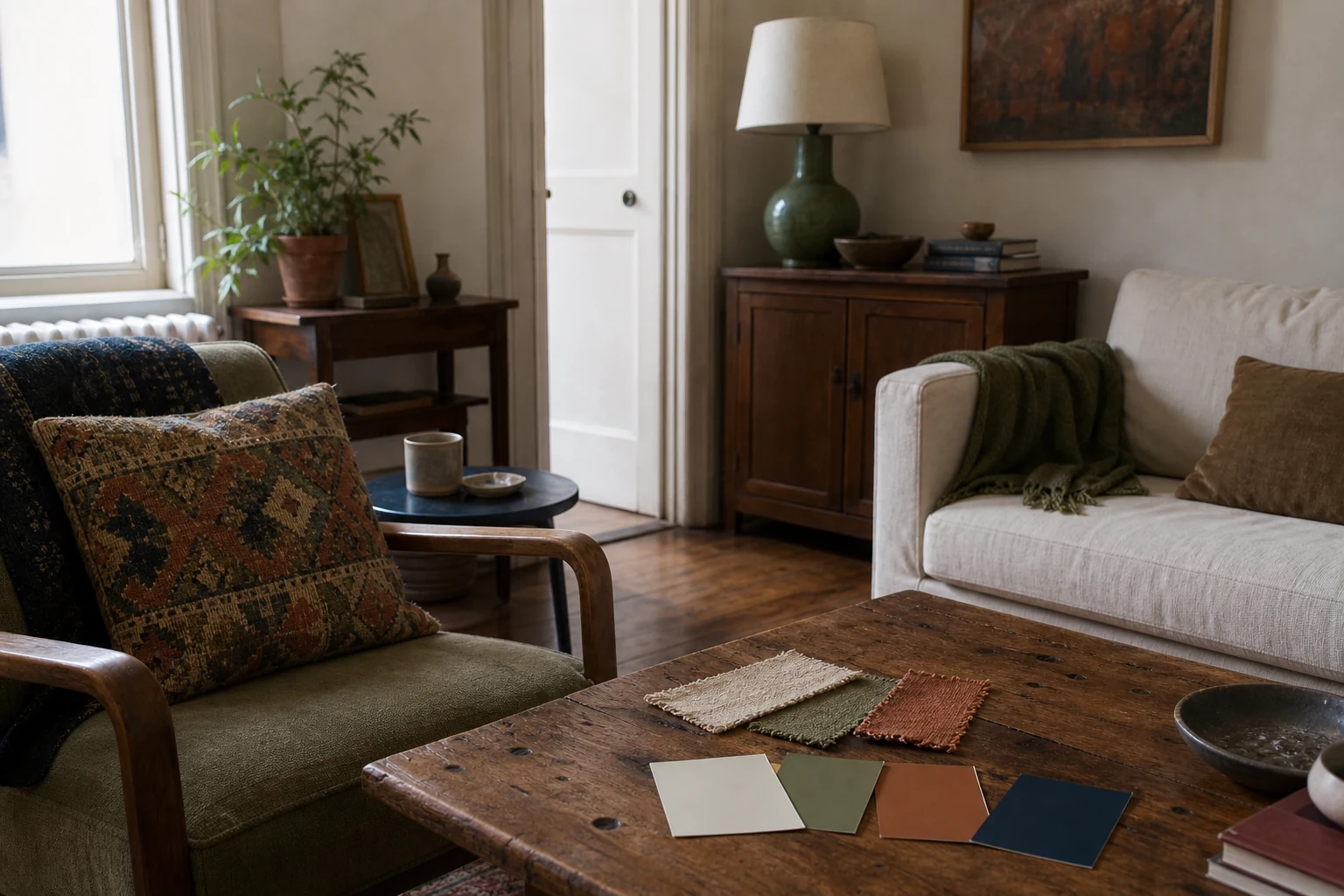
- Pull a temporary palette from one item that already earns its place.
- Move textiles according to touch and use, not a seasonal shopping list.
- Change one arrival sightline and one evening activity area.
- Test lighting, cords, heat sources and any flame- or battery-powered decoration.
- Give every displaced item a home now, not at the end of the season.
The order matters. If the room is visually noisy, adding richer colour makes the noise louder. If the reading lamp is in the wrong corner, a string of tiny lights will not solve the activity.
Identify the season your room is actually having
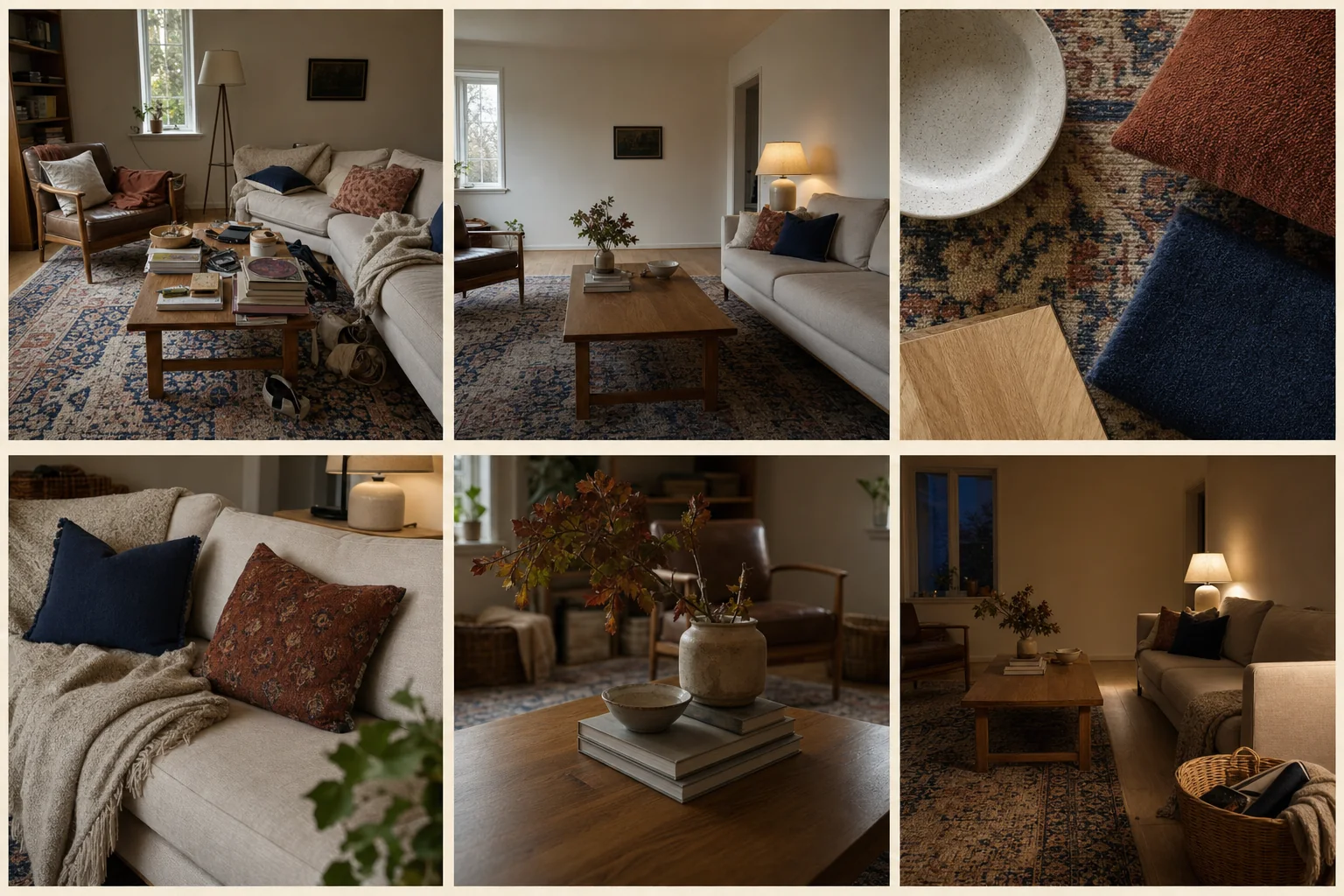
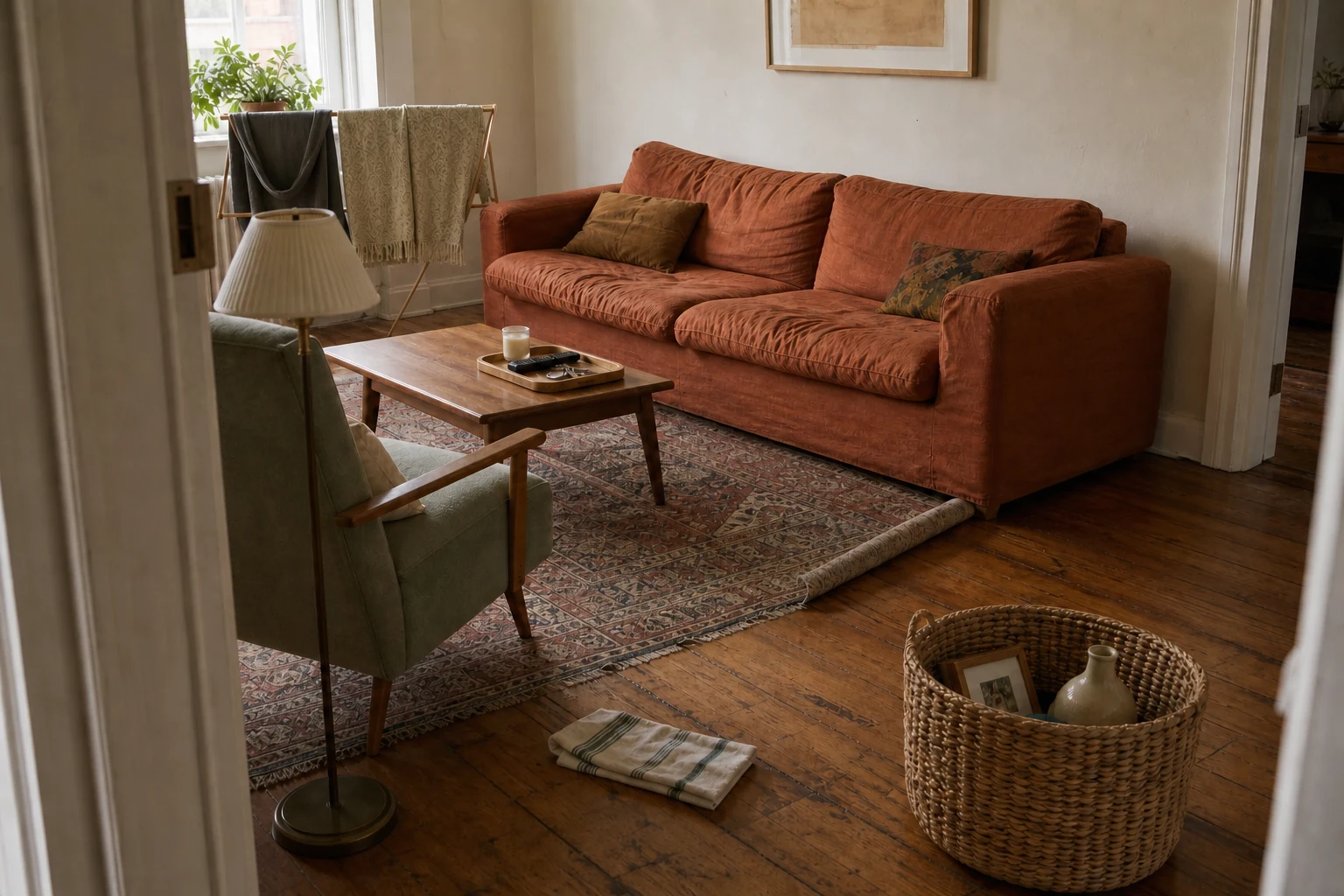
- 01Before
- 02Make it quieter
- 03Pull the palette
- 04Change the touch
- 05One focal point
- 06Night test
A calendar cannot tell you what the sofa needs. Stand in the room at the time you use it most and answer four questions.
- Light: Is the reading chair becoming dim early, or is late sun still making the room hot?
- Temperature: Would a blanket be used, or is “autumn” still air-conditioning weather?
- Routine: Are bags returning, dinners moving earlier or evenings shifting indoors?
- Visual noise: Are unrelated objects competing across every surface?
Now write two short sentences:
The room needs to work better for …
I want it to feel …
Make the first practical and the second atmospheric. “Comfortable reading after dinner” is practical. “Quieter, with more depth around the sofa” is atmospheric. These become the edit: an object stays if it supports one of those aims or remains necessary for daily life.
This prevents a common seasonal mistake—decorating an idea of autumn while the actual room still has nowhere to put the post, nowhere to set a mug and a bare bulb beside the only comfortable chair.
A worked reset: one rental, one shelf of storage
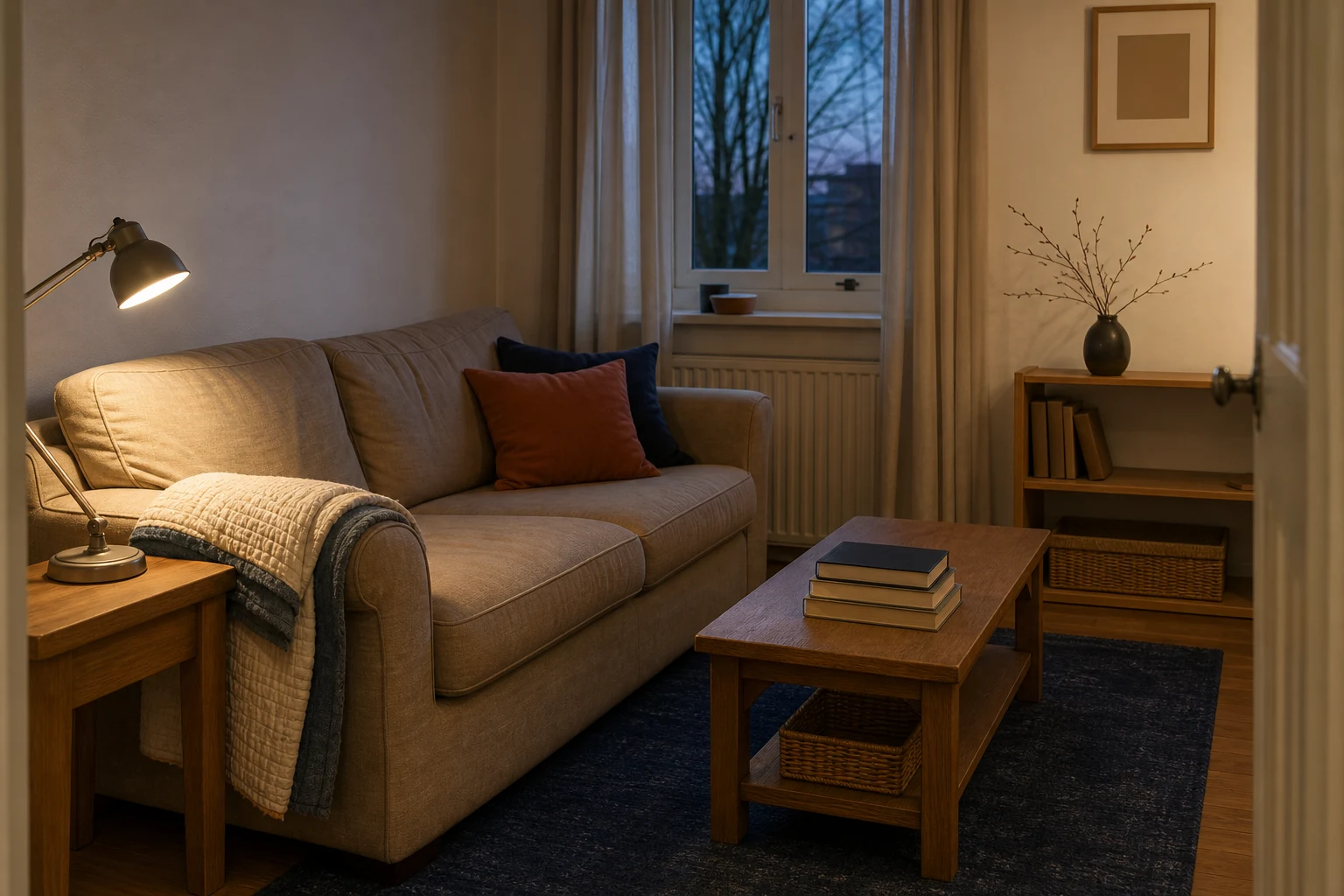
Consider a 3.6-by-4.5-metre rented living room (about 12 by 15 feet). It has a sand sofa, navy rug, cream curtains, oak side table, three lamps, six cushions, a cotton bedspread, books, a rust-coloured scarf and several bowls. The entry route passes through the room. Seasonal storage is one upper shelf.
At 6 p.m., the ceiling light is on because the useful lamp has migrated to an empty corner. Mail shares the table with three bowls. Two of the six cushions usually land on the floor. Nothing is dreadful, but every object speaks at the same volume.
The practical goal is comfortable reading after dinner. The atmospheric goal is a quieter room with deeper colour near the seat.
The reset begins without adding anything:
- Return the useful lamp to the reading end of the sofa, checking that its cord can stay out of the route.
- Remove two bowls and two cushions. The bowls go to their point of use; the cushions take the single storage shelf.
- Fold the cotton bedspread over the sofa arm instead of buying a themed throw.
- Let the navy rug set the palette, repeat rust once near the seat and leave cream and timber as the quieter background.
- Gather the three books being read into one short stack beside the chair.
- Put one clean, dry branch in the taller existing vase only if local collection is permitted and the material is pest-free. Otherwise, leave the vase empty. Empty is better than a prop with no reason to be there.
The room now has one changed view—the sofa, lamp and dark rug—and one changed activity area—the reading seat. It has gained no permanent object and has not hidden ordinary clutter inside a new decorative basket.
Make the room quieter before making it seasonal
Subtraction changes a room quickly when it has a reason. Do not sweep every surface into a mystery box. Edit one sightline at a time.
Sit in the place used most and look towards the natural focal area. Count the unrelated groups in that view. A tray, vase, candle, coasters and remote can read as five separate signals even when each is attractive.
Use three destinations:
- Use here: necessary or actively enjoyed in this room.
- Use elsewhere: belongs at its real point of use.
- Rest: temporarily removed to a named existing storage place.
Keep the things needed for the activity. Combine the books in progress. Return strays to the room where they are used. Leave one patch of surface empty and resist the urge to fill it with seasonal merchandise; the quiet patch is part of the result.
If “rest” outgrows one shelf or one small container, edit again. A reset for a low-storage home cannot depend on a second home's worth of off-season decor. If daily clutter returns immediately, work through 8 Decluttering and Organising Mistakes before adding another layer.
Pull the palette from something that already belongs
Do not begin with a list of “fall colours”. Begin with a large or loved object already in the room: the rug, artwork, curtains, upholstered chair or a textile containing several colours.
Choose:
- one base that already appears across large surfaces;
- one supporting colour you can repeat two or three times;
- one small accent that can appear once.
In the worked room, sand and cream form the base, navy supplies depth, oak stays a quiet material and rust appears once. Another room might use grey, moss and ink. Seasonal character can come from concentration, texture and light; it does not require orange or brown.
Walk through the home before shopping. A bedroom cushion cover may work better in the living room. A jug can hold a branch. A scarf can supply one patch of colour on an adult chair, provided it cannot fall onto heat or become a cord-like hazard where young children have access.
For a deeper colour method, use How to Build a Whole-Room Colour Palette From One Thing You Love. The rule here is simpler: repeat one useful colour; do not recolour the whole room.
Change what the room feels like to touch
The reset clock
Thirty minutes, four decisions, one clear stopping point.
Use the timer to protect the room from over-styling.
- 0–5QuietRemove noise before adding a signal.
- 5–12GatherPull from what the room already owns.
- 12–22LayerTexture, one colour echo, one focal point.
- 22–30Night testLight the room, edit once, stop.
Texture is convincing when it follows behaviour. Put a washable layer where somebody reaches for it. Bring out the hand towel that feels better on cool mornings. Move a small rug to the bedside only if it lies flat, suits the surface and clears the door and route. Turn a cushion to its textured side only if the cover was designed to reverse.
Inspect stored textiles in daylight before using them. Follow the care label, clean or air them as appropriate and repair loose seams. Do not use a throw to disguise a damaged cord, hot surface or unstable piece of furniture.
Try a one-in, one-rests rule for cushions and blankets. A sofa that already sheds two cushions onto the floor does not need two more. A dining chair that catches a draped blanket every time it moves is giving you honest feedback: the layer has no working home.
In warm or humid regions, the tactile shift may be lighter rather than heavier. Bring forward a breathable cover you already own, reduce clammy layers and concentrate deeper colour in art, books or ceramics instead of fabric. A seasonal room should respond to the body, not ask the body to play along.
Give the season one focal point, not twelve announcements
Choose one area seen on arrival and one area used after dark. They may be the same place.
For the arrival view, combine objects with different jobs: a lamp, a useful bowl and one natural or paper element. For the evening area, make the chair, light, washable layer and landing surface work as a group. A book that stays open because it is being read has more life than a stack chosen only by spine colour.
Collect natural material only where it is permitted. Skip unidentified berries or plants around children and pets, and reject anything damp, mouldy, shedding or insect-carrying. Keep dried material and paper away from bulbs, flame and heat sources.
No suitable branch or foliage? Use line and shape instead: three books of different widths, a folded textile, an empty dark bowl or existing art moved to a more visible wall. A home does not need a botanical prop to acknowledge a change of season.
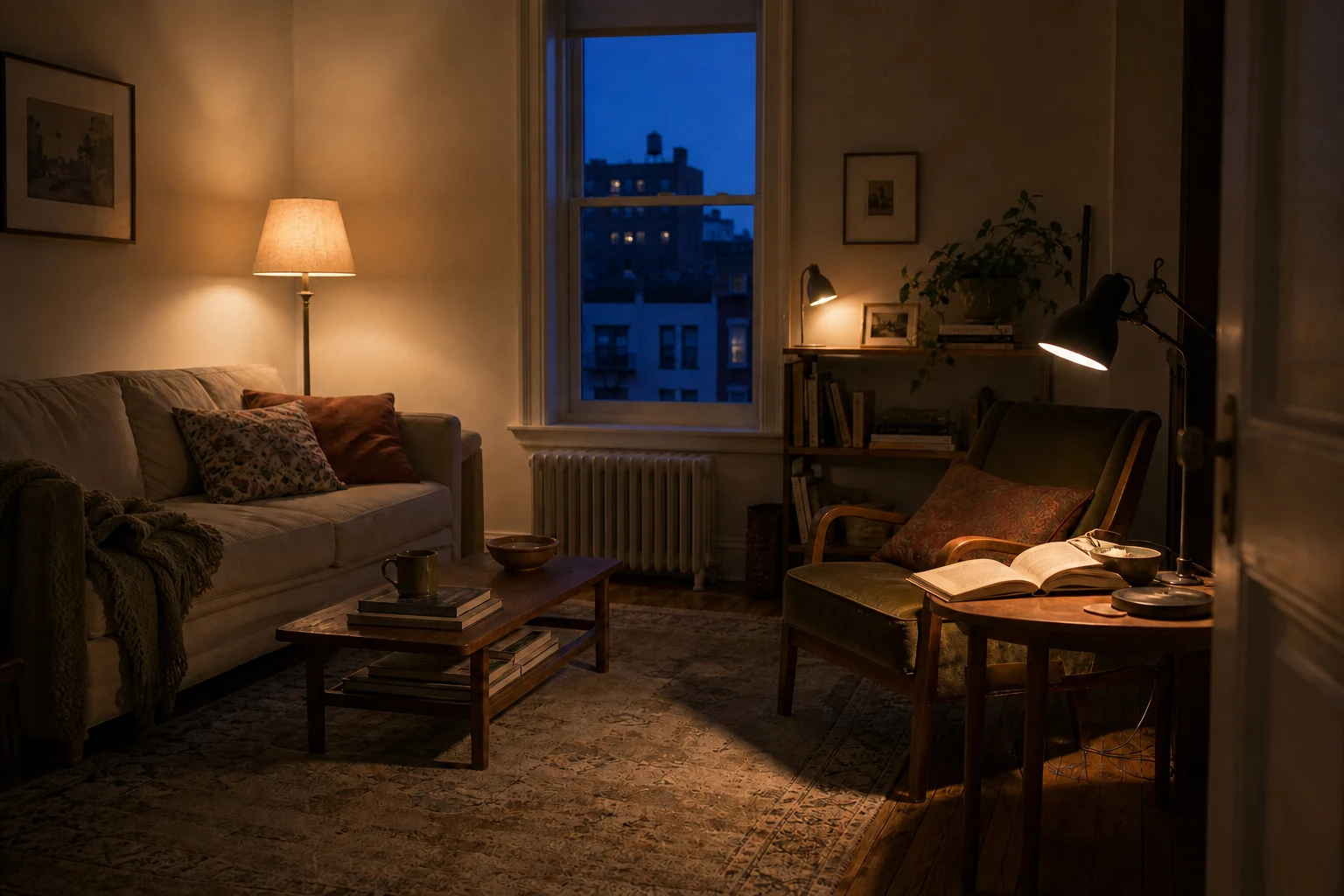
Reset the room at night
Tactile autumn
Translate the season through materials, not themed objects.
Choose two or three tactile changes and let the room stay recognisably itself.
- DryBranches + paperCrisp, graphic texture.
- SoftWool + brushed cottonWarmth where the body lands.
- DenseDark wood + ceramicVisual weight in a small dose.
- GlowShaded lampWarm evening contrast.
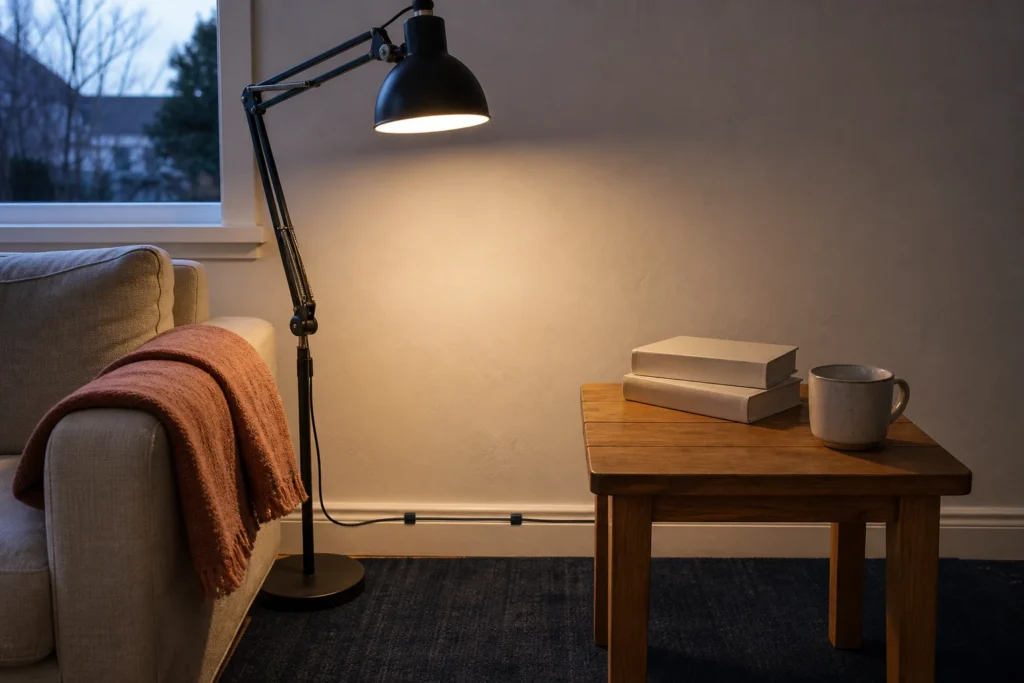
Wait until the usual evening hour. Switch off the overhead light for a moment and turn on the lamps already in the room. Can someone enter, sit, read and put down a drink without crossing a dark route or looking into a bare bulb?
If not, move light before buying decor.
The layered living-room lighting guide separates ambient, task and accent light. For this reset, aim for one useful pool at the activity and enough background light to understand the room. A tiny decorative glow is not a reading lamp.
Inspect each plug, cable, socket and decorative light set before use. Follow its label for location and duration. Remove damaged products from service. Keep cords outside walking routes and never run one beneath a rug to make it disappear. If the light cannot reach power without creating a hazard, it does not belong in that location.
Treat flame, batteries and decorative lights as equipment
Atmosphere is optional. Safety is not.
Open flame
The U.S. Fire Administration advises placing lit candles in stable holders, at least 12 inches (30 centimetres) from anything that burns, and extinguishing them when leaving the room or home or going to bed. It also advises against lit candles in sleeping areas. Local fire guidance and product instructions may be stricter.
If the room already feels good without a candle, stop there. A stable lamp has more practical value and does not ask someone to remember an open flame at bedtime.
Button and coin batteries
Flameless candles remove an open flame but can introduce a different risk. Small decorations and remotes may contain button or coin cells. The U.S. Consumer Product Safety Commission advises keeping products with accessible batteries away from children, checking that compartments are secured and repairing, replacing or disposing of products with damaged compartments. Secure loose cells immediately away from children and follow local disposal guidance.
Suspected ingestion is an emergency. Contact the emergency service or poison centre for your country without delay and follow its instructions; do not wait for symptoms.
Decorative electric lights and heat
Decorative light sets are temporary electrical products. Check for damage, use them only as labelled and do not overload outlets or connect more sets than the manufacturer permits. Keep their cords out of routes and away from pinch points.
For heating equipment, the U.S. Fire Administration advises keeping anything that can burn at least 3 feet (about 0.9 metres) away. Its specific candle guidance states at least 12 inches from combustible material. These are different U.S. messages for different hazards; use the applicable local authority, product and appliance instructions, and keep the larger separation whenever guidance conflicts.
When a purchase is the honest answer
“Use what you own” should not become a contest in making the wrong object perform a job it cannot do. Buy when the seven-evening test exposes a specific gap and the new item can be described without seasonal language.
A reasonable brief sounds like this:
- Task: light the page of a book without glare from the usual seat.
- Place: beside the sofa, with a safe power route and no blocked walkway.
- Limits: stable base, adjustable head, suitable bulb and dimensions that fit the measured space.
- Exit plan: useful year-round; no off-season storage required.
An unhelpful brief sounds like “make the room feel more autumnal”. That sentence can produce a cart full of objects without solving the evening.
Use four gates before paying:
- Is the gap practical or merely unfamiliar? A room can look bare for a day after editing because your eye is used to clutter.
- Can an existing object do the job safely? Move the lamp, rotate the chair or swap a cover before duplicating it.
- Does the item pass the room's constraints? Measure the footprint, power route, cleaning burden, child or pet access and storage.
- Will it still earn its place next season? A repair, reading lamp or washable layer may. A themed object with no other job usually will not.
If the only gap is colour, pause. Colour is easy to repeat with a book cover, art, textile or ceramic already present. If the gap is safe task light, a damaged cord replacement or a genuinely useful layer, spending may be the more responsible choice.
Build the exit plan while the room looks good
The end of a seasonal reset is not styling. It is knowing how the room returns to normal.
Make a short inventory:
| Item moved forward | Item resting | Existing storage place | Review trigger |
|---|---|---|---|
| Cotton bedspread | Two spare cushions | Upper wardrobe shelf | Warm evenings return |
| Rust scarf | Summer table runner | Linen drawer | Palette feels too dark |
| Reading lamp | Nothing purchased | Beside sofa | Review after seven evenings |
Do not create a “fall” box for objects with year-round homes. The scarf returns to the wardrobe; the vase remains a vase; the books remain books. Set a firm space limit for anything genuinely seasonal.
Then run the room for seven evenings. Notice what gets moved, ignored or dropped.
- If the blanket is never used, return it.
- If the bowl fills with unrelated clutter, move it to the point where its contents belong.
- If the lamp stays off because it glares, adjust its shade, bulb or placement within the fixture's limits rather than disguising the problem with smaller decorative lights.
- If a cushion repeatedly lands on the floor, let it rest elsewhere instead of treating the sofa as a display shelf.
This pause uses the same discipline as The No-Buy Home Reset: let the room show you what still rubs before buying the proposed solution.
Your 30-minute reset
- Name one practical seasonal change and one atmospheric goal.
- Clear the arrival sightline using “use here, use elsewhere, rest”.
- Limit resting items to one existing shelf or small container.
- Choose a palette from one object that already belongs.
- Repeat one supporting colour and use one small accent.
- Place a textile only where someone will touch or use it.
- Set one arrival focal point and one evening activity area.
- Test the room after dark with normal household routines.
- Inspect lamps, decorative lights, plugs and cords; follow product labels.
- Keep decor clear of flame and heating safety zones.
- Check button-battery compartments and secure loose cells away from children.
- Record where displaced items live and review the room after seven evenings.
30-minute room reset
Change the emphasis, then review seven evenings later
Give displaced objects a real home now so the seasonal edit does not create a storage bill later.
0 of 7 checked
The most convincing seasonal room is not the one displaying the most effort. It is the one where tonight's life fits a little better: the lamp is beside the reader, the useful layer is within reach, the entry route is clear and colours that were already present finally speak to one another.
Start with the view you see when you enter. Remove two things, move one useful light and live with that change tonight. If the room needs a stronger visual direction after the practical work is done, continue with How to Mix Interior Styles Without Making a Room Feel Random instead of automatically filling the quiet space.
Sources and scope
- U.S. Fire Administration: Candle Fire Safety — stable holders, combustible clearance and extinguishing guidance.
- U.S. Fire Administration: Heating Fire Safety — heating-equipment separation and operation guidance.
- U.S. Consumer Product Safety Commission: Button Cell and Coin Batteries — battery-compartment, loose-cell and ingestion guidance.
- U.S. Consumer Product Safety Commission: Seasonal and Decorative Lighting Products — U.S. electrical-shock and fire-risk context for temporary decorative lighting.
- U.S. Consumer Product Safety Commission: Holiday Safety — current consumer guidance for candles, decorative lights and outlet loading.
These sources establish bounded U.S. safety guidance. They do not replace local fire or electrical requirements, product instructions, emergency services or qualified advice for a particular home.
About the visuals in this guide
These are original Dealsmaster editorial illustrations produced with AI assistance for explanation and inspiration. They do not document a real household, tested installation, reader result, or professional inspection.