Food flow, not container theatre
A pantry is working memory with shelves.
Trace food from arrival to visibility to retrieval to refill. The best system makes the next meal easier to see.
- 01Arrive
- 02See
- 03Use
- 04Refill
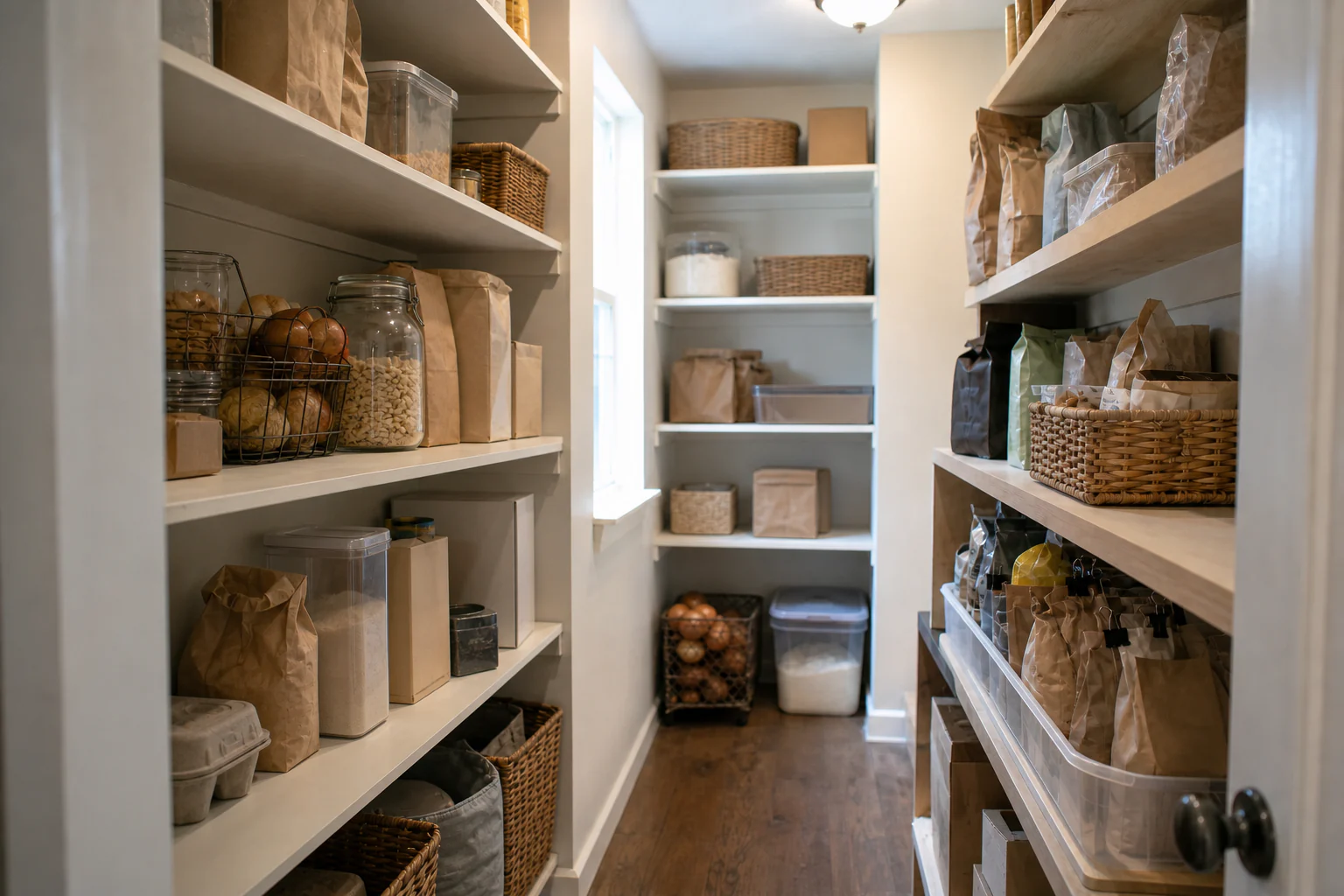
A pantry can be walk-in and still require excavation. Deep shelves hold two invisible rows. Matching containers turn half-used packets into a decanting job. The floor receives bulk purchases until the room is technically storage and practically a narrow corridor.
Plan the pantry around four movements:
- arrival;
- visibility;
- retrieval;
- refill.
Use the test:
One reach, one glance, one refill.
An everyday ingredient should be reachable without moving several unrelated things. Stock level should be understandable at a glance. Refilling should not require reorganising the whole shelf.
Empty one shelf, not the whole pantry
Food-flow circuit
Every item needs a route through four states
- ArrivalA temporary landing for sorting and checking
- VisibilityA place where quantity and condition can be seen
- RetrievalA one-motion path to the food used most
- RefillA signal that back-stock should move forward
Choose the shelf causing the most repeated problem. Remove its contents and record:
- package dimensions;
- frequency of use;
- weight;
- whether it is open or sealed;
- whether the cook needs it together with another ingredient;
- whether it attracts moisture or pests if poorly stored;
- expiry/use-by or best-quality information according to the label;
- duplicates.
Do not decant yet. The original packaging contains identity, ingredients, allergen information, preparation and date information that may be important. If decanting is useful, preserve required information and use food-safe containers suitable for the product.
Draw shelf depth as a section
Shelf-depth section
Deep shelves create a second, invisible row
- Shallow zoneSmall packets and cans visible in one layer
- Medium zoneCategory tray can bring the rear forward
- Deep zoneUse for large, low-choice items—not many small duplicates
Shelf width is obvious. Shelf depth creates the hidden row.
Measure:
- actual shelf depth;
- doorway and aisle;
- largest frequent package;
- hand and forearm reach for the users;
- container pull-out depth;
- door swing;
- any corner where shelves overlap.
Deep shelves are not automatically more useful. For small packets and tins, excess depth creates a second pantry behind the first.
Possible responses:
- shallower shelves for everyday goods;
- full-depth lower shelves for large light bulk items;
- pull-out bins that bring the back forward, within rated loads;
- stepped risers for stable small containers;
- one category per deep bin rather than loose rows;
- no storage at the narrowest body turn.
Do not reduce an aisle or block an exit to gain a few centimetres of shelf.
Give the pantry six addresses
Six pantry addresses
Give food a state, not only a category
- ArrivalNew groceries waiting to be checked
- EverydayThe ingredients reached for most
- Open nowPackets already started
- Back-stockTrue duplicates waiting to move forward
- Meal familyIngredients that leave together
- Non-food boundaryHousehold items clearly separated
Arrival shelf
A temporary, clearly limited place for groceries before they are integrated. It stops the floor becoming a permanent receiving dock.
The shelf should empty after each shopping cycle. If it stays full, the household may be buying beyond visible capacity.
Everyday shelf
Frequent breakfast, snack and cooking items in the easiest safe reach. Keep heavy items where they can be lifted comfortably.
Open-now shelf
Part-used packets and current jars. Visibility prevents three open bags of the same ingredient.
Back-stock shelf
Only genuine replacements. Use a clear maximum: one open plus one spare, or a household-specific number.
Meal-family shelf
Ingredients regularly used together. This may be pasta/tomatoes/beans, baking basics or lunch-packing supplies. Organise by the cook's sequence where it helps.
Household/non-food boundary
Keep cleaning chemicals and non-food items separated from food according to labels and local guidance. A pantry should not become overflow for every product in the home.
Rotate without running a shop
Low-admin rotation
Make the oldest suitable item the easiest to take
- 01NoticeCheck the open-now shelf before shopping.
- 02Pull forwardMove suitable older stock into view.
- 03Add behindPlace new duplicates behind or below.
- 04ReviewUse FoodKeeper and package guidance for storage decisions.
When refilling, place newer suitable stock behind older stock so the earlier item is visible first, while following date labels and product guidance.
Use a simple token:
- clip on the last spare;
- note on a small whiteboard;
- shared list;
- empty space with a label.
The system should trigger a purchase only when stock reaches the chosen minimum. An inventory app is unnecessary if the shelf itself communicates.
USDA's FoodKeeper helps consumers understand food and beverage storage and quality. Manufacturer storage instructions and local food-safety guidance still apply.
Prevent pests by removing conditions
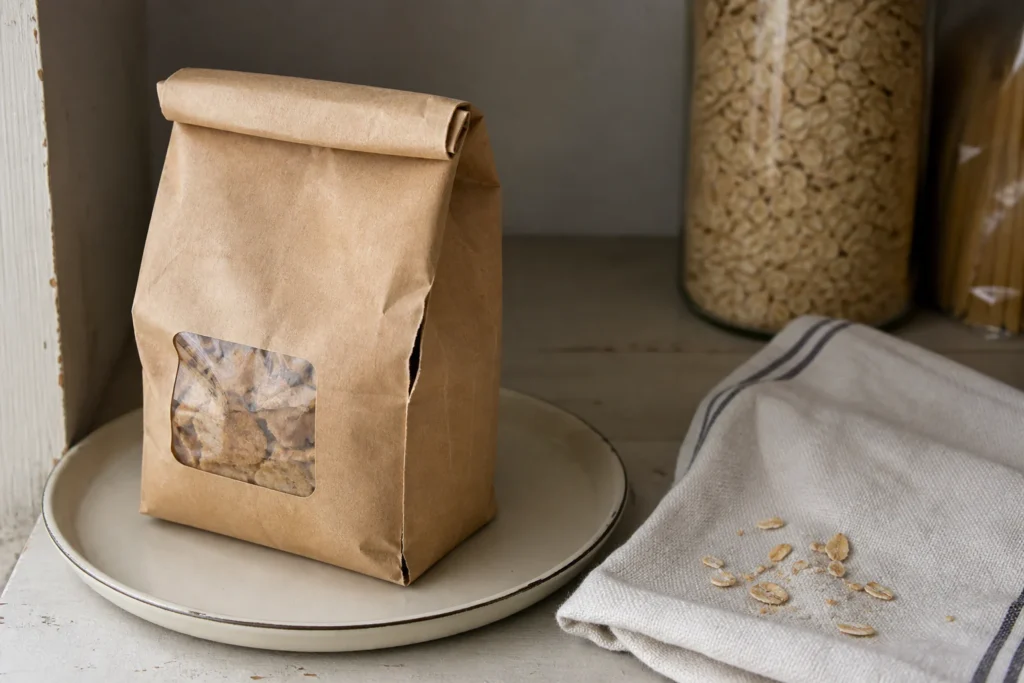
EPA's integrated pest-management guidance focuses on prevention: reduce clutter, seal entry points, maintain clean food-storage areas, clean crumbs and spills, store food appropriately and remove water sources.
For the pantry:
- clean spills promptly;
- inspect packages for holes or damage;
- keep suitable dry goods in sealed food-safe containers when needed;
- avoid open pet-food bags;
- do not let cardboard and clutter conceal activity;
- address moisture and entry gaps;
- use lower-risk professional/local guidance if pests appear.
Do not spray pesticides around food without following labels and appropriate guidance. More containers will not solve a building entry point.
Use containers only for a named failure
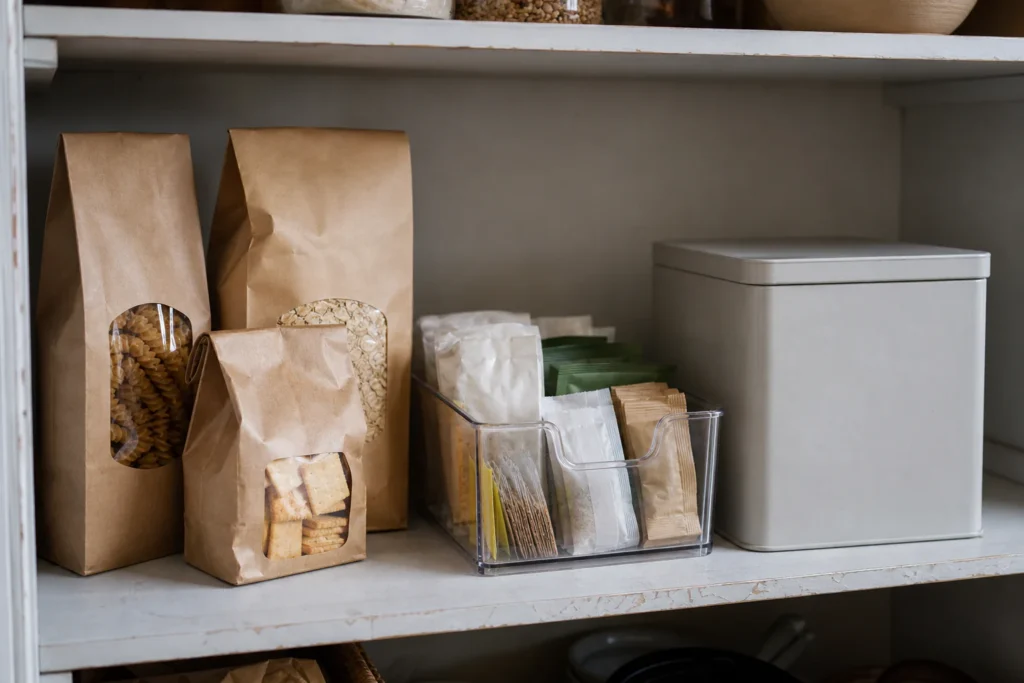
Buy a container when it solves:
- open packet will not reseal;
- pest/moisture protection is needed;
- several small identical items need one pull-out home;
- a deep shelf needs a safe removable unit;
- the original package cannot stand or stack;
- decanting makes stock level meaningfully visible.
Do not decant for visual sameness alone. A row of opaque identical jars can hide identity and date more effectively than the original bags.
Label with useful information, correctly spelled and readable. Essential food information should not exist only in a decorative graphic.
Corners, floor and top shelf
Corners
Use one large category per accessible pull-out bin or leave the deepest wedge empty. Do not build a carousel merely because it is sold for corners; test load, reach and cleanability.
Floor
Keep a clear walking surface. Heavy bulk items may need low storage, but protect them from moisture and ensure they do not narrow the route or create lifting strain.
Top shelf
Light, infrequent items only. A step stool must be suitable, stable and used according to instructions. If an item requires unsafe climbing, its address is wrong.
A constructed example: 1.2 × 1.5 metres, shelves on three sides
Constructed 1.2 × 1.5 metre pantry
The narrow aisle stays useful because shelf jobs differ
- Everyday
- Back-stock
- Arrival
The pantry has 45 cm-deep shelves and a 62 cm central aisle. Tins stand two rows deep; open baking packets share a basket; bottled drinks occupy the floor.
The revised plan:
- no shelves are added to the doorway pinch point;
- everyday tins move to stepped risers on one side;
- one pull-out bin holds open baking packets, each sealed and identified;
- back stock receives a one-spare limit;
- drinks move to a low rated shelf, not the aisle;
- arrival shelf is a small section near the door and must clear after shopping;
- deepest corner holds one lightweight bulk-paper category, not food;
- a cleaning and inspection gap remains along the floor edge.
Capacity changes little. Visibility changes greatly.
The 15-minute pantry check
15-minute pantry check
Inspect first; reorganise only where the flow fails
0 of 6 complete
- Remove expired or unsafe items according to local guidance.
- Put every open duplicate together.
- Mark the first row you can see.
- Identify the five items moved to reach something else.
- Assign one arrival space.
- Set a back-stock maximum.
- Clean crumbs and inspect damaged packages.
- Leave floor and route clear.
Repeat after the next grocery trip. If the system fails at arrival, reduce purchasing or enlarge the arrival decision—not the permanent container collection.
Organise around the meals that actually repeat
Write the five meals or snacks that appear most often. For each, trace the ingredients that leave the pantry together. If pasta lives on one wall, sauce on another, and the colander is buried under occasional bakeware, category purity is making the cook travel.
A meal-family shelf can hold the stable pantry parts of one repeated meal without decanting or buying new containers. Keep refrigeration and food-safety requirements separate, of course; the point is to make the shelf remind you what can be cooked, not to create a decorative kit.
Review the shelf before shopping. The most valuable inventory may be a visible “use next” row rather than a detailed app that nobody updates. When a household does use a digital list, let the physical address and digital category share the same simple language.
Protect information as well as food
Original packaging can carry cooking instructions, ingredient and allergen information, lot details, and date guidance. If you decant, preserve the information the household needs. Do not combine new product with old in a way that loses traceability or hides a change in condition.
Where allergy management is important, follow professional and product guidance appropriate to the household. A casual colour-coded container system is not a substitute for controlling cross-contact.
Check the pantry after a grocery delivery and again before rubbish collection. Those are the moments when packaging, crumbs, empty boxes and duplicates reveal the route. A five-minute repeatable check is more valuable than a dramatic annual decanting day that leaves the daily flow unchanged.
Useful next action
Photograph one problem shelf before shopping. Count how many objects must move to reach the back. Your first target is not beauty; it is one fewer move.
About the visuals in this guide
These are original Dealsmaster editorial illustrations produced with AI assistance for explanation and inspiration. They do not document a real household, tested installation, reader result, or professional inspection.
Sources and limits
Useful advice should show its working
Material claims were checked against the primary guidance below. Dealsmaster dimensions and layouts are editorial planning starting points, not universal codes, professional assessments, or product instructions. Local rules, tenancy terms, building conditions, user needs, and manufacturer guidance control.
- USDA FSIS — How Do I Store Dry Goods?Cool, clean, dry storage; package inspection; and extra-container context.
- USDA FoodKeeperProduct-specific storage information for freshness and quality.
- U.S. EPA — Integrated Pest Management PrinciplesPrevention-first pest-management framework.
Disclosure: This guide contains no affiliate links, sponsorship, or claimed product testing. Constructed examples are planning examples, not reported Dealsmaster households.