Small-space holiday hosting
Decorate the table only after you have reserved room for people, plates and the way food will be served. On a small table, the honest decorating budget is whatever remains after the real place settings, serving pieces and sightlines are protected. If nothing remains, put the festive gesture above, beside or beyond the tabletop.
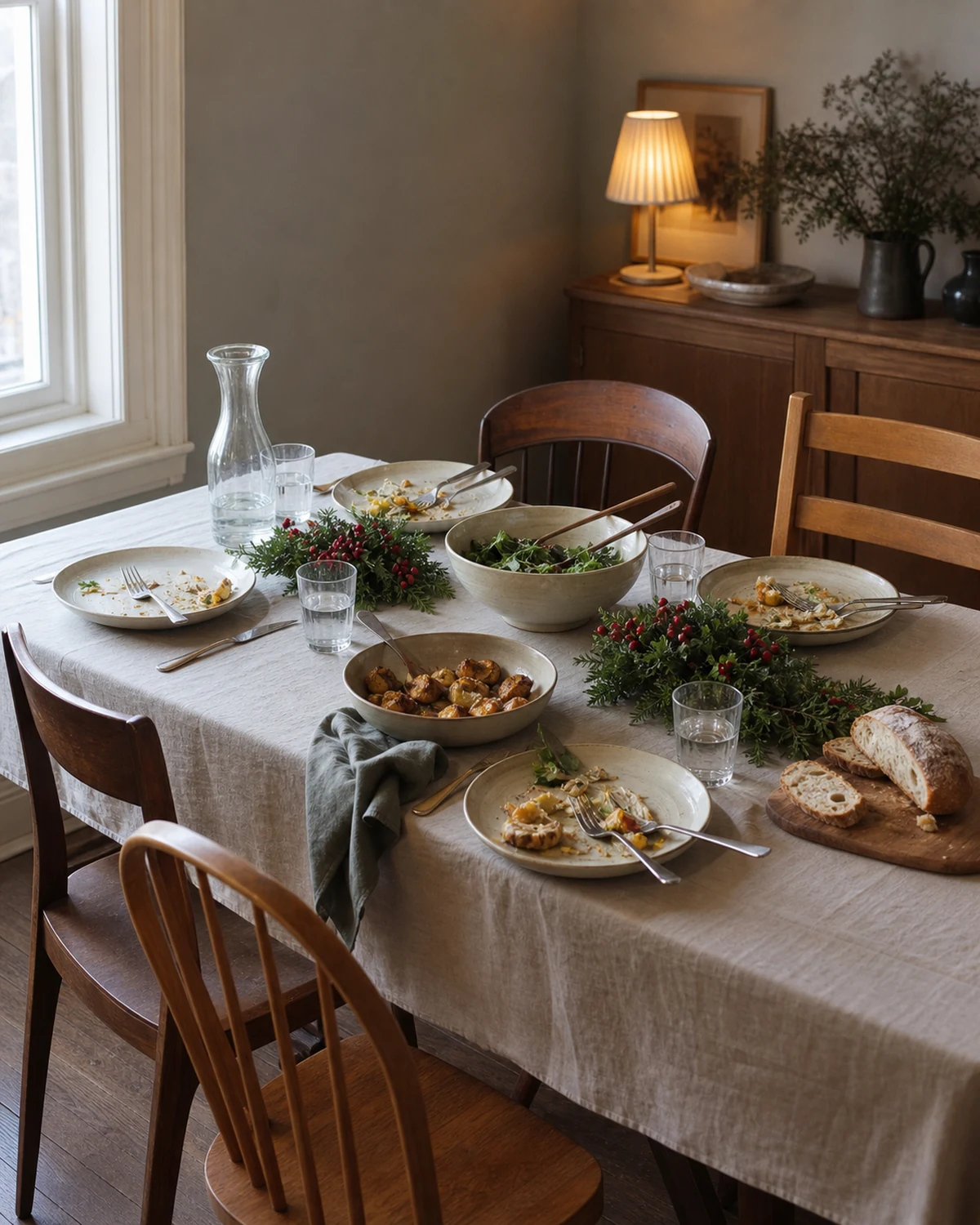
The most misleading version of a holiday table is the one photographed before dinner. Every napkin is flat. No water jug has arrived. The centrepiece owns the middle because the roast, salad bowl, bread and elbows are still in the kitchen. Ten minutes later, the arrangement is balanced on a windowsill and a candle has been nudged toward a paper place card.
A better plan treats the meal as a short performance in three acts: guests arrive, dinner occupies the room, then plates clear and conversation continues. The table is allowed to change between acts. Decoration succeeds by supporting those changes, not by remaining untouched.
The table is a finite surface, not a theme
Begin with the actual table fully extended or folded into the form you will use. Pull out the real chairs. Then place the plates, cutlery and glasses planned for the menu. Include the objects a generic place-setting diagram forgets: a child’s cup, medication kept close, a high-chair tray, a mobility-aid parking spot, or extra forearm room for a guest who needs it.
Do not start with decorative chargers if ordinary dinner plates will do. Do not reserve a runner before deciding whether hot serving dishes need mats. The first pass is functional and deliberately plain. Its purpose is to reveal the remaining area.
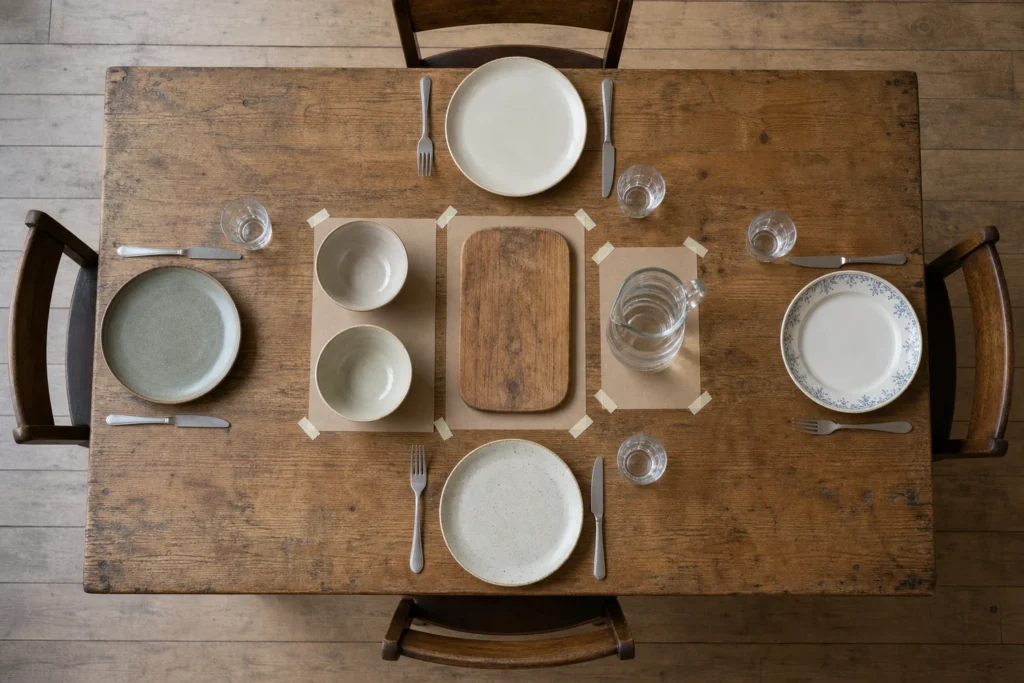
Trace objects on brown paper or mark their outlines with low-tack tape suitable for the finish. Label each outline. A water jug that “will probably fit” tends to arrive at the same hopeful patch as the bread basket. Physical outlines end the argument while there is still time to move the menu, not the guests.
There is no universal allocation per diner in this guide. Plate sizes, chair arms, serving customs and individual access needs vary too much. Copying a number from a banquet plan can make a domestic table less comfortable, not more. Use your objects and people.
Choose how food reaches the plate
The centre of the table changes value according to the service style. Choose one primary method before placing a branch, candle or ornament.
Plated in the kitchen
Table demand: lower during the main course.
Good for: a menu that can be portioned without delay.
Watch: a busy kitchen route and somewhere safe to stage full plates. Reserve tabletop space for water, condiments and anything served later.
Family style
Table demand: highest.
Good for: relaxed sharing when dishes can be reached and passed safely.
Watch: hot dishes, serving utensils and the return landing. Decoration should be low, sparse and easy to remove before food arrives.
Sideboard or counter
Table demand: lower, but circulation demand rises.
Good for: narrow tables and flexible seconds.
Watch: queues behind occupied chairs. The side surface cannot simultaneously hold food, coats, gifts, drinks and the displaced centrepiece.
A hybrid often works: plate the main item, keep one or two easy-to-pass sides on the table and place the rest on a sideboard. But name the hybrid precisely. “Some dishes somewhere else” is not a plan. List every bowl, jug and trivet, then give each a landing.
If you do not have a separate dining room, the route to and from the table matters as much as the tabletop. The guide to making a dining zone without a dining room helps protect chair pull-back and household circulation before the room fills with guests.
Worked example: four people at 140 × 80 cm / 55 × 31.5 in
Take a hypothetical rectangular table measuring 140 × 80 cm / 55 × 31.5 in. Four people sit on the long sides, two facing two. The menu includes a main dish plated in the kitchen, two shared sides, water and bread. These dimensions are an example, not a recommendation.
One surface, three plans
| Plan | Middle of table | Decorating consequence | Likely failure |
|---|---|---|---|
| Everything family style | Main, two sides, bread and water | Only small, removable accents at most | Decor competes with hot serving pieces and passing hands |
| Plated main, two sides shared | Two bowls, bread and water | A short low arrangement may fit after outlines are taped | The arrangement has no second address when dessert appears |
| Sideboard service | Water and perhaps bread | More centre space, if the route to food remains clear | Chairs pinch the queue or the sideboard is already full |
In the middle plan, the host tapes the two largest serving-bowl footprints and the water jug first. The remaining centre strip is broken by those practical objects, so a long garland would be irritating. Three small low clusters fit between the service points and lift together onto one waiting tray. The visual rhythm is not continuous, but the meal works.
Now test dessert. If the shared sides leave before dessert arrives, their landing spots can receive a cake stand and teapot. If they remain for late eaters, dessert needs a different route. Holiday hosting often goes wrong at the second menu, not the first.
The useful lesson is not that three clusters always beat a garland. It is that service pieces create the composition. Decoration fills their intervals.
When the dining table has another job
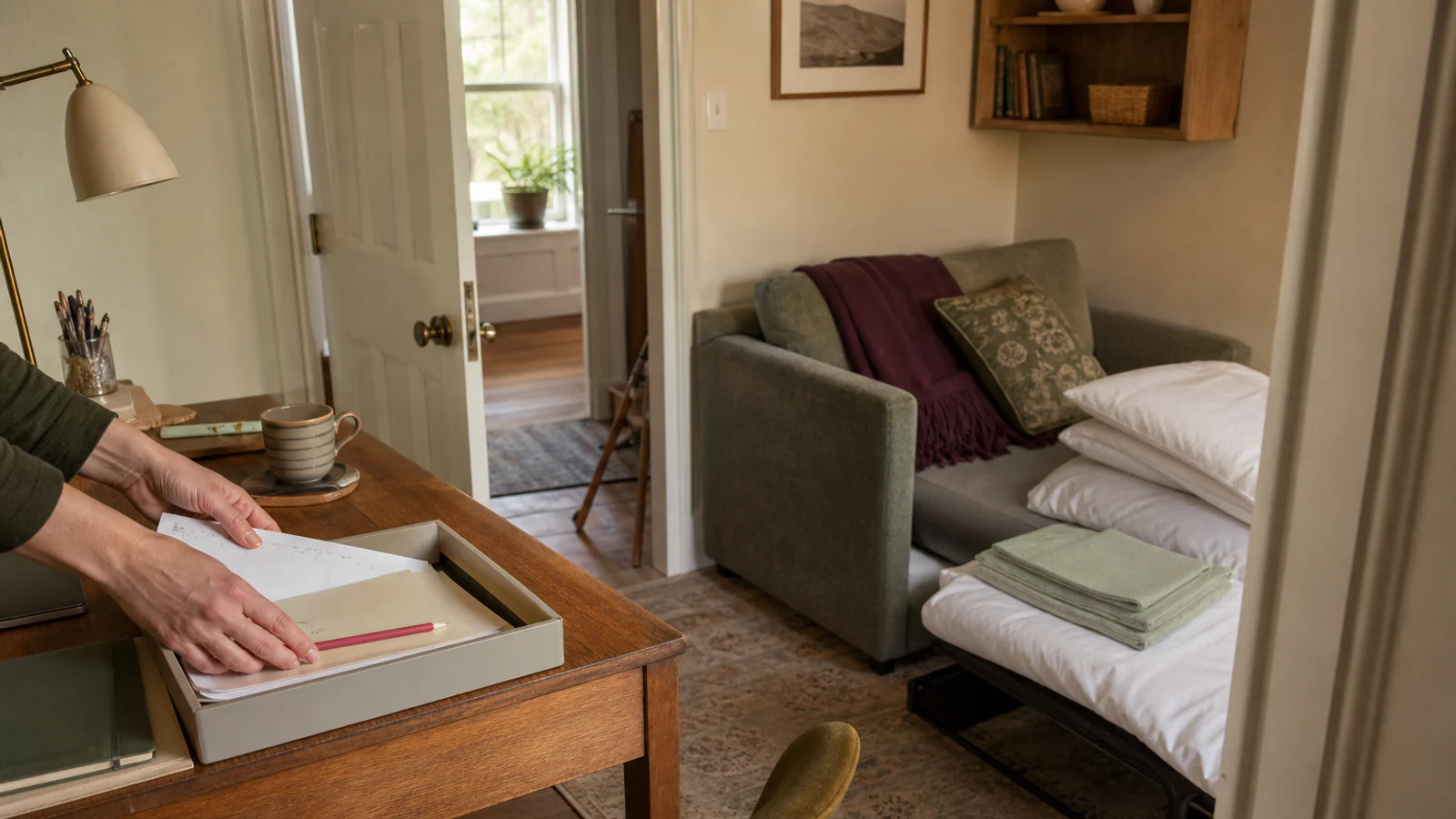
In a small home, the holiday table may be a desk, homework surface or food-preparation backup until an hour before guests arrive. Do not make the table unavailable all day for a tablescape. Decide the earliest realistic changeover time, then design a dressing routine that fits it.
Group clean, table-ready decor in one lidded box or on the same tray that will later become its second address. Keep linens folded with the place-setting plan. Photograph the plain rehearsal from above so another household member can help without reconstructing an elaborate composition from memory. Avoid storing food-contact items with shedding greenery, scented products or dusty seasonal objects.
If work materials must leave the table, give those materials their own safe landing before the cloth comes out. Shifting a laptop onto the floor or balancing paperwork beside hot serving dishes merely exports the conflict. New-home hosts still establishing those addresses may find the first-apartment 24-hour route useful: daily essentials get settled before decorative extras.
Judge the centre from a chair
A centrepiece can look low from the doorway and still sit exactly across two faces. Sit in every chair, including the chair nearest a wall. Place a person-sized object or ask another household member to sit opposite. Speak normally and reach toward the shared bowl. If you tilt, peer or thread your arm through foliage, the arrangement is asking too much.
The seated sightline lab
- Low and spreading
- Can preserve face-to-face views, but may consume the exact centre strip needed for dishes. Test its full width, not only its height.
- Tall and narrow
- May lift visual mass above faces, but only if stable, clear of lights or flame and not vulnerable to a passing sleeve. “Above the sightline” is not the same as safe.
- Small repeated pieces
- Can move easily and fit between service items. Too many become hand obstacles and create a tedious clearing job.
- Useful centre
- Bread, fruit, a water carafe or condiment dishes may supply colour while serving the meal. They count as function only when guests can actually reach them.
- Nothing in the middle
- Often the best answer for a very narrow table. Put the festive layer in napkin colour, chair backs, the wall or the room’s lighting instead.
Photograph the table from seated eye level with the lights you will use. The image is a planning reference, not proof of a perfect setup. Look for faces blocked by foliage, glare from a bare bulb, shiny objects reflecting into eyes and serving handles that point into place settings.
Check stability with ordinary, gentle table movement; do not deliberately jolt fragile or hot objects. A pedestal table, uneven floor or lightweight folding table may transmit more movement than a heavy dining table. If an arrangement depends on nobody touching the table, it does not belong on a dining table.
Make a festive story without buying a tabletop kit
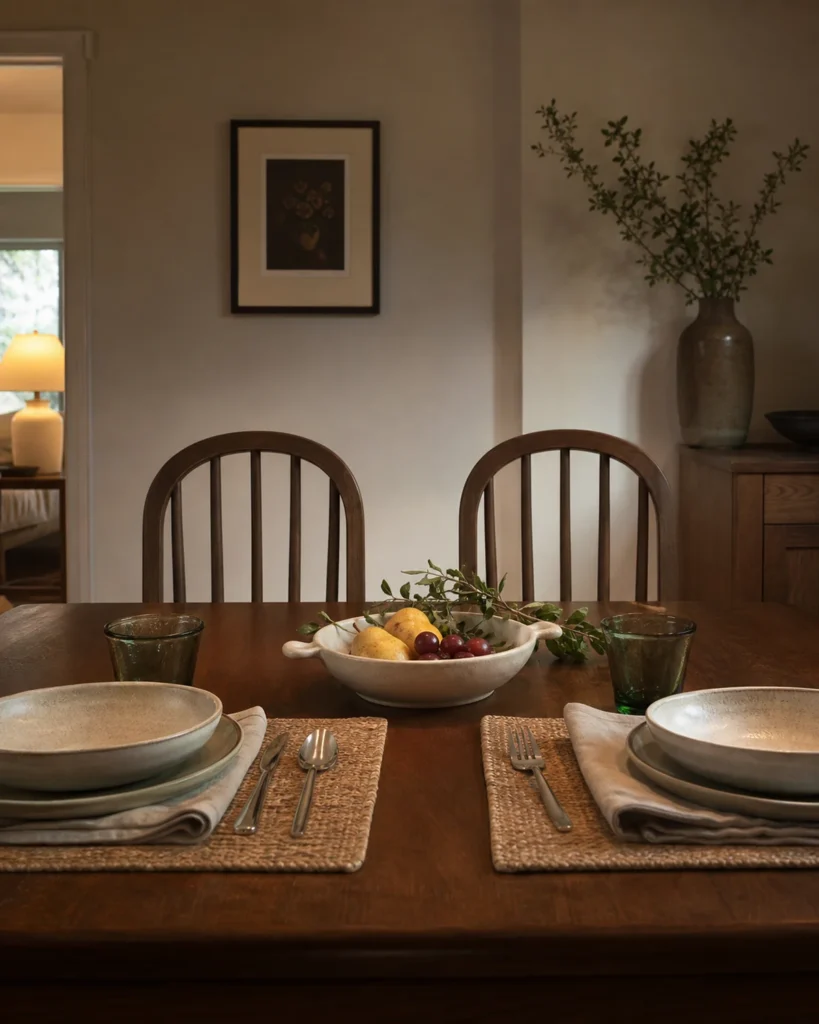
A small table benefits from fewer signals, not more miniature decorations. Choose one material, one colour relationship and one repeated shape. That might be linen, deep green and round fruit; brown paper, white crockery and a red ribbon; clear glass, brass and a branch shape echoed twice.
Start with one object already in the home: a serving bowl, a cloth, a piece of art visible from the table. Pull a compact palette from it. The whole-room colour-palette guide uses the same principle at room scale; for a table, two supporting colours and one material are usually enough to begin.
Use ordinary things with a visible job. Folded fabric napkins add colour and are then used. Citrus or apples can become food later. A small jug can hold foliage and return to serving duty after the season. Do not label an object “functional” merely because it resembles food service; an unreachable fruit tower is still decor.
Natural materials introduce practical questions. A branch may shed into food, berries may stain a cloth, unknown plants may be unsuitable around children or pets, and foraged material may bring moisture or insects indoors. Identify materials, keep them separate from food as appropriate and omit anything uncertain. A safe artificial sprig you already own may be the more sensible choice.
This is also where a no-buy approach is strong rather than austere. The existing guide to seasonal decorating with less stuff shows how repetition and relocation can create a seasonal shift without adding a storage problem in January.
Treat flame as a boundary, not a finishing touch
For a small table, flameless is often the better editorial decision. The U.S. Fire Administration advises keeping candles at least 12 inches (about 30 cm) from anything that burns, placing them in stable holders where they cannot be knocked down and considering battery-operated flameless candles. A narrow table with paper, fabric, sleeves, hair, serving dishes, children or pets may not offer a protected position for open flame at all.
The 12-inch figure is U.S. fire-safety guidance, not a promise that every position beyond that distance is safe. Follow the candle maker’s directions and the local requirements that apply. Never leave a burning candle unattended. Extinguish it before the table enters a transition that makes the flame harder to supervise.
Do not solve the open-flame problem by replacing it with careless wiring. If seasonal electric lights enter the tablescape, use products suitable for the intended location, inspect them, follow the maker’s connection and placement instructions, and keep cords out of dining and walking routes. The U.S. Consumer Product Safety Commission identifies minimum wire size, strain relief and overcurrent protection as observable safety characteristics for covered seasonal decorative lighting products; regional standards differ, so check the product and jurisdiction.
A battery candle is not automatically harmless. Check the product instructions, battery compartment and recall status; keep loose or accessible batteries away from children and pets, and do not hide a device where spilled liquid can reach it. If any lighting complicates service or supervision, remove it. The table can feel celebratory through colour and reflected room light.
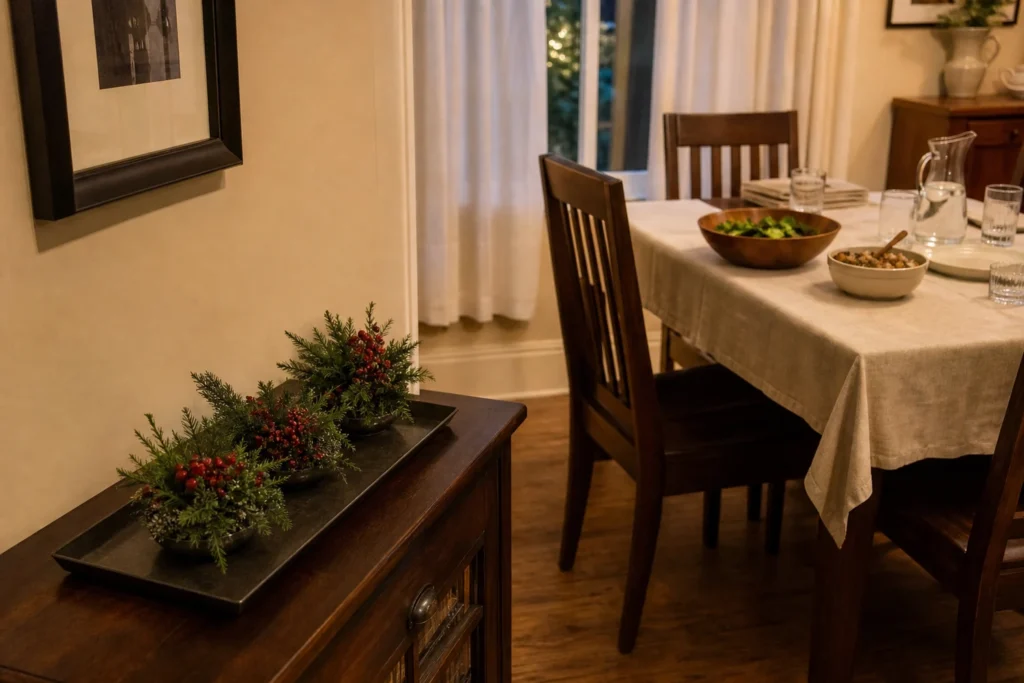
Give every removable object a second address
The table will change. Plan that change while the kitchen and side surfaces are still empty enough to accept it. Every object that may leave the table gets a named second address, not a vague promise that someone will “put it over there.”
The four-address backstage map
- Decor tray
A stable tray or shelf for the centre elements that leave when food arrives. It must already be empty. - Used-tableware landing
A heat- and water-appropriate surface for cleared plates and cutlery, outside the serving route. - Drink return
A defined place for empty bottles, jugs and cups so they do not collect at one diner’s elbow. - Gifts and extras
A chair, basket or room outside the meal route for packages, handbags and items guests bring to the table.
If the same sideboard appears in three addresses, the plan is overdrawn. Reduce objects or move one function to another room. The kitchen worktop is especially deceptive: it may look available during the rehearsal, then fill with hot pans, carving boards and ingredients. Protect cooking and cooling space first.
Use one tray for small movable decorations where practical. The tray should be light enough to lift without straining, stable when carried and sized for its destination. Do not pile lit candles, hot vessels or unstable glass together for a theatrical one-motion clearing.
Set the room around the table, not only the table
When the tabletop budget is close to zero, move the seasonal gesture to a surface that does not work so hard. A textile on the chair backs, one branch on a distant console, paper decoration on a wall or a coloured shade on an existing lamp can carry the atmosphere. Keep exits, controls, heaters and door movement clear, and follow product and property rules for anything mounted or powered.
Consider what guests see when seated. One generous element across the room may do more than six small objects between plates. This makes the table easier to use and gives the entire dining zone a point of view.
Do not let decorating reduce access. A rug edge that catches a chair, gifts placed in a walking route, a side table narrowing a passage or a cable crossing the way to the sideboard matters more than a missing centrepiece. The small home has one shared circulation system; the holiday meal does not suspend it.
Rehearse arrival, dinner and clearing
Dress the table a day early if possible, then perform the transitions using empty or room-temperature stand-ins. Do not rehearse with hot dishes or lit candles. Use the real serving bowls, trivets, jug and chairs so the evidence is useful.
Five-minute three-act rehearsal
Revision rule: if one object must be moved in two acts, move it off the table before guests arrive.
Searchable safety and limits
- Open flame is optional. Use it only when product directions, local guidance, stable placement, clearance and active supervision can all be satisfied. On a crowded small table, omit it.
- Electrical decor needs its own check. Inspect lights, use them only as directed and keep cords, battery packs and connections away from spills and routes. Do not overload outlets or exceed the maker’s connection limits.
- Hot food controls the layout. Use suitable trivets and serving pieces, preserve secure hand routes and keep unstable or flammable decor away. Food handling and temperature requirements are menu- and jurisdiction-specific and are outside this decor guide.
- Children, pets and access needs change the answer. Small batteries, glass, trailing cloth, toxic or unknown plants, reachable flame and narrow passages may rule out otherwise attractive ideas.
- Measurements are illustrative. Tape your actual crockery and service pieces. Do not treat the worked 140 × 80 cm table as a minimum, maximum or accessibility standard.
- Global readers: linked USFA and CPSC material is U.S. guidance. Product instructions and the fire, electrical, food and property rules where you live take precedence.
Your next action: set the plain table tonight
Put out the real plates, glasses, cutlery, water and largest serving dishes. Pull in the chairs and sit down. Whatever remains after people, service and sightlines is the true decorating budget. If that budget is one low bowl, use one low bowl. If it is nothing, give the room—not the eating surface—the festive moment. A good holiday table does not preserve a photograph; it makes room for dinner to happen.
Sources and scope
- U.S. Fire Administration: Holiday Fire Safety — candle clearance, stable holders, flameless alternatives, light inspection and manufacturer connection limits.
- U.S. Fire Administration: Candle Fire Safety — supervision, extinguishing and placement boundaries.
- U.S. Consumer Product Safety Commission: Seasonal and Decorative Lighting Products — U.S. scope and specified observable safety characteristics for covered products.
Editorial disclosure: Measurements and meal plans are hypothetical worked examples. Dealsmaster did not test a candle, lighting product, table or hosting setup and has no product or affiliate recommendation in this guide. Follow exact product directions and local requirements.
About the visuals in this guide
These are original Dealsmaster visual studies made with AI-assisted image tools and art-directed for this article. They illustrate planning examples, not photographed reader homes, product tests, or guaranteed outcomes.