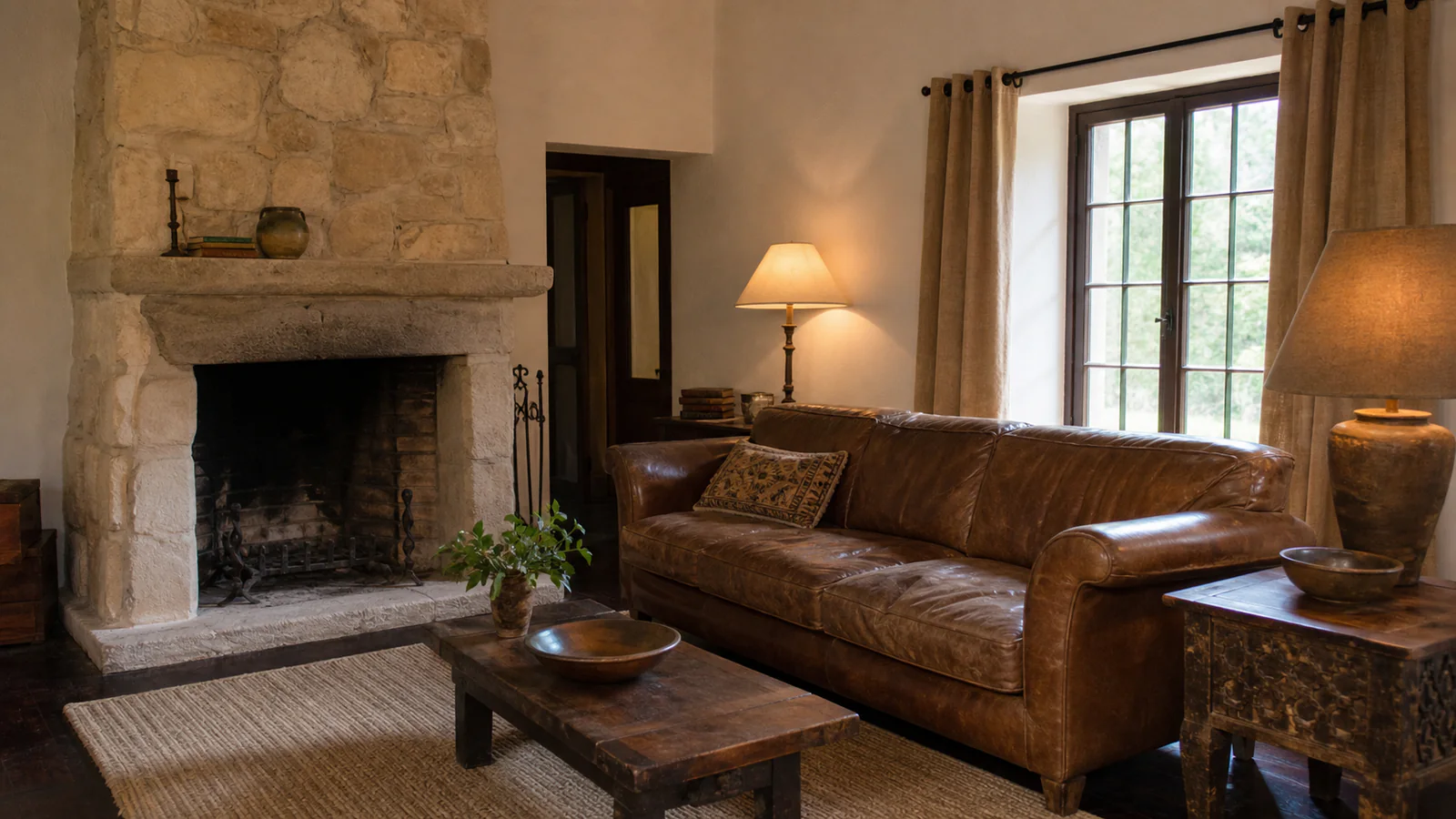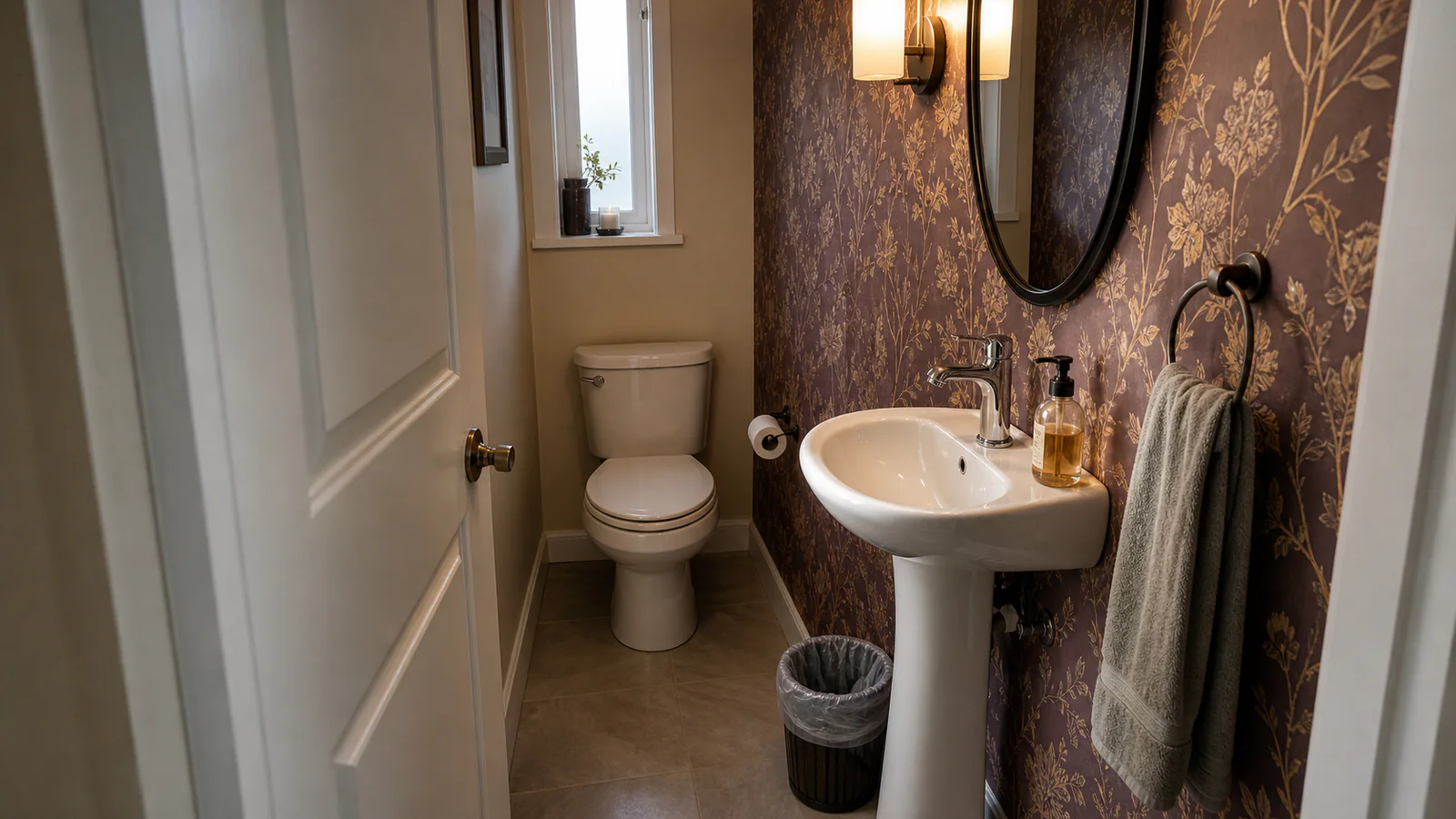
The guest-route powder room
Make the switch, latch, paper, soap, towel and exit obvious to someone who has never used the room. Then give one surface permission to be memorable.
Start before the wallpaper: enter as a visitor, close the door, find the essentials, wash, dry and leave without using anything you know about the house. Remove the first point of hesitation. A dramatic surface works better when it is not competing with a floor basket, a hidden towel and wet hands searching for instructions.
A powder room is one of the few domestic rooms a guest often uses alone. The visit is short, private and unfamiliar. A host cannot explain that the switch is behind the open door or the clean hand towel is folded inside the lower basket. The room has to do that work.
Ninety seconds is a narrative lens, not a measured average or a performance promise. Likewise, the five-minute host reset later in this guide is an exercise, not a universal cleaning time. Plumbing, ventilation, electrical work, fixture installation, mold concerns and accessibility compliance remain outside decorating scope and require the exact property, product and applicable local route.
- Enter and close
- Use without searching
- Find soap and water
- Control splash
- Dry hands
- Check and leave
At the threshold: what the open door hides
Stand in the hall with the door in its usual open position. What disappears behind it? Find the light switch as if you have never seen it. Look for the latch. Check whether the door meets a bin, rug, basket or decorative stool before it clears the person entering.
Do not begin by imagining a different door. Remove movable conflicts first. A construction change creates property, structure, hardware and local questions that a styling article cannot answer. The first useful edit may be the unglamorous one: a smaller suitable bin, a wall-side object removed or nothing stored on the floor.
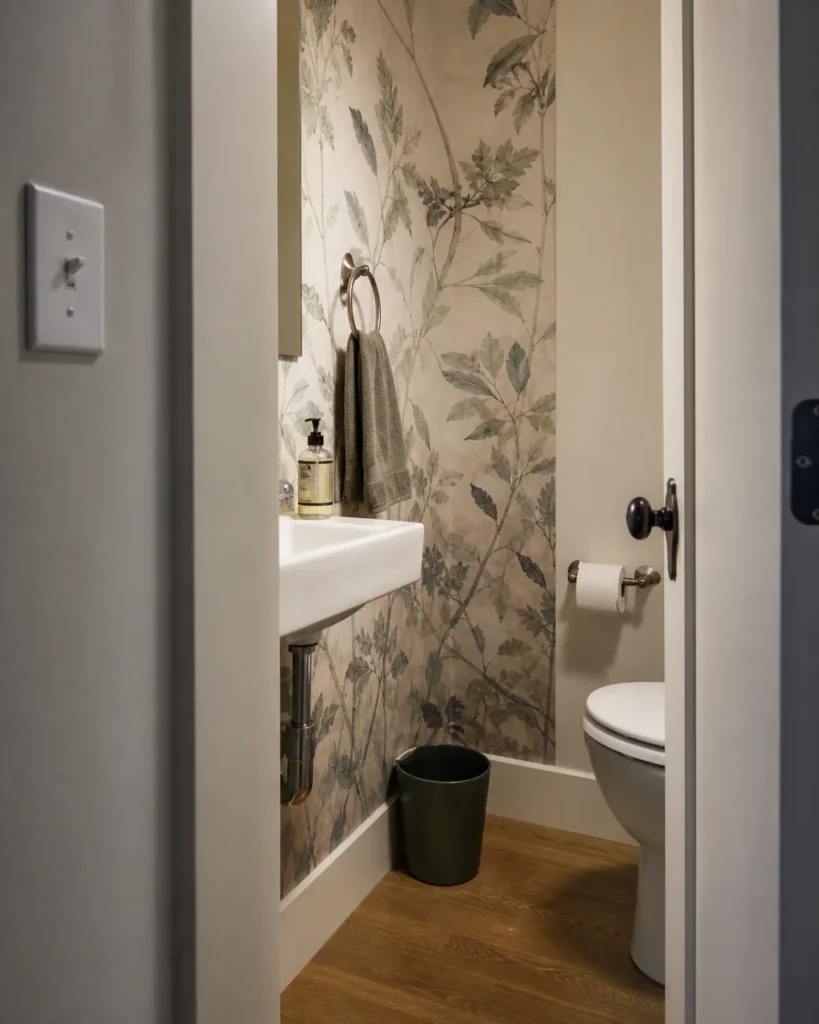
The room has two maps
The host’s map is made from memory. It knows the switch is behind the door, the spare roll is in the basket with the lid and the towel with the decorative edge is the one guests should use. The visitor’s map contains only what can be seen, reached and understood now.
Photograph both thresholds: door fully open and door closed with a person’s likely standing position left empty. Annotate the photographs in a notes app or on paper. Circle the first essential object that vanishes in each state. If everything is technically present but three necessities share the same visual weight as six decorations, reduce the competition.
Legibility does not require labels on every wall. Repetition and position can explain the room quietly: soap at the basin, one towel on the reachable rail, paper where the seated user can find it, a bin whose purpose is apparent. The aim is not hotel impersonation. It is a room that does not make a guest rummage.
0–10 seconds: enter and close
Walk in carrying the kind of item a guest may have: a small bag, coat or mobility aid. Can the person clear the door before closing it? Does the bag have a stable, appropriate place, or is the only option the sink or floor? If the room is too small for a bag landing, let that be true rather than adding a tiny stool that blocks the exit.
In a hypothetical 90 × 180 cm / 35 × 71 in room, an inward-swinging door can occupy much of the apparent standing area. That example is not a minimum or a compliant plan. It simply shows why the closed-door photograph is incomplete.
Worked plan · show every operating state
Standing or approach area
Toilet zone
Compact sink and front edge
Clear return to the door
No dimension in this diagram establishes code, accessibility, fixture or safety compliance. Draw the actual room and route its property-specific questions appropriately.
A rug deserves the same test. If it catches the door, folds under a foot or stays damp, it is not earning its pattern. Use only a suitable product in a position that works with the actual door and cleaning routine—or leave the floor clear.
Work the hypothetical narrow room in the cheapest order
In the 90 × 180 cm example, imagine a tall basket behind the door, a small rug in front of the sink and a wide decorative tray on the basin. None is fixed. Remove the basket first and open the door. Remove the rug and repeat. Empty the tray, returning only soap, and repeat again.
Those three edits may restore the standing and exit route without touching a fixture. If they do not, the article stops pretending a decorating move can solve a property or fixture relationship. Record the exact conflict—door meets toilet, sink front consumes the usable standing position, required approach does not work—and route it to the owner or appropriately qualified professional.
This order matters because tiny rooms can make every centimetre feel structural. Some of the pressure is movable clutter. Some is not. Remove the former before making claims about the latter.
10–35 seconds: the room should not need searching
The next portion is deliberately uneventful. Paper is visible and reachable. The bin, if the room needs one, does not enter the route. Privacy controls are understandable. Nothing leans against the wall waiting to fall or asks the guest to open decorative containers.
Reserve supplies do not all need to be displayed. They need a nearby host address and an obvious in-use address. One spare roll can be legible without becoming a tower of bathroom decor. The guide to keeping small-bathroom storage off the floor can help with the reserve system; this guest route protects the objects needed during one short visit.
The U.S. Access Board’s ADA standards page explains the actual public/commercial and state/local government scope. Its operable-parts guidance can still prompt inclusive questions about clear approach and reachable controls. It does not make this hypothetical private room compliant. Test the people and equipment the home actually serves, and seek the proper assessment where accessibility requirements apply.
Make labels do their real job
Keep product identification and directions where they matter. Decorative decanting can make soap, cleaning products or other contents ambiguous. A guest should not have to decide whether the attractive bottle beside the basin is hand soap. The host should not have to remember which unlabelled container needs which care.
This is also why “hide everything” is a poor tiny-room rule. One visible, well-placed necessity is calmer than three anonymous containers that invite investigation.
35–65 seconds: water reveals bad placement
The wash zone needs to explain soap, water and a dry landing edge. Place soap where it stays stable, does not obstruct controls and can be refilled or replaced without dismantling a tray. Leave somewhere for a ring or small item only if it can remain dry and secure; otherwise the guest’s bag may be the better place.
Observe splash during normal use. If water repeatedly reaches wallpaper, timber, a basket or the floor, styling cannot overrule the condition. The U.S. EPA’s mold and moisture guide emphasizes moisture-source control, fixing water problems and drying wet areas. It also cautions around possible hidden mold. This article does not diagnose mold, prescribe remediation or approve a finish.
The EPA’s remodeling and indoor-air guidance notes the importance of bathroom ventilation and addressing leaks and condensation. It does not size a fan or determine the correct system for this room. If water, odour, staining, damaged material or ventilation performance is uncertain, route the issue to the owner and appropriate qualified help before covering it.
Pedestal or compact vanity? Follow the front edge
A pedestal sink reveals more floor and can reduce visual mass. It offers little landing space and exposes plumbing and cleaning relationships. A compact vanity can hold supplies and create a dry edge, but its front projects into the room and its doors or drawers need somewhere to open. Category labels do not decide which trade the guest route can afford.
More visible floor and a lighter outline. Test the exact fixture, support, plumbing, landing, cleaning and applicable requirements; appearance does not approve installation.
Potential landing and enclosed storage. Draw the front edge, every door/drawer state, plumbing/service access and the wet cleaning route.
Compare the distance from the closed door and the place a person can actually stand. Open the vanity. Place soap. Wipe the side nearest the wall. A narrow unit with an awkward projecting handle can perform worse than a slightly deeper plain-fronted one; only the exact product and room reveal the relationship.
Give wet hands one dry landing
A dry landing need not be a styled tray. It may be a modest clear edge where a ring, phone or folded tissue can rest without entering the basin or touching soap. Test it with water running and the exact dispenser in place. If the item must balance on a curved rim, the room does not have that landing.
Do not create one by adding a shelf at shoulder or head level without resolving its projection, mounting and wall conditions. A small, stable accessory designed for the exact fixture may be an option; an ordinary bag kept out of the wet zone may be better. The guest route does not require every possible convenience when the room cannot support it cleanly.
65–80 seconds: wet hands choose the towel route
A hand towel should be visible before wet hands begin searching. Stand where washing happens and reach without crossing the toilet, door swing or a fragile object. Check that the towel does not drag on the floor or rest against a persistently damp surface.
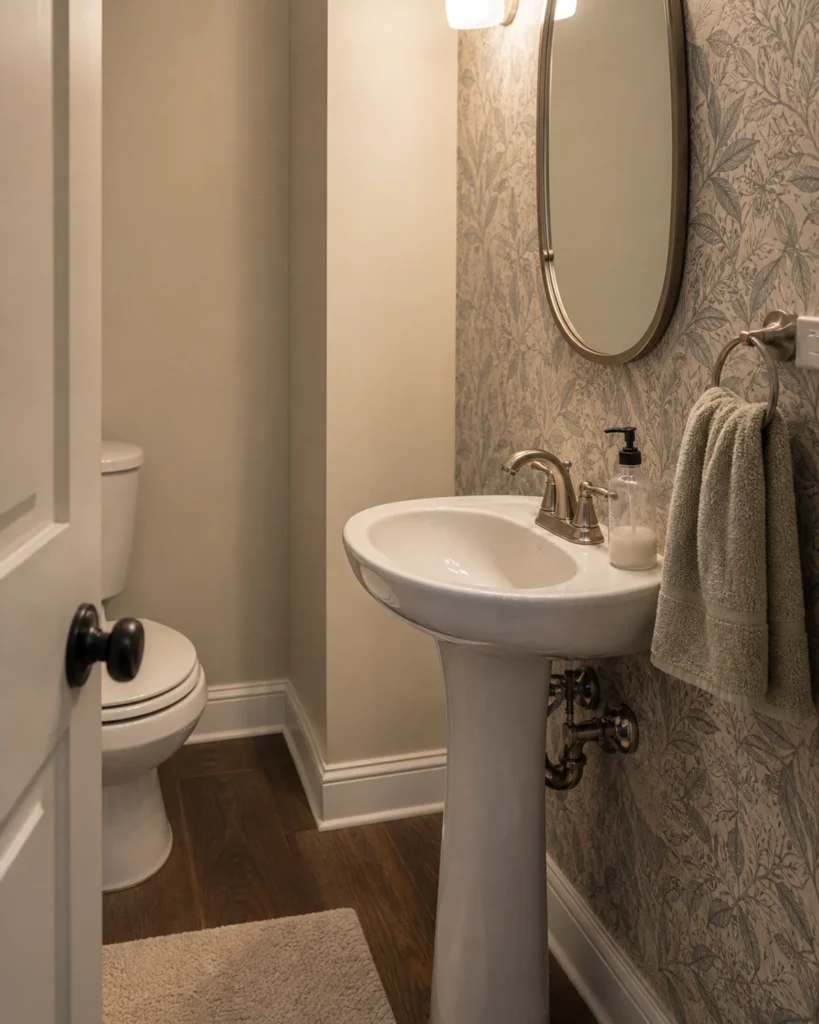
A reusable towel creates a laundry and replacement rhythm. Paper towels create a waste, refill and bin-capacity decision. Neither is automatically more hospitable. Choose one system and make the next clean supply easy for the host to reach without storing a bulk package in the guest’s standing space.
If the towel never dries or the wall remains wet, that is a condition to investigate, not an argument for more hooks. Exact material, ventilation and property guidance controls.
80–90 seconds: mirror, light and a clean exit
Stand at the only position a guest can occupy. Does the mirror show a useful view, or is it centred on an empty wall relationship? Does the light create glare or leave deep facial shadow? A larger mirror can create an impression of more visual space, but it does not add standing room, and its weight and mounting require exact wall and product decisions.
Use temporary, product-appropriate lighting observations before hardwired changes. The guide to indirect light without glare offers helpful optical principles, but a powder room’s moisture, fixture and electrical conditions still require the correct qualified route.
Now turn back to the door. The bin, spare paper, bag and open vanity must not make the exit a backward shuffle. Open the door with every object in its ordinary state.
The five-minute host cutaway
The guest leaves; the camera stays. The room’s caretaker needs a short, visible route of their own. Run the reset before adding storage.
- Remove rubbish
Can the bin leave without striking fixtures? - Replace towel
Is a clean one nearby and easy to identify? - Check supplies
Can soap and paper be refilled without a search? - Wipe splash
Are basin edges and nearby surfaces reachable? - Observe condition
Is anything still wet, damaged, stained or poorly ventilated?
When a reset drags, name the transaction. Perhaps the refill kit lives two rooms away. Perhaps the oversized bin cannot clear the door. Perhaps a decorative tray must be dismantled to wipe the sink. Fix the transaction rather than adding another basket.
A shallow host kit may outperform deep storage because its contents are obvious and rotate frequently. Keep appropriate items together, retain necessary labels and avoid storing anything in a way that conflicts with product, child, pet, moisture or property requirements.
Split the guest layer from the refill layer
The guest layer is sparse: what one person needs during the visit. The refill layer serves the host between visits. Mixing them produces the familiar stack of five spare rolls, three soaps and a towel tower occupying the same tiny room.
Choose a nearby refill address that the host can reach without entering the guest’s standing area with a large package. Decant only where the product permits and identification remains clear. Add a small “replace when one remains” note to the host kit if supplies are frequently forgotten. The note belongs inside the host system, not as decorative bathroom signage.
One surface gets the drama
Now the room has earned visual energy. Choose the surface from the guest’s actual viewpoints: doorway, basin and mirror. A saturated wall can frame a simple fixture. Pattern at the doorway can create a strong first read. A quieter wall may let an expressive floor or light fitting lead.
Saturated wall fieldTest beside the actual sink, mirror and light at different times. Dark colour is not a substitute for useful illumination.
Pattern at the thresholdCheck repeats around fixtures and corners. Product and substrate suitability control; “removable” is not a damage-free promise.
Expressive lower surfaceLet floor or vanity material lead while walls stay quieter. Cleaning, moisture and installation conditions come first.
Build the palette from one real material or object rather than stacking every fashionable signal. The guide to creating a room palette from one loved item offers a disciplined way to do that.
Test large samples where the surface will live. Observe them with the door open, at the basin and in the mirror. A dark field may feel rich from the hall and swallow useful contrast at the sink. A large print may break awkwardly around small fixtures. A glossy finish may reveal every surface irregularity. These are reasons to test, not blanket rules against bold rooms.
Let the bold surface point, not camouflage
Strong contrast can help organize the short route. A deep wall behind a pale towel makes the towel obvious. A patterned doorway wall can draw the eye in while the basin wall stays calm enough for mirror and handwashing tasks. A quiet floor may keep the exit readable when every vertical surface carries pattern.
Do not use visual busyness to hide a panel, recurring stain, damaged finish or awkward fixture relationship. Unknown conditions stay visible until they are understood. Boldness is the final layer because it can support the route only after the route is real.
Fragility is not luxury
A handwashing room needs materials and objects that tolerate their specified care. A delicate accessory that cannot be wiped, a tray that traps water or a framed item that projects into the towel route is poorly placed however expensive it looks.
Renters should check lease terms, wall condition and the exact finish product before adding adhesive, paint or hardware. “Peel-and-stick” describes an application method, not guaranteed removal without damage. If the surface question is uncertain, colour can arrive through an appropriate towel, art placed outside movement or another reversible item whose instructions fit the room.
The no-explanation visitor test
Ask someone unfamiliar with the setup to use the room while you remain outside. Do not direct them. You are not timing or judging the person; you are watching what the room failed to communicate. Ask afterward where the first hesitation occurred.
- Was the switch apparent from the threshold?
- Could the door close with the person and their carried item inside?
- Were paper, soap and towel obvious without opening unrelated storage?
- Did any object feel loose, unstable, wet or in the route?
- Could the person turn back to the door without moving the room?
- Could the host reset the room without dismantling the styling?
Fix the first hesitation and run the route again. If the first pause is the switch, a beautiful towel ring is not yet the priority. If the towel is hidden, a stronger wallpaper pattern will not explain it. If the floor basket blocks the door, the storage system has moved into the guest experience.
The first edit is an observation
Enter as if you have never seen the room
Open the door. Say nothing. Find the switch, latch, paper, soap, towel and exit. Write down the first moment you use household knowledge instead of visible information.
Fix that. Then choose the wall that gets to be loud.
Sources and boundaries
This article does not diagnose mold, prescribe ventilation, provide fixture dimensions, approve installation or certify accessibility. The timed route and 90 × 180 cm example are editorial tools. Exact product, wall, plumbing, electrical, ventilation, property and applicable local requirements control.
- U.S. EPA mold and moisture guide — moisture-source control, drying wet areas and caution around possible hidden mold.
- U.S. EPA remodeling and indoor-air guidance — bathroom moisture/ventilation and leak/condensation boundaries, not project-specific sizing.
- U.S. Access Board ADA scope and operable-parts guidance — approach and reach concepts within actual scope, used here only to prompt inclusive questions.
How this guide was made
Host Lens is an AI-assisted editorial voice; this exact version was reviewed by Dealsmaster on 2026-07-30. The desk name describes a writing framework, not a person, credential, household, product test or firsthand experience.