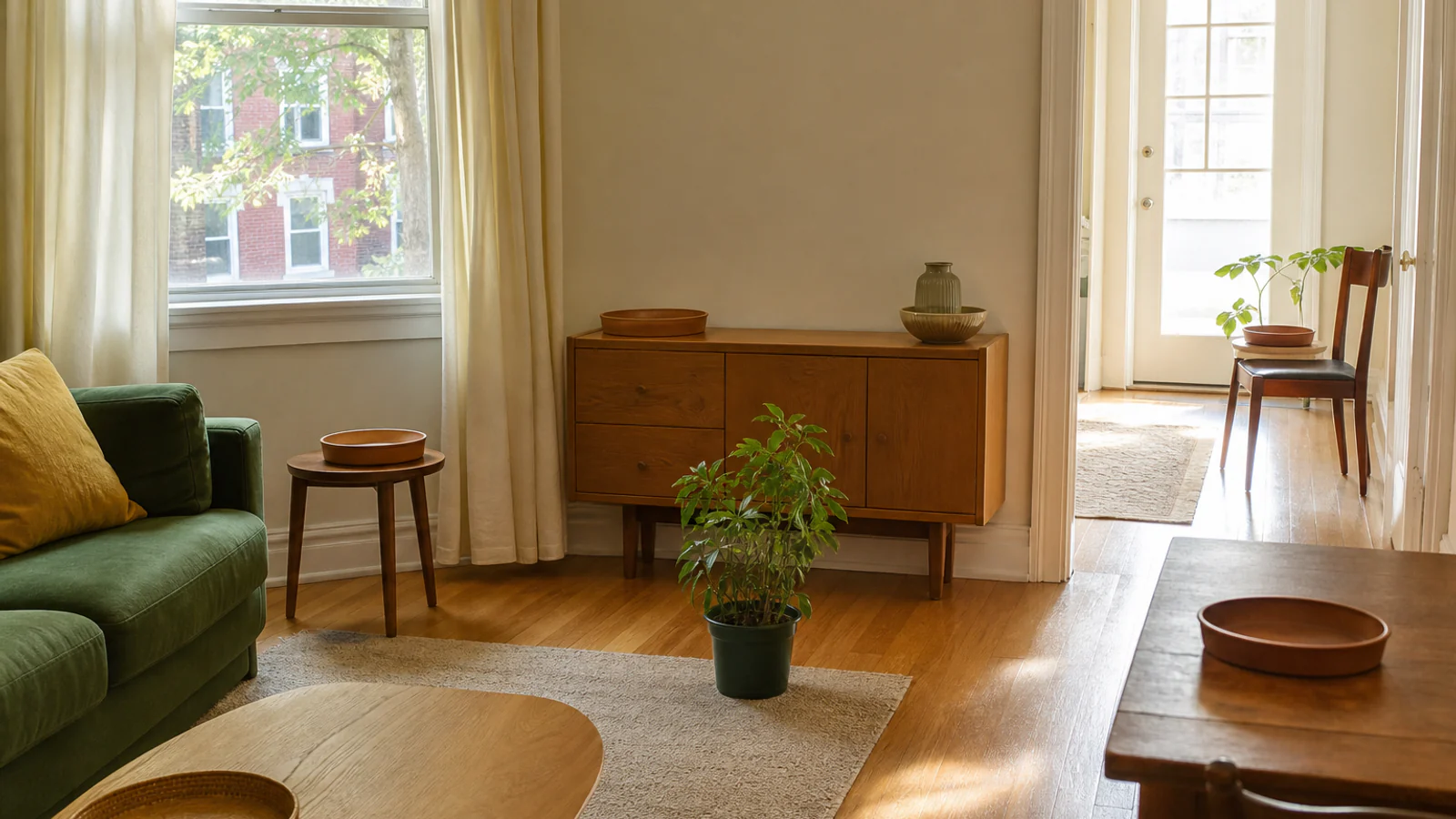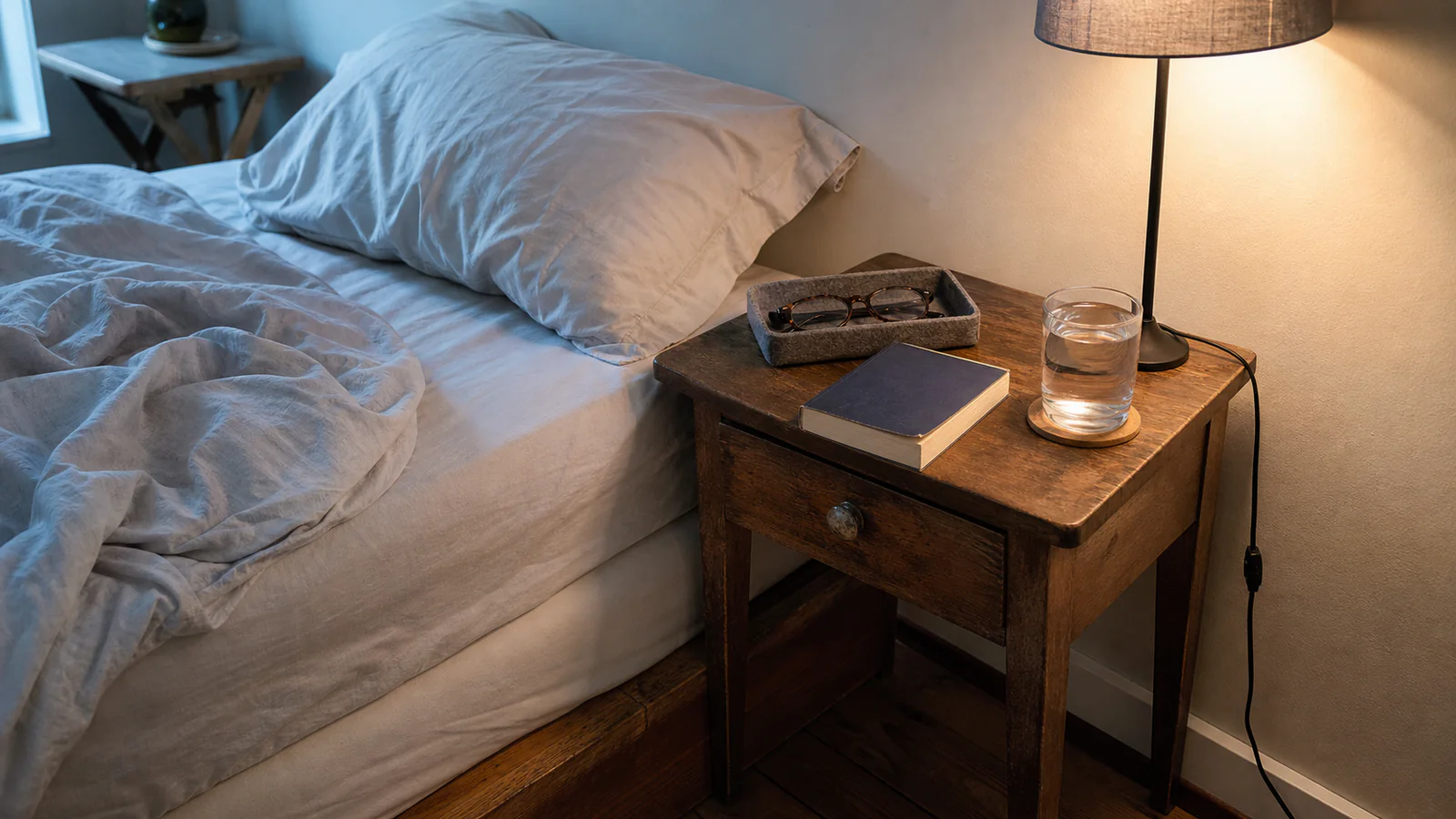
Night Shift · a routine-first bedside guide
Turn off the light. The bedside table is now used by touch, not styling. Reverse the last five minutes and let every object earn its landing place.
At lights-out, the room loses the visual information that made the nightstand look simple. A hand moves toward the switch. Glasses need a landing that will not scratch them. Water is suddenly very close to a cable. The book is larger than the empty tray in the listing photograph. An open drawer may be waiting for the first bare foot in the morning.
So begin at the end. Run the final five minutes backward, from darkness to the moment the room unloads its day. The record concerns actions, not sleep or styling. The right bedside surface is the one that supports those actions without making the path, power or equipment harder to manage.
- Lights out Find the essential item without searching.
- One minute earlier Land glasses and phone in separate, reliable addresses.
- Two minutes earlier Switch off the reading light and place the book.
- Three minutes earlier Keep water from competing with powered items and cords.
- Four minutes earlier Give equipment exactly the position its instructions require.
- Five minutes earlier Decide what arrives, what stays and what leaves in the morning.
Lights out
What must a hand find?
Choose no more than three things that must be found promptly in the dark. The answer differs by person: a lamp switch, glasses, water, phone, hearing aid, prescribed item or another essential. “Must find” is not the same as “usually lives nearby.” A decorative object does not belong in this first category simply because the table has room.
Give each essential a tactile address. A shallow soft-lined tray feels different from the timber top. A water coaster has an edge. A switch stays in one reachable position rather than hanging behind the table. The point is recognition without a sweep of the hand that knocks over everything else.
The dark-room reach arc is personal
Lie in the normal position, then sit as you normally sit. With eyes closed, reach slowly for the essential address. Do not twist farther, lean over an edge or perform a movement you would not ordinarily make. Mattress compression, frame height, pillow layers, body, mobility and equipment all alter the useful zone.
The familiar advice to align a nightstand “around mattress height” is only a starting observation. Test the real dressed bed, including the layers that remain overnight. If those layers are still unsettled, build the test around the bedding combination real sleepers actually use.
Do not assume vision, dexterity, side reach or the ability to transfer. A resident may need another arrangement or appropriate support. The test belongs to the person who uses the side of the bed; an able-bodied helper should not “prove” it on their behalf.
Test height with the whole hand path
Do not measure only from floor to mattress top and call the height solved. Watch the hand travel from its resting position to the landing. A surface slightly below the compressed mattress may feel straightforward for one person; another person may need a higher, nearer address. A deep soft mattress can lower the body far more than the catalogue height suggests.
Use a stable existing surface that is suitable for the intended load, then place a firm removable layer on top only if that use is itself stable and appropriate. Do not build a tower of books or loose boxes beside the bed. Test one height at a time with the resident, the bed occupied and the normal pillow support in place. Record “easy,” “requires sitting,” “requires twisting” or “cannot reach” rather than forcing a universal ideal.
One minute earlier
Glasses and phone land before the room goes dark
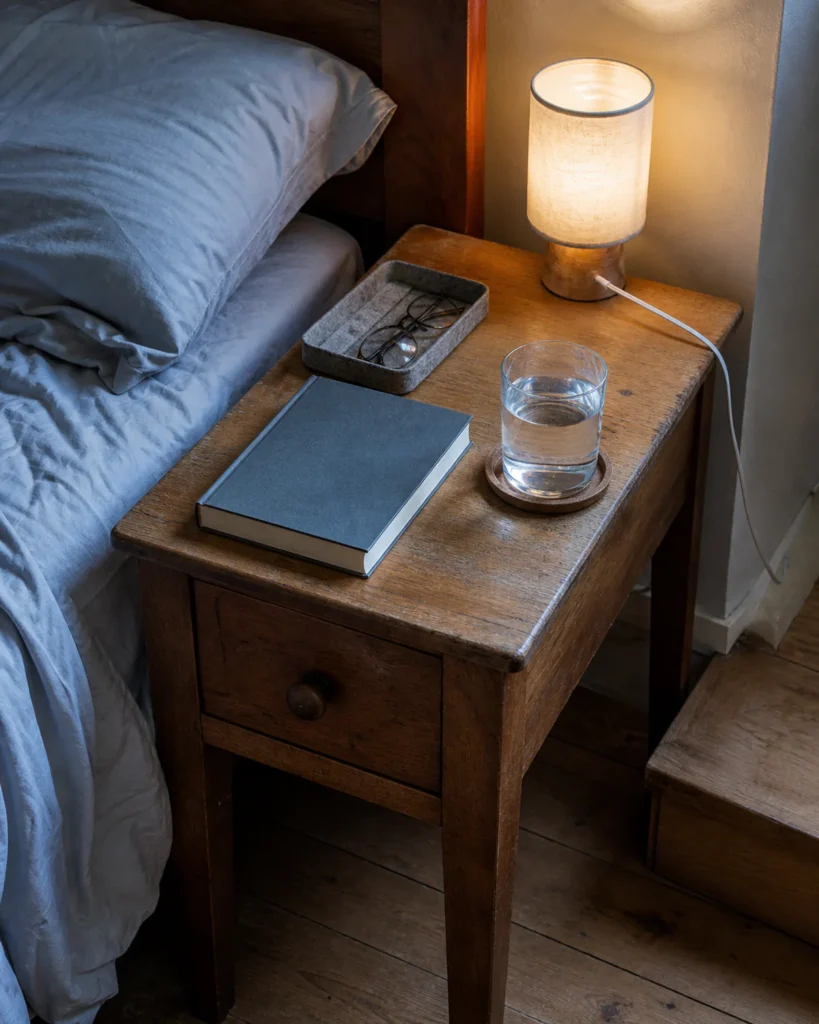
Fragile and essential objects need an address that does not move when the book arrives. Put the glasses tray where the hand approaches from the bed. Keep it clear of the water landing. If the phone stays bedside, decide whether it is face down, silenced, charging or simply parked; this guide makes no claim about sleep or screen habits.
Test the normal case, cable and any accessibility setting that changes how the phone is handled. A raised lip may help one person locate the edge and frustrate another person’s grip. A drawer can protect an object but also add a pull and an opening arc. Use the actual hand, not a universal organizer.
Two minutes earlier
Reading ends; the book still needs somewhere to go
Switch on the normal reading light and settle into the actual position. Can the control be operated without pulling a cord, reaching behind hot or fragile parts, or moving the water? Does the shade produce glare at eye level? Does the open book cover the switch, glasses or equipment?
A narrow surface may not need a smaller lamp. It may need the lamp somewhere else: a floor lamp, a properly installed wall light or another product intended for the position. Each alternative has its own stability, attachment, cable and clearance instructions. “Wall-mounted” is not automatically renter-safe, and a clamp does not suit every headboard or shelf.
Think in three lighting jobs—general room light, the task of reading, and a lower orientation light—rather than asking one tiny lamp to do everything. The same distinction used in a layered room-lighting plan can clarify the bedside at a much smaller scale, but exact bedroom products and placement still control.
If the wall light, outlet and headboard all want the same position, pause before installing any one of them. The headboard fit passport maps the wall, dressed pillow line and connection separately. Combine those observations with this night routine so the wall is solved once.
Three minutes earlier
Water meets power—give them different territories
A coaster is useful for condensation and a stable landing. It does not make a crowded electrical arrangement safe. Draw three territories across the surface and floor: tactile essentials, a dry landing for water or other liquids, and the area occupied by products that use power. If those territories overlap, the answer may be a different furniture shape or a different location—not a smaller tray.
Find by touch
Glasses, switch and any essential object keep a fixed address with no decorative obstacle course.
Land liquids
Use a stable, distinct location. Test the real glass or bottle and how it is lifted from bed.
Follow instructions
Device, charger, cord and ventilation arrangements follow their exact manuals and appropriate property/electrical route.
USFA advises that extension cords are for temporary use only, should stay out of foot traffic and should not run under carpets or rugs. Its electrical guidance also says major appliances should connect directly to a wall outlet. CPSC identifies observable extension-cord characteristics tied to shock and fire risk, but a compliant consumer cord is not permission to improvise permanent wiring.
If the bedside plan depends on a cord crossing the route indefinitely, daisy-chaining products, hiding a power strip, or modifying the outlet, stop. Use the exact device instructions and an appropriate qualified electrical route for the property. This guide does not calculate electrical capacity or approve a power arrangement.
Include cleaning in the cord state
A cable can look controlled when the floor has just been styled. Now remove the glass, lift the book, change the bedding and clean behind the temporary surface. Does the cord get pinched by a leg, pulled tight, trapped beneath a rug or draped into the first step? Does moving the table strain the device connection? If the only way to clean is to disconnect equipment, check the exact shutdown and reconnection instructions rather than inventing a routine.
Photograph the cable route only to help an appropriate product or property discussion; a neat photograph is not an electrical approval. Keep labels and plugs identifiable, and do not conceal heat or damage behind a fabric cable sleeve for appearance.
Four minutes earlier
Equipment stays visible to its instructions
A bedside table may need to support CPAP, hearing equipment, monitoring products or another powered device, but a decor article must not configure any of them. The exact manufacturer’s manual and clinician guidance govern orientation, ventilation, clearance, water, hose or cable routing, cleaning, filters, stable support and what must remain reachable. Requirements vary by device and user.
Do not copy a bedside cabinet because a photograph appears to hide equipment neatly. The product may not be the same; the operating state may be cropped out; the setup may be unsuitable. If the furniture cannot meet the documented requirements, change the furniture. Do not change the device’s instructed position to make the furniture look calmer.
Five minutes earlier
The room unloads its day
Stand at the bedroom door with the things that normally arrive: glasses, phone, book, tissues, jewellery, water, medication stored according to its instructions, or equipment. Put each object into one of five groups:
- Must remain visible or findable: it serves a night need.
- Must remain dry: it needs separation from water and condensation.
- Uses power: its exact product and electrical instructions control.
- Needs secure storage: access by children, pets or another person matters.
- Leaves each morning: it is a visitor, not a reason to buy permanent storage.
This is where decor quietly loses its automatic place. A vase can stay if it genuinely belongs and does not consume the landing every night. It does not earn the only open square merely because a product photograph suggests “three objects at varied heights.” Bedside space is too active for styling by formula.
If this is a first move and routines are still changing, delay the nonessential furniture. The first-apartment setup sequence keeps the first day focused on sleep, light and basic function; the permanent nightstand can wait for evidence.
Worked gap: only 30 cm / 12 in remains
Imagine a hypothetical 30 cm / 12 in gap between bed and wall. This is not being presented as a safe, accessible or recommended passage width. It is simply the measured space a reader has found after placing the bed. Protecting the first step and the route around the bed may rule out furniture entirely.
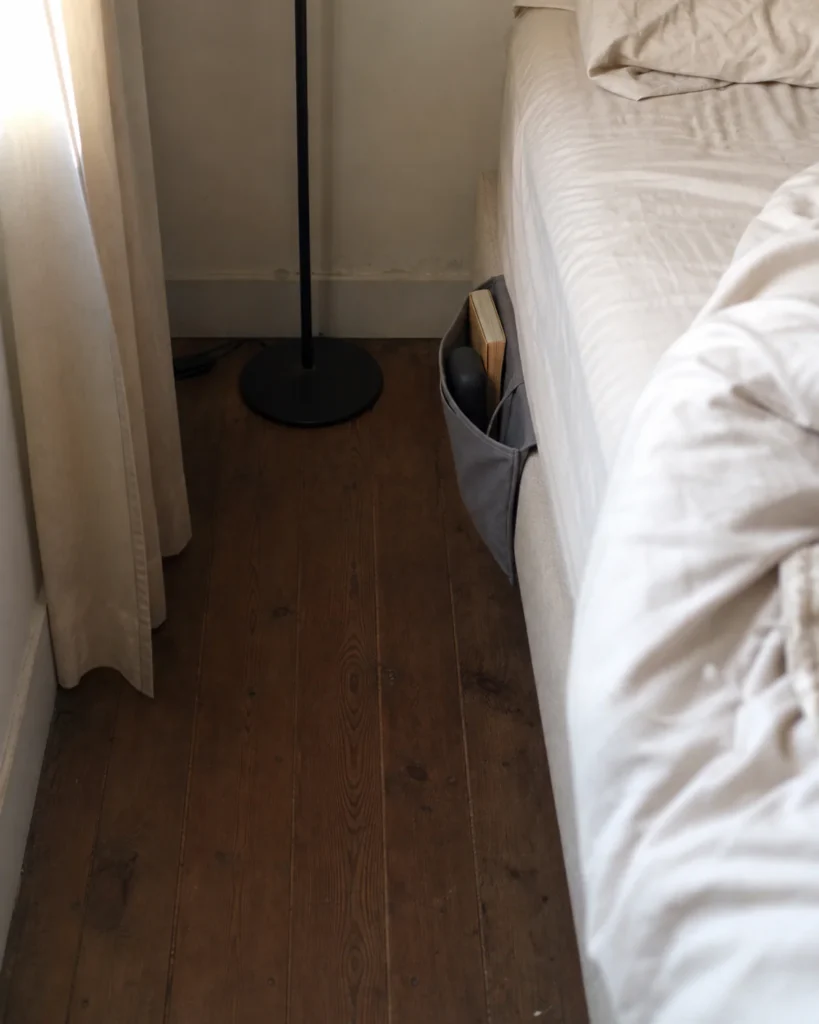
Tape each freestanding footprint on the floor and model the full operating state: drawer open, trolley approached, pocket filled, bed made. Then protect the first footfall and the walking route around the bed. A narrow table that requires stepping around its leg at 3 a.m. has failed before its finish matters.
Morning · minute one
Find the floor before finding the phone
Sit on the bed and place both feet where they naturally land. An open drawer, charging cord, shoe, trailing blanket or table foot should not surprise that movement. Do the test in low light and with the bed occupied as usual. If a mobility aid is part of the route, place and use the actual aid; do not approximate its footprint with decor.
Now test stability without climbing, leaning or exceeding the product’s intended use. A narrow tall piece can be easier to tip. Follow assembly and restraint instructions. CPSC’s Anchor It guidance is especially relevant where children might climb on top-heavy furniture; it does not choose a restraint for a particular nightstand or wall.
Morning · minute two
Choose the reset you will perform while tired
A drawer hides visual noise but asks for an opening motion and can catch bedding. An open shelf is fast but shows everything. A basket contains soft items but can become an unsearched cave. A tray gives tactile order but steals some flat surface. Choose by the action the resident will actually repeat, not by the tidy photograph taken once.
Reset the bedside for seven mornings without changing the system. Notice what remains. The water glass may leave daily; the book may stay for weeks; tissues may need a fixed address; the decorative stack may never be touched. That evidence should size the furniture.
Build the temporary week without buying an organizer
Choose a sturdy, stable surface already intended to hold at least the real bedside load. It must sit level, keep the first step clear and follow its own use instructions. Do not balance a tray on soft bedding, stack crates, turn a lightweight decorative stool into equipment furniture or assume a wheeled trolley will remain still.
Use removable paper labels beside—not on top of—each address: “glasses,” “water,” “book,” “powered item.” Labels make the first arrangement visible while you learn it; the final system should work without a sign. Leave a deliberately empty patch equal to roughly one ordinary visiting object, such as a mug or tissue packet. This is not a prescribed percentage. It simply tests whether the surface has any tolerance for real life.
Do not add baskets or drawer inserts during the first three nights. Observe the problem before buying its container. If one object repeatedly lands on the floor, ask whether the surface is too far away, the address is blocked, or the object should leave the bedroom. Containment is only one answer.
The seven-night bedside audit
Use a sturdy temporary surface appropriate for the load. Each morning, tick only what occurred and add a short note. The audit is observational; it does not approve electrical or medical-equipment setup.
Turn seven nights into a furniture specification
At the end, circle the objects used on at least several nights and separately mark anything essential even if rarely used. Record the largest simultaneous state: book open, glasses landed, water present and equipment operating according to instructions. Measure that arrangement as evidence for a surface—not as permission to crowd it to the edges.
Next list the failures by cause. “Fell” may mean the surface is too small, but it may also mean the object has no tactile edge. “Could not reach” may mean the table is too low, too far away or blocked by bedding. “Cord moved” belongs to the product/property route, not to a prettier cable box. “Never used” is a candidate for removal, unless it is an essential emergency item stored according to its governing instructions.
Finally, decide what the furniture must not do: enter the first step, require a permanent extension cord, block a drawer, hide equipment, wobble, or demand an identical partner on the other side. Those negative requirements are often more useful while shopping than a style name.
Mismatched nightstands can be the honest answer
Two sleepers can have different routines, bodies and equipment. One side may need a larger instructed device surface and secure storage; the other may need only a book and switch. Forcing identical furniture can create equal appearance and unequal function.
Balance the pair with one quiet relationship: a similar top line where useful, related lamp scale, one repeated material, or colours that belong to the same room. Do not force equal capacity. The routine is the specification.
Begin tonight with a temporary surface
Use something sturdy, stable and suitable for the real load. Turn off the light. Give the three essential objects tactile addresses, keep liquids and powered items from competing, and protect the first step. Record what happens for seven nights before opening a furniture tab. By the final night, the hand should know where to go without searching.
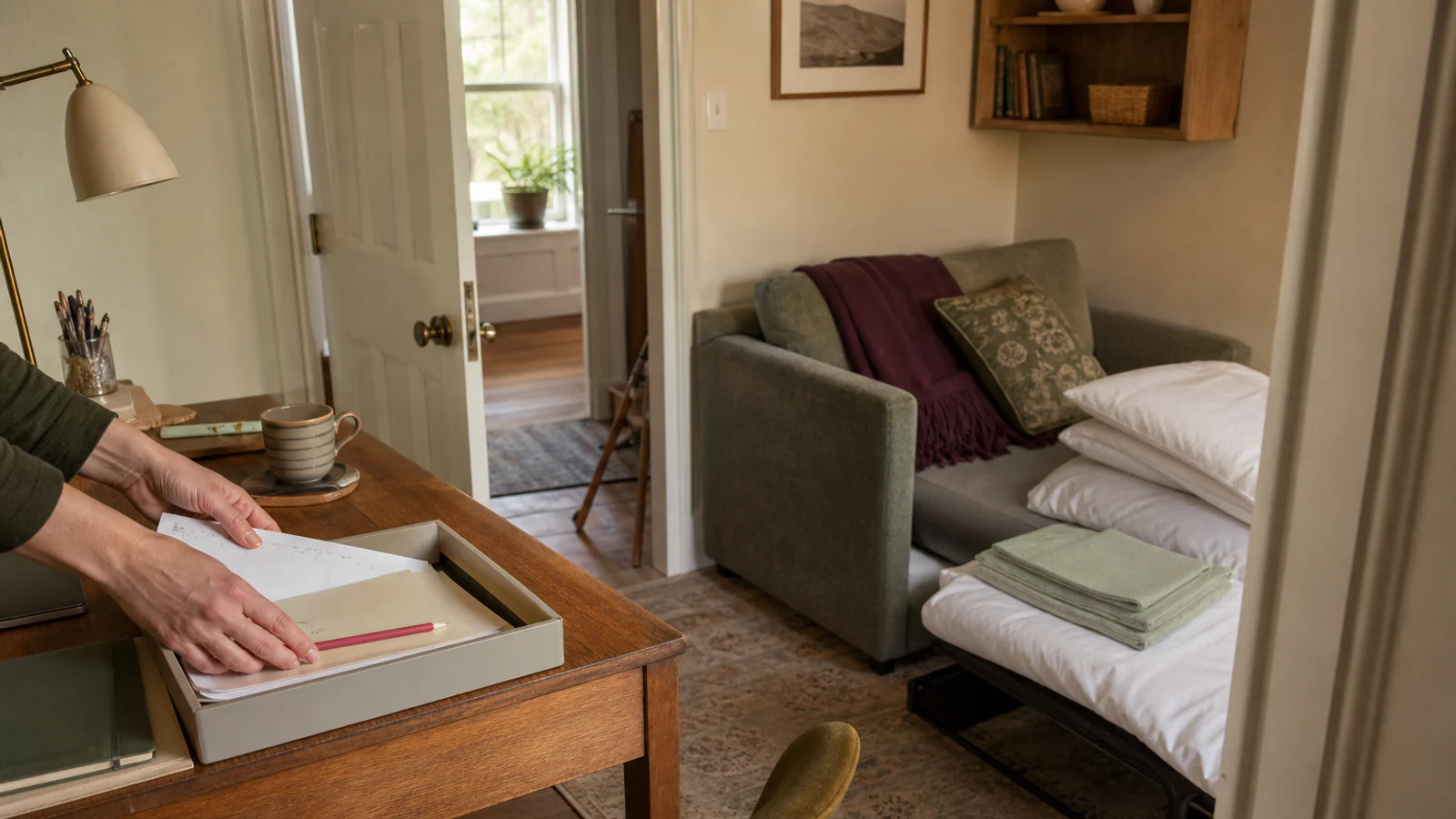
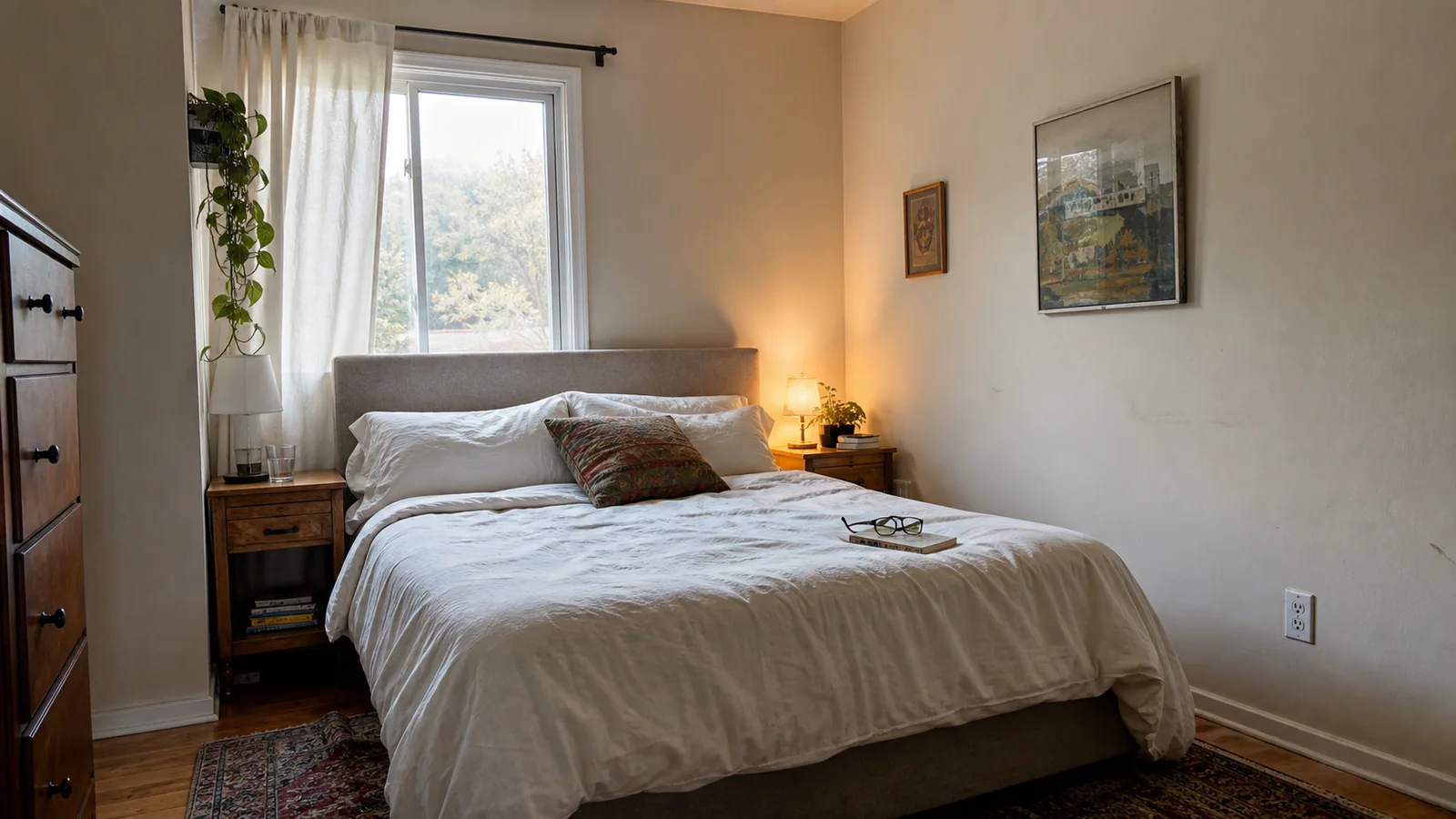
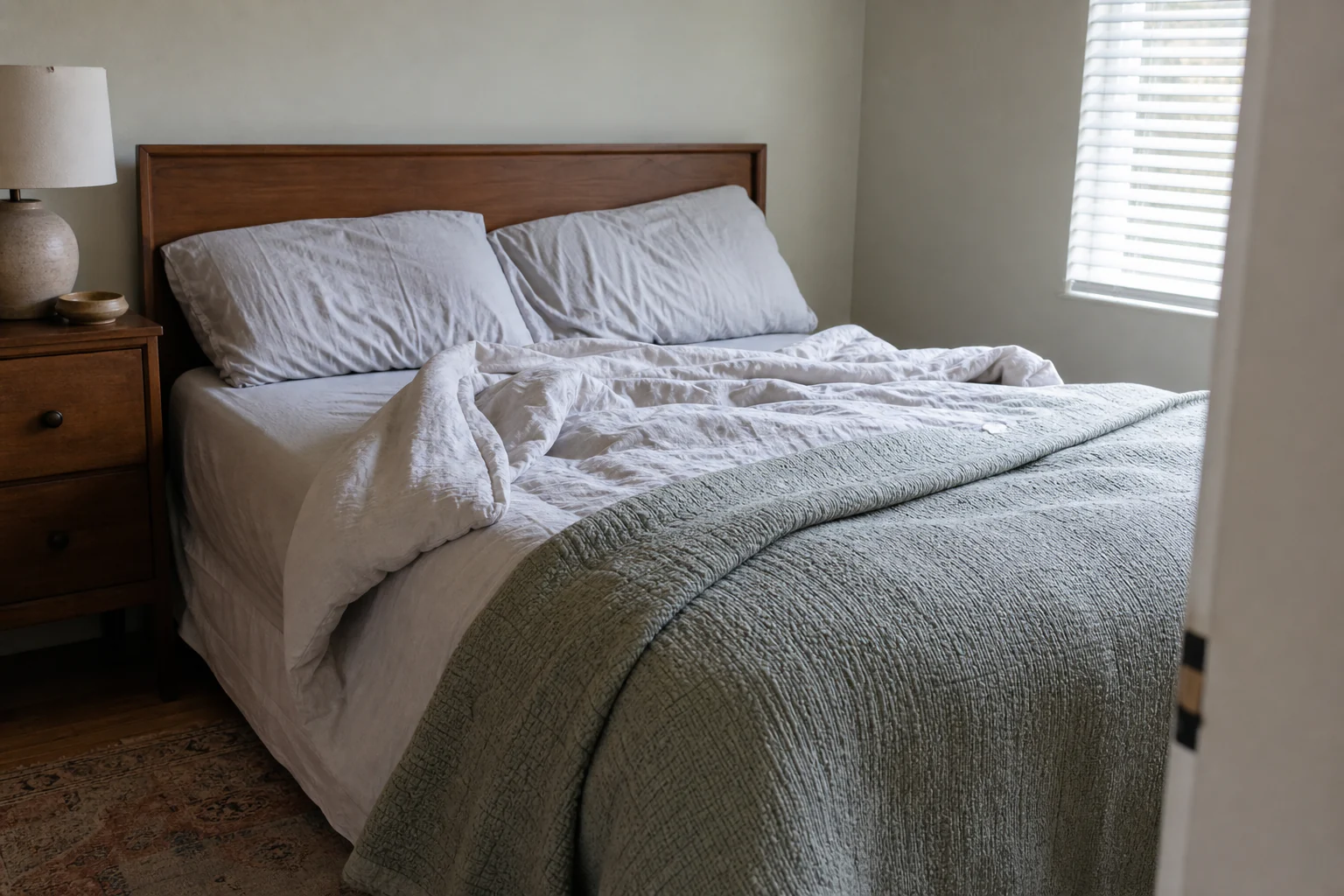
Visual production note. The scene images in this guide are original AI-assisted editorial visuals, reviewed by Dealsmaster. They illustrate plausible bedside routines; they do not show a reader, medical-device setup, electrical inspection or product test.
Sources and boundaries
- U.S. Fire Administration: sample fire-safety releases — states that extension cords are temporary-use products, should remain out of foot traffic and should not run under rugs.
- U.S. Fire Administration: appliance and electrical fire safety — major-appliance and damaged/pinched-cord boundaries.
- U.S. CPSC: extension cords — product definition and observable safety characteristics; not permission for permanent wiring.
- U.S. CPSC: Anchor It — top-heavy furniture and child tip-over boundary.
Scope: This guide gives no medical-device, clinical, electrical, mounting or accessibility-compliance advice. Exact manufacturer and clinician instructions govern medical or powered equipment. Exact product, property and applicable local requirements govern furniture, wall and electrical decisions.
How this guide was made
Night Shift is an AI-assisted editorial voice; this exact version was reviewed by Dealsmaster on 2026-07-30. The desk name describes a writing framework, not a person, credential, household, product test or firsthand experience.