Fit Studio · a room-first buying guide
A headboard can match the mattress width and still be wrong for the room. Approve it against four physical interfaces before you buy, build or mount anything.
The headboard looked right on the product page. Its listed width matched the bed. Then real life arrived: the left edge clipped the curtain, the useful part disappeared behind three normal pillows, and the vacuum head could not reach the strip behind it. None of those problems appeared in the mattress-size menu.
The missing measurement was not another number. It was context. A headboard meets a wall with prior commitments, a bed with a specific connection, a pillow stack that changes its visible height, and a cleaning routine that has to reach the unphotographed side. Think of those four meetings as passport control. A beautiful object is allowed into the room only when all four stamps are clear.
The mattress label is not a room measurement
“Queen,” “king” or “double” helps identify a compatible product range. It does not tell you where a curtain falls, how far a skirting board projects, whether a frame accepts brackets, how high your pillows sit or who can move the bed to clean. Even mattress and frame dimensions vary by market and maker. Start with the actual room and actual assembled bed.
This article gives you a fitting method, not a mounting method. Exact product instructions, wall construction, the bed maker’s compatibility information, property permission and applicable local requirements govern any attachment. If moving the bed or reaching the wall is difficult, use a helper or qualified installer rather than turning the test into a strain.
Passport stamp 1
The wall has prior commitments
Pull the bed forward only if you can do so safely. Otherwise photograph around it. Mark the window opening, curtain stack, outlets, switches, wall lights, cables, skirting or baseboard, vents, controls, picture rails, sloped ceiling and any panel that needs access. Then mark stains, peeling, softness, odour or recurring damp as conditions to resolve—not imperfections for a headboard to hide.
A social photograph often crops out the awkward information. Your passport keeps it in frame. Open and close the curtain fully. Operate the switch from the position in which it is actually used. Note whether the skirting prevents a floor-standing object from sitting as the product expects. Do not reroute a cable, cover a vent or decide that a panel is obsolete because it disrupts the composition.
For the same reason, stop at an unknown wall rather than borrowing a fastener from a tutorial. The site-wide measure, test and safety gate helps you route an unknown before opening, drilling or cutting. The passport can say “scale approved; installation unresolved.” That is a successful result.
Passport stamp 2
Name the connection—do not improvise a hybrid
A headboard is not one product category with interchangeable hardware. It may connect to compatible points on a bed frame, mount independently to a verified wall system, form part of a complete bed, stand on the floor with the restraint specified by its maker, or exist only as a visual wall treatment. Name which one you are evaluating before discussing colour or shape.
Bed-mounted
Compatibility depends on the actual frame, hole pattern, supplied hardware and maker’s instructions. “Same mattress size” does not prove a connection.
Wall-mounted
The wall system, product load, bracket geometry, hidden services and permitted installation all require specific verification.
Floor-standing
Floor contact does not automatically make a piece stable. Use it only in the manner and with the restraint its manufacturer specifies.
Visual treatment
Paint, paper or lightweight decorative treatment can supply a backdrop without pretending to provide back support. Surface and removal limits still apply.
Do not combine a bed bracket, improvised spacer and wall hook because each seems nearly right. A mixed connection changes how the object moves and carries force. It also makes later cleaning or bed movement harder to predict. Ask the seller or maker for the exact assembled dimensions, compatibility, supplied restraint, care instructions and installation document before purchase.
CPSC’s Anchor It campaign is relevant where top-heavy furniture can tip—especially where children may climb—and it tells consumers to follow manufacturer instructions. It does not choose a headboard fastener or declare that every headboard uses the same anchoring method. Keep that boundary in the buying conversation.
Ask for the boring documents before the exciting fabric
A useful listing should survive questions that do not fit in a swatch selector. Save the answers with the passport; a phone conversation remembered later is not a specification.
- What are the complete assembled dimensions? Include legs, brackets, wings, trim, curves and any part that projects behind the bed—not only the padded face.
- How is this exact model intended to connect? Request the current installation and assembly document. Ask which parts are supplied and which bed or wall conditions must be confirmed separately.
- What is the packaged size? A product can fit the finished wall and still fail the delivery turn, stair, lift or doorway. Packaging may be larger than the assembled piece.
- What care does the maker permit? “Spot clean” is incomplete unless the product documentation explains suitable methods and exclusions for the actual cover or finish.
- What happens if the frame changes? If an adjustable base, new frame or different mattress is planned, do not assume the relationship remains compatible. Ask both relevant makers.
- What is the return condition? A made-to-order, assembled or wall-mounted product may have different return limits. Know them before a test becomes irreversible.
Do not ask a retailer to approve your wall from a photograph. The goal is to gather product facts, then give property questions to the person qualified and authorized to answer them.
Passport stamp 3
Dress the bed before measuring height
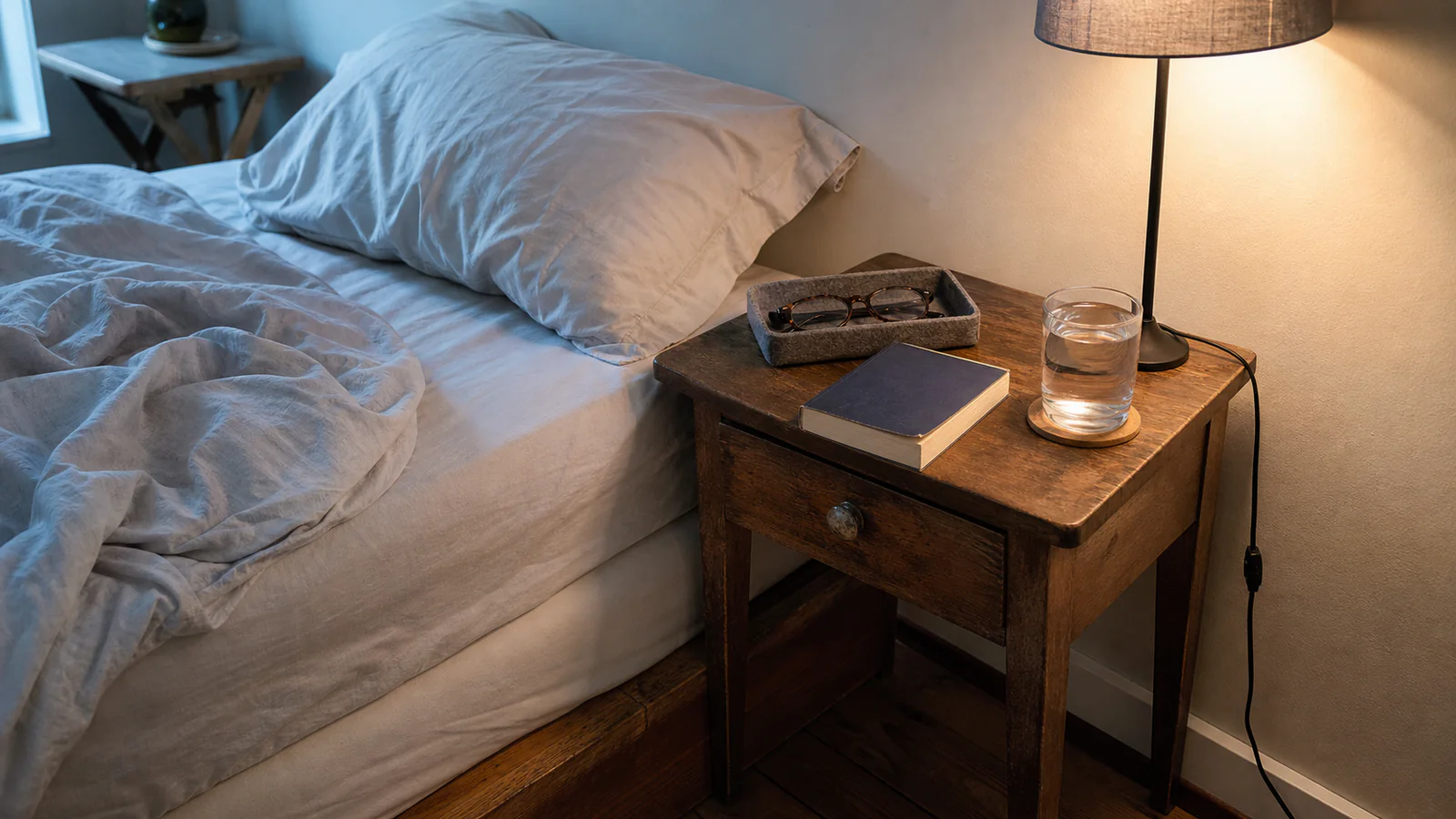
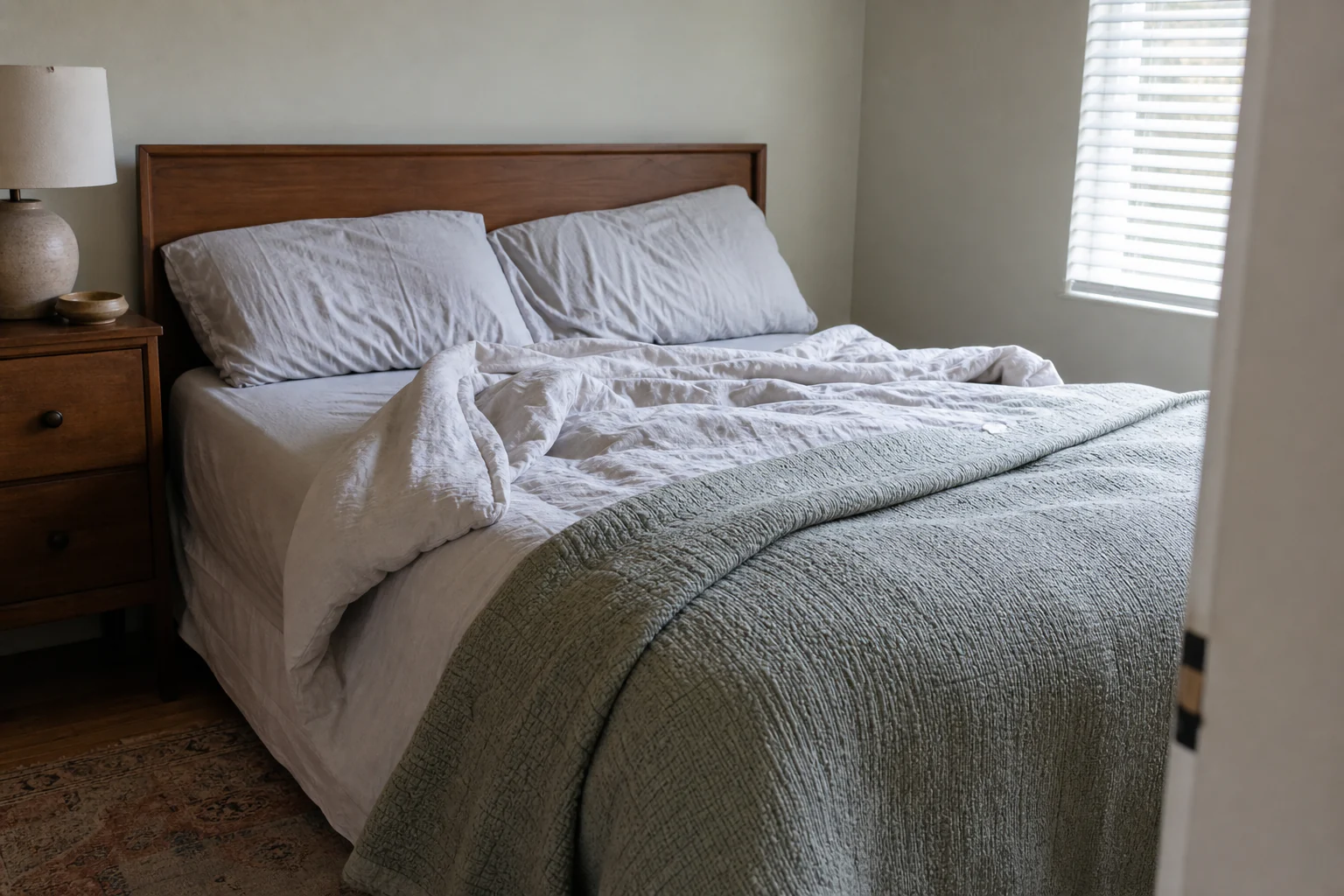
Now make the bed the way it exists at 10 p.m., not the way it appears in a shop photograph. Include sleeping pillows, reading pillows, the cushion that migrates to a chair, and any protector or topper that changes the mattress line. Sit in the usual reading position. Lie down. Reach the wall light or switch if one is part of the routine.
Pillow-stack profile
The useful question is not “How tall should a headboard be?” It is “What remains visible, comfortable and operable behind this dressed bed?” Mark the normal pillow line, seated shoulder/head contact, controls and any gap into which pillows could fall.
If the pillow combination itself is still changing, measure against the layers real sleepers use and can realistically launder before approving the headboard height.
Press gently against the paper outline or a non-installed sample only if it is stable and intended for contact. Notice where a hard top rail, button, seam or open weave would meet the body. This is not a medical or sleep-quality test; it is a plain fit observation. A soft-looking product photograph does not establish comfort, and an upholstery label does not tell you how it feels behind your pillow arrangement.
Check visibility from the doorway and from the seated position. A very tall headboard may dominate a low room; a low one may vanish behind pillows or become an uncomfortable ledge. Neither is universally wrong. The passport records what happens in this room.
Passport stamp 4
Account for the unphotographed strip
Headboard photographs are almost always frontal. Dust approaches from every direction. Before buying, decide how the front, top, seams, openings, back, wall and floor edge will be reached. Read the material-care instructions. Identify the tool that fits and the person who can use it without unsafe stretching or moving a heavy bed alone.
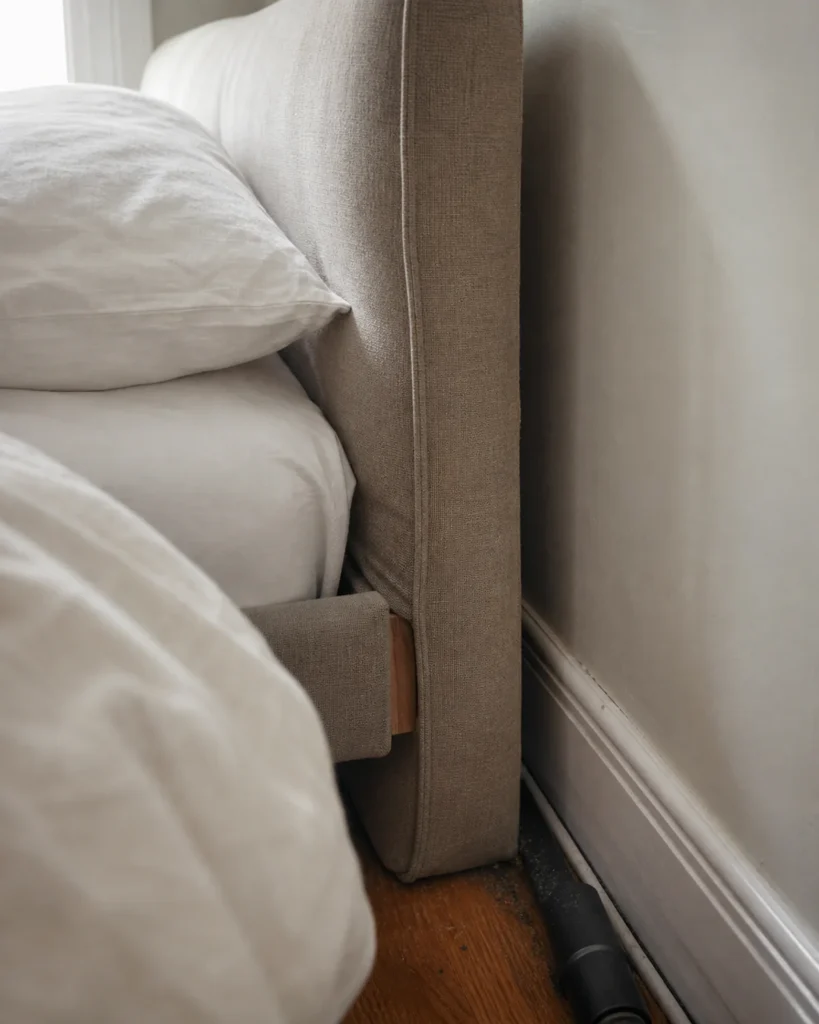
- Upholstery
- Notice: contact feel, seams, fabric-specific cleaning, dust and whether the normal pillow stack rubs the surface.
- Ask: What does the care label permit, and can the back/top be reached?
- Wood or metal
- Notice: hard edges, projections, weight, finish care and how the form meets the pillows.
- Ask: Which connection and restraint does this exact product require?
- Cane or openwork
- Notice: openings, snag potential, dust paths and construction quality.
- Ask: Can the weave be cleaned without moving the entire bed?
- Wall treatment
- Notice: surface preparation, reversibility and the absence of physical back support.
- Ask: What does the finish maker allow on this verified surface?
Run the maintenance motion before approving the texture
Place the actual cleaning tool beside the paper outline. Can its head reach the floor edge without levering against the wall? Can a lint tool follow an upholstered seam without the bedside table blocking the hand? Can open weave be approached from both sides, or would the back become an unreachable dust screen?
Then model the laundry routine. Strip the fitted sheet and remake the bed while the outline is in place. Notice whether knuckles meet a hard wing, whether the mattress must be dragged away from a connection, and whether pillows snag on an opening. The headboard is not being rejected because cleaning takes effort; it is being judged against the effort this household can repeat. If access depends on one person shifting a heavy bed alone, write “maintenance route unresolved” and choose help, a qualified service route or a different product.
Worked case: a queen bed and an off-centre window
Imagine a 152 cm / 60 in mattress on a freestanding frame. The bed sits where the room’s walking space works, but the window is closer to the left corner. The curtain stacks toward the bed. An outlet and wall light occupy the right side. These dimensions describe a hypothetical room, not a universal standard.
curtain moves here
bed axis
and dressed pillows
outlet + light
Three viable directions
- A bed-width upholstered model connected only if the actual frame and product are compatible. Its edge stops before the curtain’s operating area.
- A visual field centred on the bed using an appropriate paint or wall finish. It supplies scale and colour without introducing a heavy object or claiming back support.
- A pair of smaller panels composed around the bed axis, installed only after wall construction, product method, hidden services and permission are verified.
Keep the window’s asymmetry. Compose the bed around it while every fixed feature continues to work. Before widening anything, protect the bedside walking route and the first clear step. A wider headboard that steals useful floor or curtain operation has not solved the room.
Build the reversible mock-up at full size
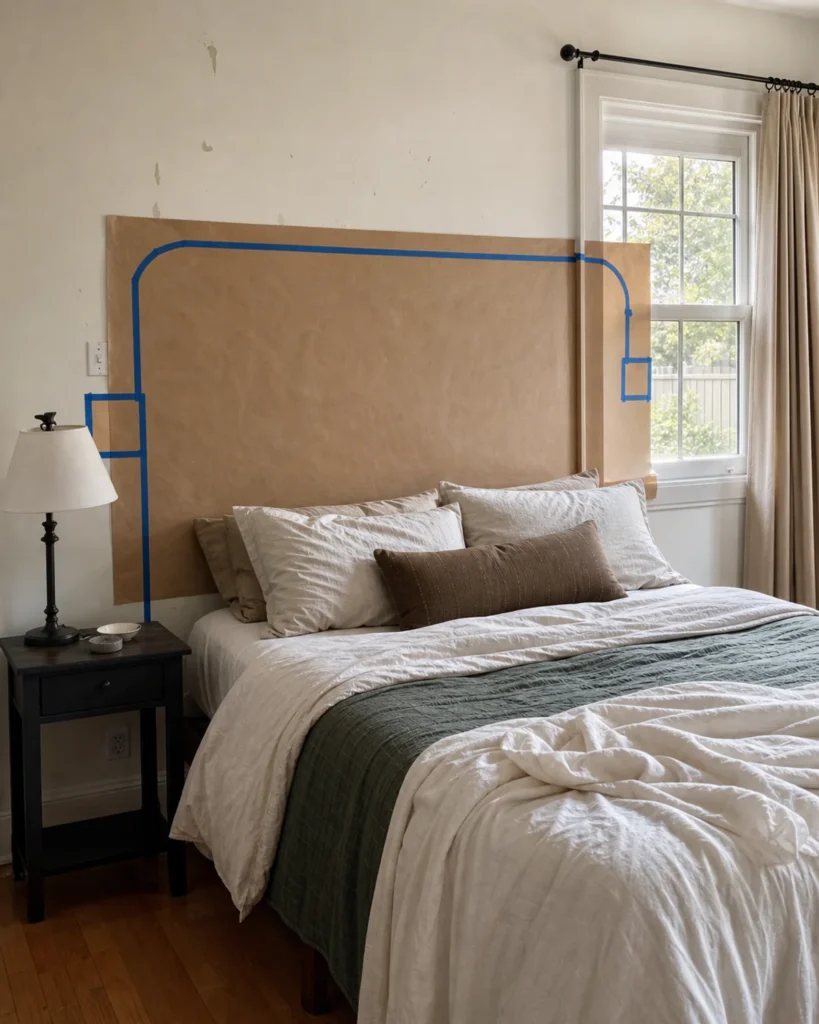
Scale surprises are expensive because small samples are polite. Build the complete visible outline using paper or flattened clean cardboard. Hold it without adhesive, or use only a method confirmed suitable for the surface. Mark connection points separately so nobody mistakes the mock-up for installation approval.
- Daylight photograph: make the bed normally, open the curtain to its usual position and photograph from the doorway. Include floor and ceiling so the scale can be judged.
- Night photograph: arrange the reading pillows, switch on the normal bedside light and photograph from the same position. Check glare, reach and how much of the outline remains visible.
- Two-night routine: make the bed, open the window or curtain, use the switches, place the book and clean the floor. Record every collision or awkward reach.
- Remove the outline: inspect the surface. If the temporary method marked or lifted anything, stop and address that before any finish or installation.
Keep a failure log, not a vague impression
Write the moment, state and conflict in one line: “Curtain catches the left outline when fully open”; “reading pillow hides all but 18 cm of the visible panel”; “floor tool cannot turn behind right leg”; “switch reachable only after moving pillow.” Avoid verdicts such as “too big” until the specific collision is named.
Specific failures produce better alternatives. A curtain conflict may shrink one wing rather than the whole headboard. A hidden design may need a different visible height, not a taller product overall. A cleaning conflict may favour a bed-mounted piece that moves as intended with the frame, or a visual treatment with no furniture back. The log also prevents one successful daylight photograph from overruling an awkward night routine.
Review the log with every household member who uses the bed. One person may sit upright against several pillows; another may use none. One side may need a clearer route or a reachable control. The finished composition can be asymmetrical when the routines are. Fit is not a vote for visual sameness.
If wall lights, outlets and bedside furniture are competing for the same narrow zone, use the last-five-minutes nightstand test to map what your hand and powered items actually need. Fit the two pages together once; do not let each object win the same patch of wall independently.
Printable headboard fit passport
Complete this before ordering. A blank or uncertain answer is a stop, not a cue to guess.
Give the headboard one visual job
Once the passport passes, the headboard can carry one clear visual responsibility: introduce a tactile field, repeat a curve already in the room, establish the darkest value, or provide a quiet background for patterned bedding. It does not also need storage, charging, display shelves, lights and art. Every added function creates another connection, cable, projection or cleaning edge.
If you want the bed to lead the palette, pull one colour relationship from a textile or material you already love. The headboard can support that relationship without matching every fabric. Fit gives the room calm first; styling makes that calm visible.
Your approval is two photographs
Do not approve the product from a cropped listing. Photograph the full-size outline with the bed made in daylight, then photograph it again with the real reading setup at night. If the wall, connection, pillows and cleaning route all remain clear—and every fixed feature works in both—the fit passport can move to product-specific installation review.
Visual production note. The scene images in this guide are original AI-assisted editorial visuals, reviewed and composed by Dealsmaster. They illustrate plausible fit conditions; they do not document a reader’s home, a product test or a completed installation.
Sources and boundaries
- U.S. EPA: Renovation, Repair and Painting Program for consumers — pre-1978 painted-surface and disturbance boundary; other countries have their own requirements.
- U.S. CPSC: Anchor It — child tip-over prevention for furniture and the instruction to follow the manufacturer’s securing directions; not a headboard fastener guide.
Scope: This guide does not determine wall construction, structural capacity, hidden services, product compatibility, fire clearance, material safety or code compliance. Exact product instructions, property conditions, permissions and applicable local requirements control.
How this guide was made
Fit Studio is an AI-assisted editorial voice; this exact version was reviewed by Dealsmaster on 2026-07-30. The desk name describes a writing framework, not a person, credential, household, product test or firsthand experience.