A stoplight audit before the moodboard
Do not decorate over the information the basement is giving you.
Red means stop, yellow means observe, and green means a reversible layer may begin. The order is the budget strategy.
- 01Red
- 02Yellow
- 03Green
- 04Review
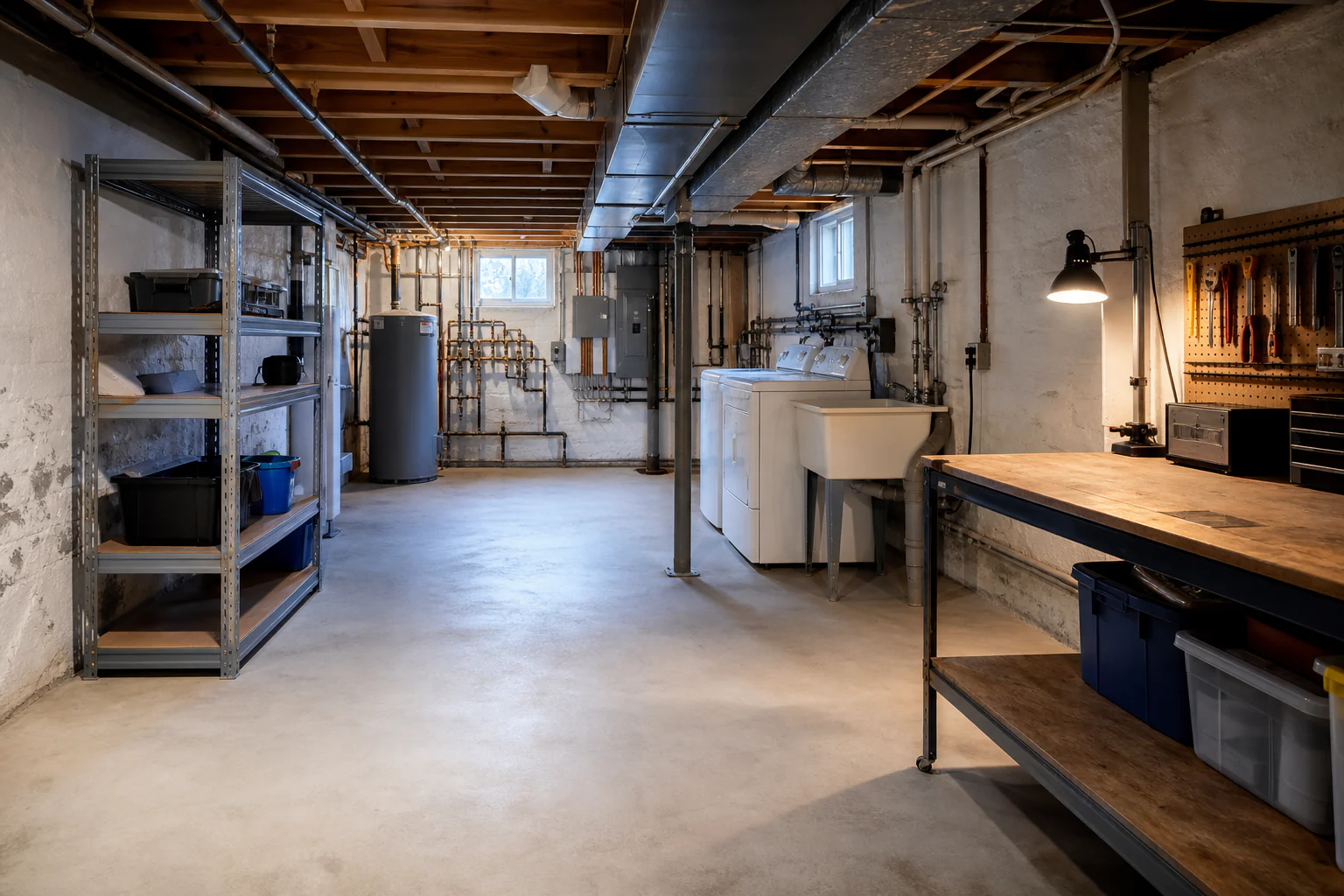
An unfinished basement can look like inexpensive square metres waiting for paint. It can also be the lowest point for water, soil gases, combustion equipment and every pipe the rest of the house would rather forget.
The budget mistake is not always spending too much. It is spending in the wrong order: rugs before moisture, walls before access, a play area before egress, storage before the leak pattern is understood.
Use a stoplight.
- Red: stop using the area for the proposed purpose and get qualified help.
- Yellow: stabilize, monitor and keep changes reversible.
- Green: improve comfort and function without concealing the building.
The goal is not to make an unfinished basement impersonate a finished one. The goal is to make the safest honest version of the space you have.
Red: conditions décor must not cover
Basement stoplight
Let the condition decide the next move
- Red · stopActive water, musty odour, visible growth, damaged wiring, blocked egress, or combustion concern
- Yellow · observeOld stain, seasonal humidity, unknown crack, cold surface, or incomplete service history
- Green · reversibleDry, understood, ventilated, accessible, and suitable for the intended non-habitable use
Pause the project for:
- active water entry or recurring puddles;
- visible widespread mould or strong persistent musty odour;
- damaged, sagging or questionable structure;
- exposed or damaged wiring;
- signs of sewer backup;
- suspect asbestos- or lead-containing materials likely to be disturbed;
- combustion equipment concerns, soot or suspected backdrafting;
- missing safe exit for the intended occupancy;
- flood damage not professionally assessed where needed;
- alarms, panels, valves or equipment that would be enclosed or obstructed.
EPA advises correcting moisture problems before converting a basement to living space. It also recommends radon testing at the lowest lived-in level and notes that mitigation is often easier before finishing.
Do not sample or disturb suspected hazardous materials casually. Building age, country and product history change the risk. Use the relevant local environmental and building authorities.
If floodwater is present, the problem is not a decorating article. FEMA warns that pumping a flooded basement too quickly while surrounding soil is saturated can create dangerous pressure on walls and floors. Follow emergency and professional guidance.
Yellow: make an evidence ledger
Evidence ledger
Record change instead of trusting memory
| Date | Weather | Place | What changed |
|---|---|---|---|
| Week 1 | Dry | North corner | No odour; stain outline marked |
| Week 2 | Heavy rain | North corner | Lower edge darkened |
| Week 3 | Dry | Dehumidifier area | Condensate amount recorded |
For four weeks—or through relevant weather if practical—record:
- date and weather;
- smell;
- visible dampness;
- condensation;
- floor/wall temperature if measured with an ordinary instrument;
- dehumidifier collection, if one is already used appropriately;
- where stored cardboard softens or stains;
- drain or sump behaviour;
- equipment noises or changes.
Photograph the same corners from the same position. Do not create fake certainty from one dry afternoon.
Draw a plan showing:
- water entry clues;
- drains and sump;
- electrical panel and shut-offs;
- furnace, boiler, water heater or other equipment;
- windows and exits;
- low ducts and head-height changes;
- posts and structural walls;
- areas that must remain accessible.
This is the building map. Furniture fits around it, not over it.
Green: choose an unfinished purpose
Choose one honest purpose
An unfinished room works better with a narrow brief
- WorkshopBright task light, tool route, sweepable surfaces
- ExerciseClear headroom, stable floor, ventilation
- Laundry supportSorting, drying, service access
- Seasonal storageRaised, closed, inspectable
- Occasional hobbyPortable comfort, no claim of finished-room performance
Some uses ask less of the basement than others.
Workshop or making space
Needs task light, stable work surfaces, tool storage, dust control appropriate to the work and clear equipment boundaries.
Exercise space
Needs head clearance, ventilation, a stable non-slip surface and enough fall/route space for the actual movement. Heavy equipment loads may need structural review.
Laundry and household support
Needs access to machines, drains, vents, valves and service paths. Do not build storage that hides lint, leaks or maintenance.
Seasonal storage
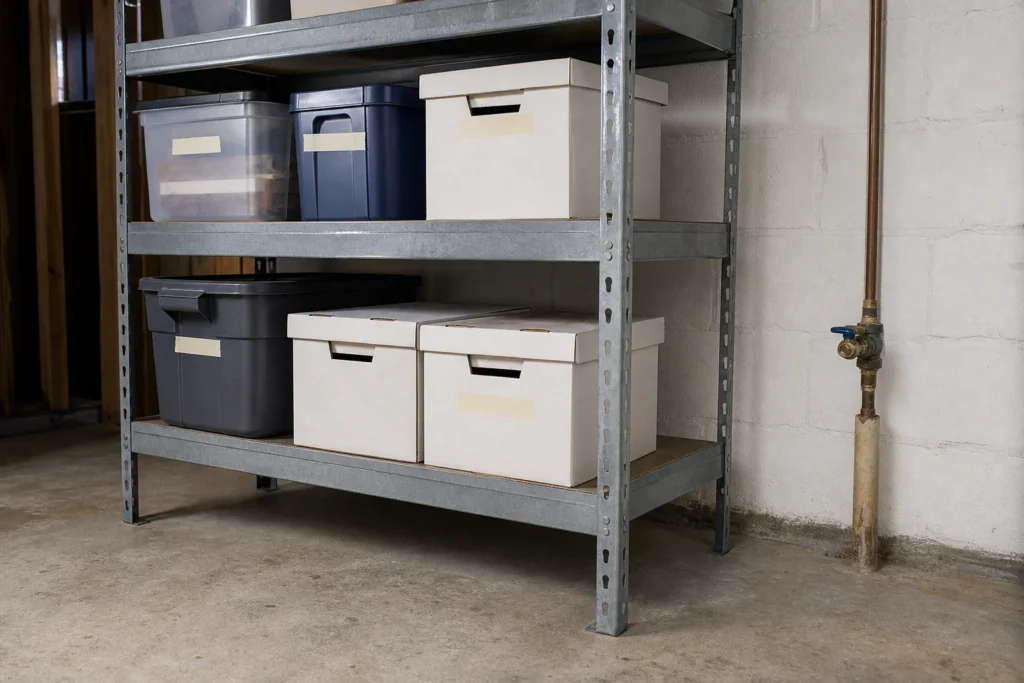
Needs raised, inspectable storage; moisture-aware containers; labels visible from the aisle; and no blockage of equipment or exits.
Occasional hobby or hangout
Needs a candid limit. “Occasional” must not quietly become sleeping accommodation without meeting the relevant requirements for safety, egress, ventilation and occupancy.
Children should not be assigned an unsupervised basement play area merely because toys fit there. Sightlines, egress, moisture, cords, stairs, equipment and local safety requirements matter.
Spend in six reversible layers
Six reversible layers
Spend from evidence outward
- 1 · DiagnoseFind and repair the cause
- 2 · CleanRemove grime without concealing surfaces
- 3 · RouteProtect exits, utilities, and movement
- 4 · LightIlluminate the jobs and inspection points
- 5 · RaiseUse inspectable furniture and storage
- 6 · ComfortAdd washable, removable warmth
1. Diagnose and repair
Leaks, drainage, radon, combustion, electrical, structure and hazards precede style. Some solutions belong outside the basement: gutters, grading and drainage may influence water entry.
2. Clean without concealing
Remove rubbish and damaged porous materials according to local guidance. EPA emphasizes moisture control; cleaning mould without fixing water does not solve the cause.
3. Improve the route
Create a clear aisle to panels, shut-offs, machines, exits and storage. Mark low overhead obstacles visibly. Improve stair lighting and handrails through qualified, code-compliant work where needed.
4. Light the jobs
Use approved, correctly installed lighting. Keep temporary cords out of routes and damp areas. A qualified electrician should handle new fixed wiring.
Layering still helps: general visibility, task light at a bench or laundry surface, and limited atmosphere where safe. Do not create dark decorative corners that hide moisture or steps.
5. Add raised, inspectable furniture
Prefer shelves and furniture that allow air movement and inspection. Keep appropriate clearance around equipment according to manufacturers and local codes.
Avoid pressing upholstered furniture against cool foundation walls. Avoid storing valuables directly on the floor where water has a history.
6. Add removable comfort
A washable chair cover, a cleanable floor mat suitable for the conditions, a sound-absorbing panel installed safely or a portable screen can change the feel without burying evidence.
Do not install carpet over a slab with unresolved moisture. EPA specifically cautions about carpet on cool or damp basement slabs because moisture can become trapped.
A budget ladder
Budget ladder
A higher budget should buy certainty before finishes
- Level 0Observe and record
- Level 1Stabilise known problems
- Level 2Make one job work
- Level 3Improve reversible comfort
- Level 4Finish properly with qualified advice and permits where required
Level 0 — Observe
Cost: time, labels and existing light.
Result: building map, evidence ledger, stop conditions.
Level 1 — Stabilize
Cost: problem-dependent.
Result: qualified diagnosis and repairs; alarms/testing; clear access.
Level 2 — Make one job work
Cost: one stable surface, approved light, raised storage, cleaning.
Result: laundry folding, tools or exercise has a defined footprint.
Level 3 — Improve comfort
Cost: reversible furniture, acoustic/visual layer, better task setup.
Result: longer, more pleasant use without pretending the shell is finished.
Level 4 — Finish properly
Cost: design, permits, qualified trades and durable assemblies appropriate to moisture, energy, egress and services.
Result: only after the building and intended occupancy support it.
Cheap finishes applied early can make Level 4 more expensive by hiding damage and creating demolition.
A constructed example: 5 × 6 metres, occasional damp corner
Constructed basement example
The damp corner stays visible
- Wrong orderA rug, fabric screen, and low boxes cover the evidence.
- Useful orderThe corner remains clear; storage is raised; the hobby zone moves to the reliably dry side.
The owner wants a media room. The basement has a water heater, laundry machines, two small windows and a corner that smells musty after heavy rain.
The red/yellow/green audit changes the plan:
- media-room finishing pauses;
- qualified moisture and radon assessment comes first;
- cardboard storage leaves the damp corner;
- a clear service aisle is marked;
- laundry receives a stable folding table and proper task light;
- tools move to raised metal shelving with inspection space;
- one clean, dry, monitored area receives a portable chair and hobby table;
- no upholstered suite, carpet or concealed wall is added.
The basement becomes more useful without making a claim the evidence cannot support.
What “cozy” should mean here
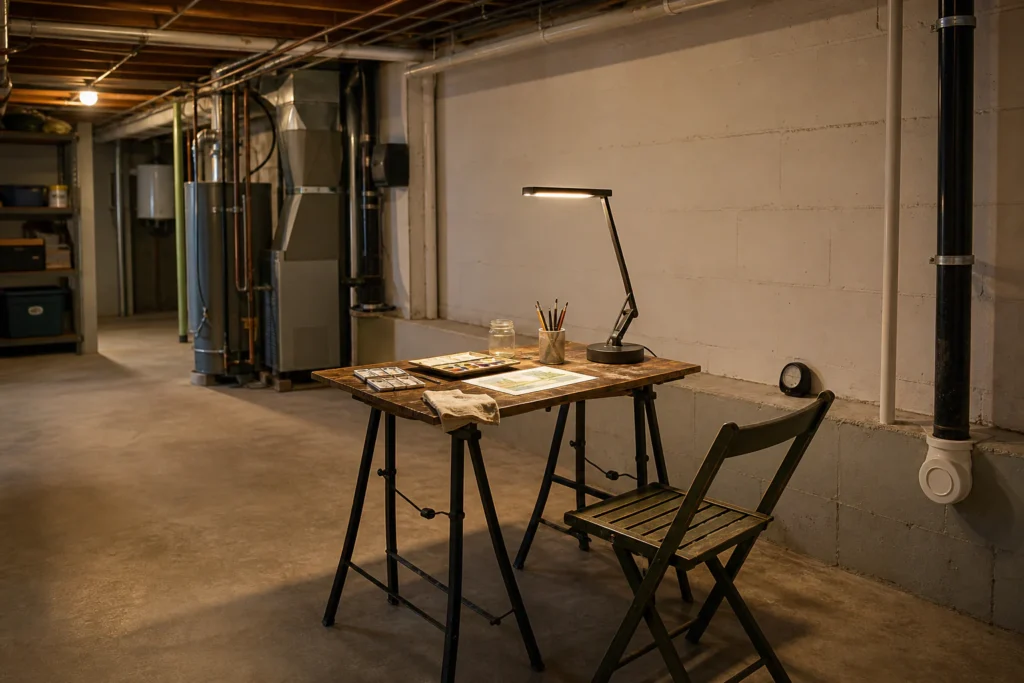
In a basement, cozy should not mean covered.
It can mean:
- even, low-glare light;
- warm colour on a safe, suitable surface;
- a chair not facing mechanical clutter;
- reduced echo through appropriate removable materials;
- one organised activity ready to begin;
- a route that feels obvious;
- visible care for the building.
The most reassuring room is the one that is not hiding a reason to worry.
Do not borrow the language of a finished room
Calling a basement corner a bedroom, office, or playroom can imply performance that the space may not provide. Egress, ceiling height, ventilation, heating, electrical work, moisture control, fire separation and occupancy rules vary by location and use. Treat the current area according to what it lawfully and safely is, and get local advice before converting it to habitable space.
This is not a reason to make an unfinished basement joyless. It is a reason to make the use precise. “A one-hour repair bench while an adult is present” is a clearer brief than “family room.” “Raised seasonal storage with a monthly inspection route” produces better choices than “cozy storage den.”
Keep service labels, shutoffs, panels, drains and inspection edges visible. A decorative screen that takes three minutes to move may still be too much during an urgent problem. Test access while carrying a flashlight and wearing the shoes you would realistically have on.
Give stored things a basement suitability test
Ask four questions before moving an item downstairs: would dampness ruin it, would pests be attracted to it, can one person lift it safely, and can its container be inspected without unpacking the shelf? Sentimental paper, irreplaceable photographs, important documents, upholstered pieces and electronics may deserve a different environment.
Put the heaviest stable containers at a safe reachable level rather than overhead. Keep floors, wall junctions and the underside of the lowest shelf visible. Avoid packing a rack so tightly that a new stain, droppings, corrosion or condensation becomes invisible.
Review the zone after the wettest local season, not only after a dry week. Compare the ledger photographs. Smell the room after it has been closed. Look behind—not merely at—the storage. A reversible plan earns its value by making this review easy.
Useful next action
Make the building map before the wish list. Mark water, equipment, access, exits and low head-height points in red. If any red condition affects the planned use, pause the décor budget.
About the visuals in this guide
These are original Dealsmaster editorial illustrations produced with AI assistance for explanation and inspiration. They do not document a real household, tested installation, reader result, or professional inspection.
Sources and limits
Useful advice should show its working
Material claims were checked against the primary guidance below. Dealsmaster dimensions and layouts are editorial planning starting points, not universal codes, professional assessments, or product instructions. Local rules, tenancy terms, building conditions, user needs, and manufacturer guidance control.
- U.S. EPA — Remodeling Your Home and Indoor Air QualityBasement moisture, radon, ventilation, and combustion-appliance context.
- U.S. EPA — Mold CleanupGeneral and post-flood mold-cleanup pathways.
Disclosure: This guide contains no affiliate links, sponsorship, or claimed product testing. Constructed examples are planning examples, not reported Dealsmaster households.