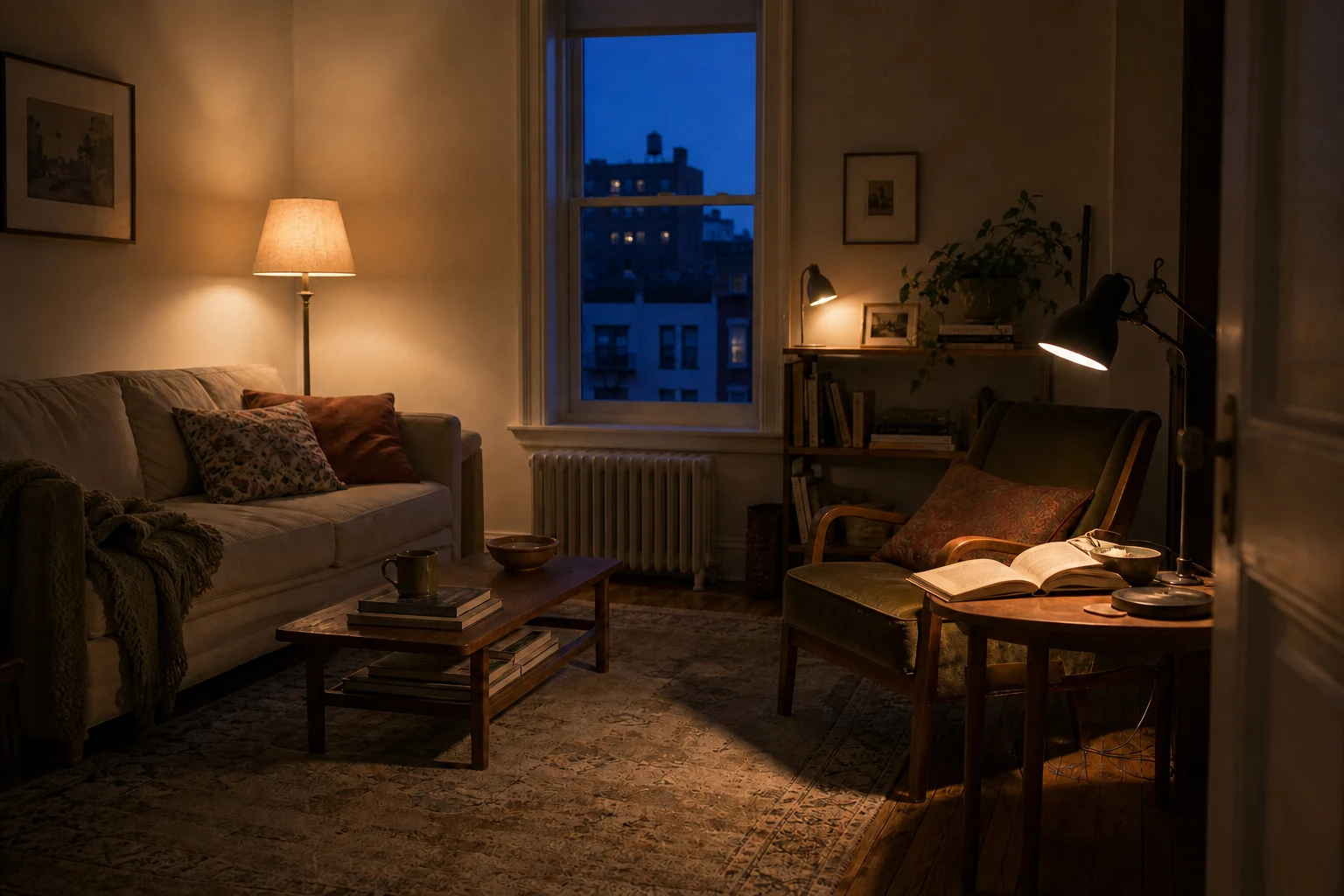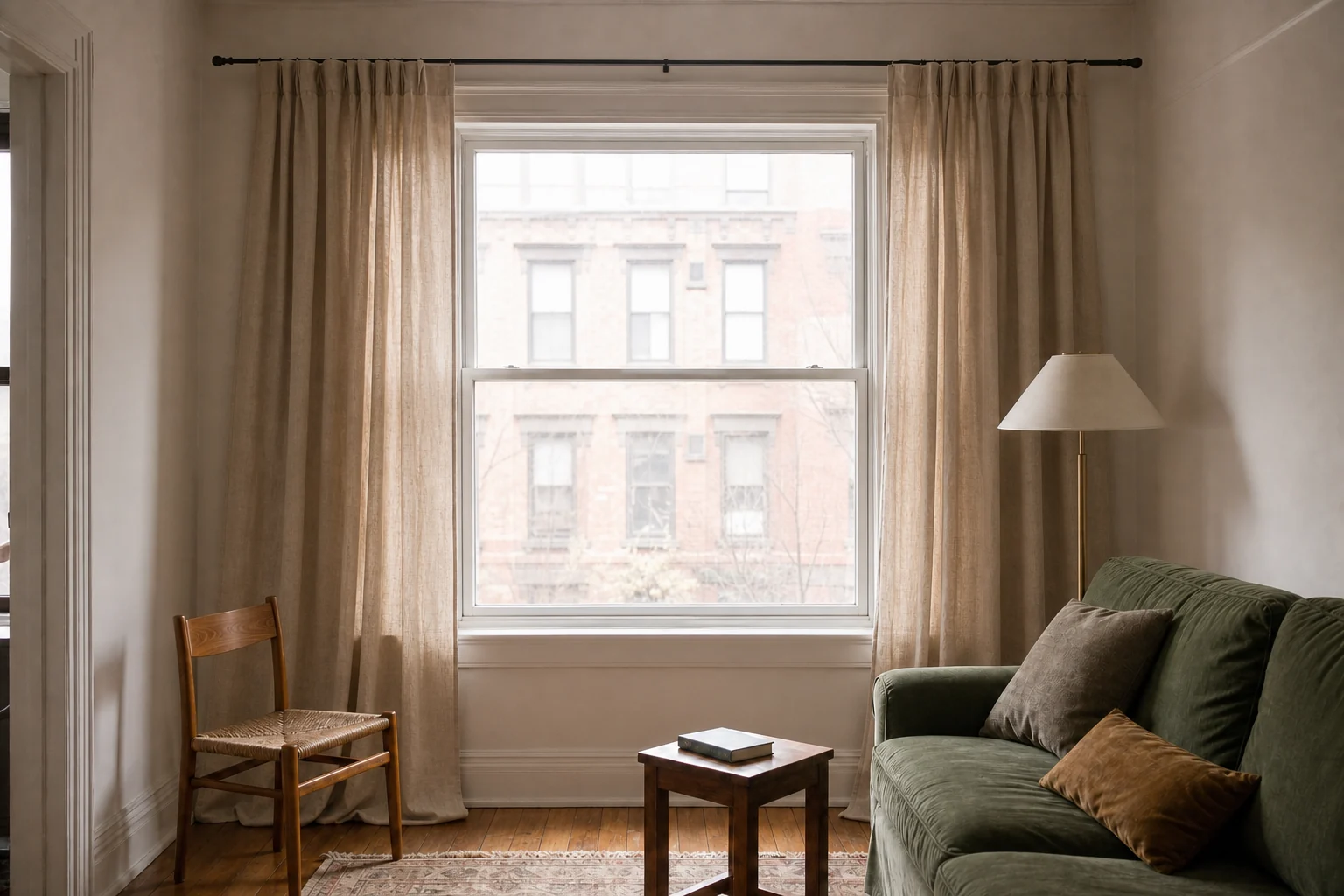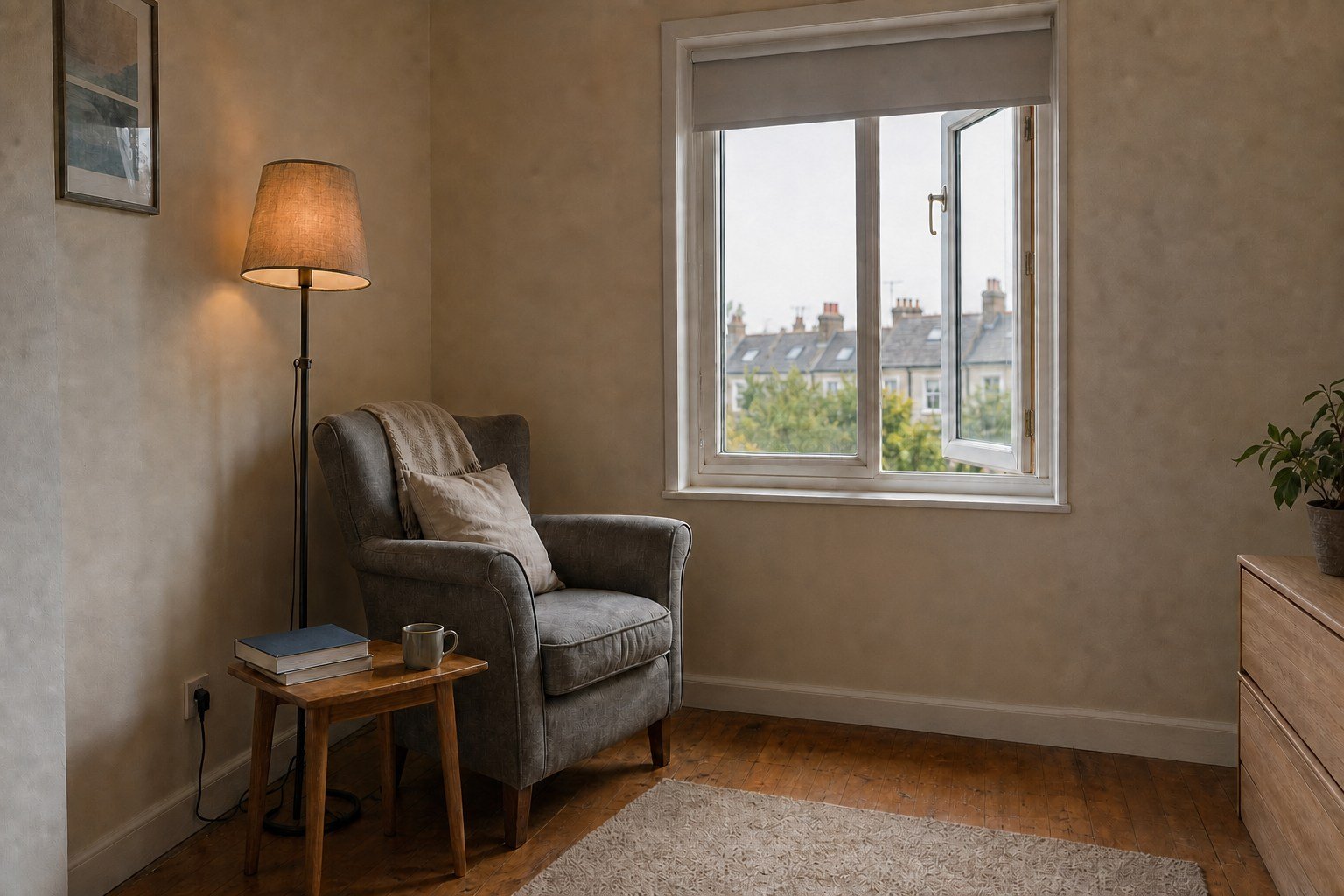
A window reading nook needs four things: a seat that does not obstruct the room, a stable place for the objects in your hands, light that works after sunset, and a window that can still do every one of its jobs. Carpentry is optional. A seven-day trial is not.
Start with the window, not the chair. Open it. Close it. Draw the covering. Reach the latch. Notice the hot, bright and exposed hours. Then borrow furniture from elsewhere in the home and live with the arrangement for a week before buying anything.
That order is less photogenic than ordering a bench on day one. It is also how you avoid creating a lovely little corner that blocks a casement, cooks beside a radiator or goes unused once the afternoon glare arrives.
First, a firm boundary where children can reach the window
This is an adult or general-use reading-place guide. It is not a plan for placing climbable furniture beside an openable window where a young child lives or visits.
The U.S. Consumer Product Safety Commission (CPSC) advises keeping furniture away from windows to discourage climbing. It also warns that insect screens do not prevent falls. A chair, bench, toy chest or low bookcase immediately beside an accessible window conflicts with that guidance. CPSC also says cordless window coverings are the safest option when young children are present and recommends moving furniture and toys away from windows and covering cords.
Do not improvise around that conflict by casually fixing the window shut. Guards, stops and opening limits have to suit the specific window and preserve any required emergency escape function. Requirements vary by building and location. If a child can access the proposed corner, put the reading chair on another wall and obtain appropriate local advice about the window itself.
The same caution applies when a child only visits occasionally. A piece of furniture does not become non-climbable because the room is normally used by adults.
Give the window its six-minute job interview
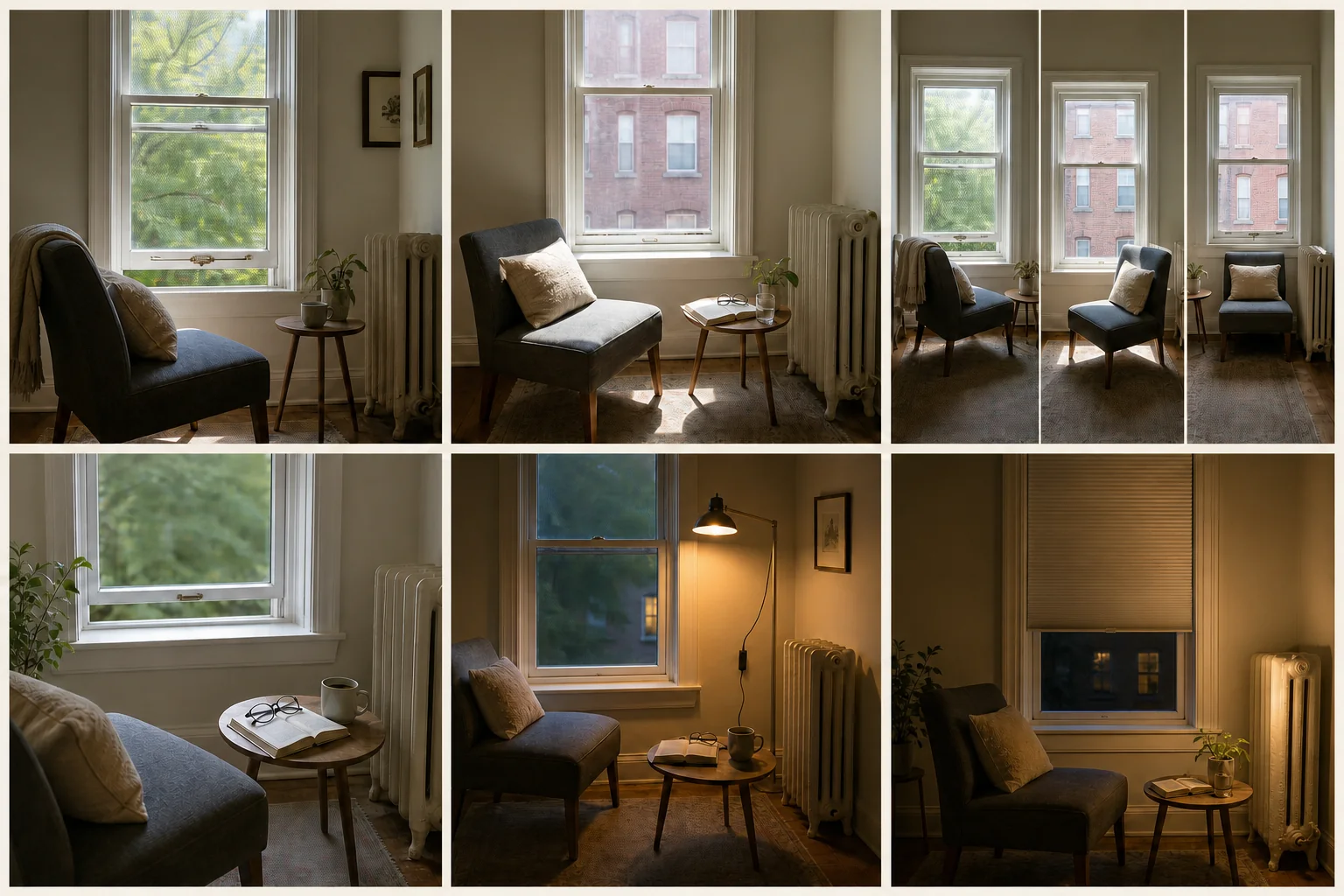
- 01Morning light
- 02Noon glare
- 03Three chair positions
- 04Clear sill + landing
- 05Evening page light
- 06Night privacy
Before measuring furniture, stand at the bare window and work through these six checks.
- Operate everything. Open every sash, latch, restrictor and covering through its full normal movement. Include any position needed for cleaning.
- Trace the escape route. Check the household fire plan. If the window is part of that plan—or you are unsure—keep its entire approach clear until local requirements are confirmed.
- Locate heat and air. Note radiators, floor registers, wall heaters and portable heaters. Use the appliance or building instructions for clearance and airflow, plus applicable local rules.
- Watch one full day of light. Check morning, midday and late afternoon. The pleasant 10 a.m. glow may become page glare or uncomfortable heat at 4 p.m.
- Run a night privacy test. Turn on the proposed reading lamp, close the covering, and look in from outside only where that is safe and lawful. A sheer that feels private by day may reverse after dark.
- Find a protected power route. A lamp lead should reach an approved outlet along the wall, without crossing the walking path, a rug, the window mechanism or a heat source.
If any check fails, move the nook sideways or choose another wall. A narrower chair does not make a blocked safety function acceptable.
Beside, under or away: there are three honest positions
The phrase “window nook” makes the space directly below the glass sound inevitable. It is only one of three options, and often not the best one.
Beside the window
This is the most adaptable arrangement. Place the chair to one side and turn it slightly toward the view. Put the table on the room side of the chair so a cup never has to balance on the sill. Let the lamp cable follow the wall.
It works when the sash misses the chair, the handle stays reachable, the route remains usable and any heat source keeps the clearance specified for that home and product.
Under the window
Use this position only after window movement, escape, heat and child access are resolved. A fixed pane in an adult-only room is not equivalent to a low opening sash in a shared family space.
A freestanding bench is still furniture. It can slide, tip, cover a heater, trap a curtain or become a climbing step. Do not let its built-in appearance persuade you that it has become architecture.
Away from the window
The adjacent wall can borrow the view and reflected daylight without asking the chair to live under the glass. Prefer this when the window is an exit, the only useful ventilation opening, above heat, or accessible to young children.
Here is the editorial rule that saves the most trouble: if the nook works only while the window stops working, the chair is in the wrong place.
A rented-room example: west light, a radiator and no permission to build
Picture a 2.2-metre window wall in a rented bedroom. A 1.4-metre casement opens inward on the left. A radiator occupies most of the wall below. The bed sits to the right, the wardrobe is opposite, and the only convenient outlet is on the short wall to the left. Late sun hits the glass; once the lamp is on, the street can see through an open sheer.
The first idea—a storage bench under the window—creates four new problems. It obstructs the radiator, conflicts with the casement, adds storage the room does not need, and becomes climbable furniture whenever a child visits.
So the test uses what the room already owns:
- a 70 × 75 cm armchair moves to the adjacent wall, outside the casement swing and heat area;
- the chair turns toward the view rather than facing the glass head-on;
- a stable 35 cm side table sits on the room side, clear of the wardrobe route;
- an existing shaded floor lamp reaches the outlet with its cable protected along the wall;
- the cordless shade and curtain are each moved through their full range to check that neither catches the lamp;
- two current books move to the table, while the main bookcase stays elsewhere.
The shade is lowered when direct late-afternoon sun reaches the page. At night, the closed shade passes the privacy check with the lamp on. The window handle, radiator and approach remain clear without resetting the furniture.
After a week, the useful evidence is not a first-day photograph. It is that the chair was chosen, the wardrobe opened normally and drinks landed on the table instead of the sill.
Use the Nook Go / Move / Stop test before spending
Three-position study
Beside, under, or away are three different agreements with the window.
Choose the position that preserves operation, comfort, and the room route.
- BesideBorrow the lightKeep latch and curtain path accessible.
- UnderUse the wallOnly where heat and window safety allow.
- AwayControl glareAim the chair toward the view, not into it.
“Move” is not a disappointing result. It is the tool protecting the room from a bad purchase.
| Check | Go | Move | Stop and resolve first |
|---|---|---|---|
| Window | Handle and full movement remain accessible | Shift the chair to a side wall | Furniture blocks normal or required operation |
| Escape | Approach and opening remain clear | Another position protects the route | A required exit is obstructed or casually restricted |
| Children | The arrangement is not accessible to young children | Put the reading place on another wall | Climbable furniture is proposed beside an accessible window |
| Heat | Product and local clearances are met | Shift seat, lamp or textiles | Furniture, books or fabric conflict with a heat source |
| Daylight | The page is readable without persistent direct glare | Turn the chair or operate the shade | Normal use remains uncomfortably hot or glaring |
| Privacy | The evening lamp-and-covering test works | Adjust position or covering | The room remains exposed and the covering cannot be changed |
| Power | The cable follows a protected wall route | Use a different approved outlet or position | The lead crosses a route, rug, heater or mechanism |
| Landing | A stable surface holds normal essentials | Borrow a different table | The sill or an unstable stack is the only landing place |
A chair moved half a metre can preserve the window, improve the light and still deliver the reading ritual. The name of the arrangement does not depend on its touching the glass.
Borrow the seat before choosing one
Move an existing chair into the proposed footprint for twenty minutes. It does not have to be beautiful or even especially comfortable. Its first job is to reveal scale and conflict.
Open the room door, wardrobe, drawer, window and covering. Sit while another person uses the route. Notice the small humiliations: a knee clipped by a table, a sideways shuffle around the chair back, a shade that cannot drop without grazing the lamp. Those are layout facts, not inconveniences to ignore until later.
Test the posture needed for the reading you actually do. Can you support a hardback or device, place your feet, change position, and stand without using an unstable table? There is no single medically correct reading-chair shape. Individual mobility, pain or access needs may call for specialist advice.
Measure the borrowed chair’s full external footprint, including arms, back angle and the space used while sitting down. Compare a future purchase with those numbers. “Compact” is marketing; width and depth are evidence.
If the chair is sharing an already tight bedroom, use Small Bedroom Layout Ideas That Protect Storage and Walking Space to map doors, drawers and walking routes before committing.
Add one landing surface with a real job
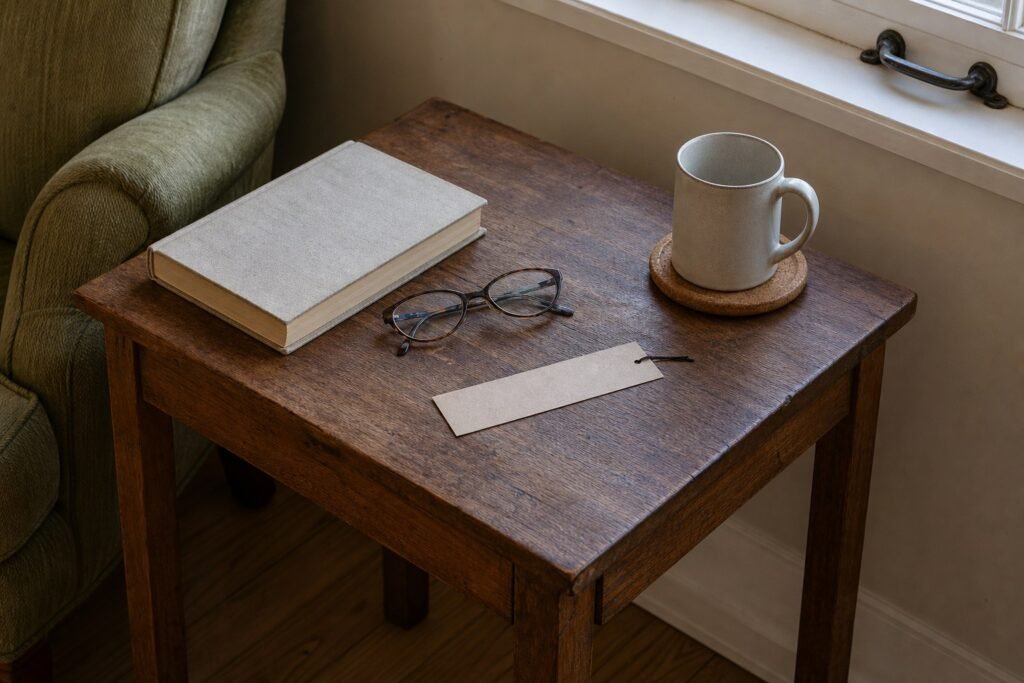
A reading corner unravels quickly when glasses, a bookmark and a cup have nowhere reliable to land. The sill is not automatically a table. It may need to stay clear for opening hardware, condensation checks, cleaning or a covering.
Borrow a table and test it with an empty mug, closed book, glasses and phone. All four feet should sit firmly. Nothing should balance at an edge, hide a heater control, obstruct the route or trap a cable. Sit down and stand up without leaning on it.
Storage is optional. A shelf packed with aspirational books may add visual weight without helping tonight’s reading. Keep the current one or two books nearby and store the rest where light and temperature are steadier. The Library of Congress recommends minimal exposure to direct or intense light for books and notes that heat and changing environmental conditions can accelerate damage.
If a tall freestanding bookcase enters the room, follow its manufacturer’s anchoring instructions. Where children are present, CPSC’s Anchor It guidance explains why top-heavy furniture and tempting objects require particular care.
Make daylight adjustable, not idealised
Window direction alone cannot predict comfort. Climate, glazing, nearby buildings, trees and season all change the result. U.S. Department of Energy guidance notes that solar heat gain, daylight and appropriate window choices vary by climate; it also identifies interior shades and blinds as ways to reduce unwanted solar gain. That is context, not a promise that a particular covering will cool every room.
Keep a one-day note before you buy a new shade:
| Time you expect to read | Direct sun on the page? | Page or screen glare? | Area too warm or cool? | Covering position that worked |
|---|---|---|---|---|
| Morning | ||||
| Afternoon | ||||
| Evening | Not applicable |
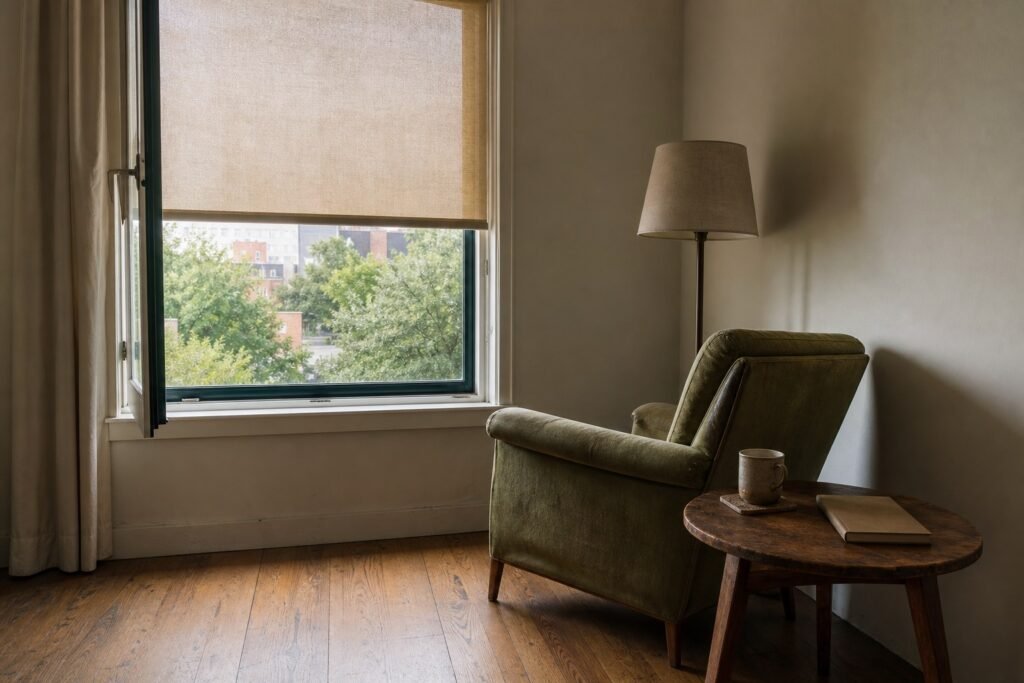
Turn the chair first. A small angle can move the page out of a reflection while retaining the view. If a new covering is still needed, choose it for the actual combination of glare, privacy, window operation and child safety.
Do not assume a sheer provides privacy at night. With the room light on, perform the outside check. And do not let loose fabric enter an inward-opening sash or approach a heat source. For measuring the frame, rod and stack-back around real obstructions, continue to How High and Wide Should Curtains Hang?.
Give the page its own light after sunset
The window clock
Comfort changes even when the chair does not.
Test the nook at the hours you actually read.
- 08:00Soft daylightCheck warmth and latch access.
- 13:00Glare testTurn the chair or adjust the shade.
- 19:00Page lightAdd a stable shaded task lamp.
- 22:00Privacy + routeClose the shade; keep the exit clear.
After dark, the window becomes a view and sometimes a mirror. A nook without task light is only a daytime chair.
Use a shaded lamp that puts light on the page without placing a bare bulb in the normal sightline. Test the actual paper or screen used there; a glossy page, matte paperback and tablet do not reflect light in the same way. Move the lamp to the side that avoids hand shadow for the reader.
Follow the fixture’s bulb type and limits. Keep textiles away from heat, and run the cord clear of the window mechanism, covering, rug and approach. If an approved outlet cannot be reached safely, move the chair or seek qualified electrical advice. Do not solve the problem with chained adapters.
Portable heaters deserve their own clear zone. U.S. Fire Administration guidance says to keep anything that can burn at least three feet (about 0.9 metres) from heat sources, including radiators and space heaters, and to switch portable heaters off when leaving the room or going to bed. Product instructions and local rules may be stricter.
For bulb-box terms and the difference between task light and decorative glow, use How to Layer Living Room Lighting for a Warm, Useful Room.
Make the nook survive an ordinary week
Leave the borrowed arrangement in place for seven days. Do not tidy it specially before each check. A successful nook has to work with the real book, throw and cup in their real positions.
Once during the trial, repeat the full window test:
- open and close the sash and covering;
- reach the latch or key without climbing over the chair;
- check that cups and books have not migrated to the sill;
- look for condensation or damp material, and investigate the cause rather than hiding it behind cushions;
- confirm the route remains clear in daylight and darkness;
- remove any textile that has crept toward a heat source.
The U.S. Fire Administration advises mapping all doors and windows in a home fire plan, finding two ways out of every room, and making sure doors and windows are not blocked. Whether a particular window is a legally required escape opening depends on the building and local rules; this article cannot determine that remotely.
If a guard, stop, new shade or other hardware seems necessary, pause the styling project. Check landlord permission, product instructions, window warranties, the household escape plan and local requirements. Before You DIY: The Measure–Test–Safety Checklist offers a useful stop-and-call framework.
The seven-day note
Record only what changes the decision:
- Use: Did anyone choose the chair without prompting?
- Duration: Was it comfortable for the intended reading period?
- Movement: Did the chair, table or lamp creep into a route?
- Window: Could every normal operation happen without resetting the nook?
- Light: At what hour did glare or darkness interrupt reading?
- Privacy: Did the covering work with the evening lamp on?
- Landing: Where did the book, drink and glasses actually go?
- Maintenance: Did the sill stay visible and reachable?
At the end, choose one outcome: keep, move and repeat, or release. Releasing the idea can be good editing. A comfortable chair on another wall may deliver the same reading habit without asking the window to surrender ventilation, heat, privacy or safety.
Seven-day trial
Keep, move or release the arrangement
Repeated use is better evidence than a first-day photograph.
0 of 8 checked
Build the ritual, not the photograph
The chair, window, light and route have to work at the same time. That is why the best first action is free: move a chair near the window today, operate everything around it, and sit through the hour when the light is most difficult.
If the window still works and the chair earns repeated use, add the smallest missing piece—usually a stable landing surface or better task light. If the arrangement fails, move it without regret. The view can remain part of the room even when the furniture stays safely away from the glass.
If the whole room feels crowded before the nook arrives, begin with The No-Buy Home Reset and make space before adding another piece of furniture.
Sources and further guidance
- U.S. Consumer Product Safety Commission: Preventing Window Falls
- U.S. Consumer Product Safety Commission: Window Covering Cords
- U.S. Consumer Product Safety Commission: Anchor It
- U.S. Fire Administration: Home Fire Escape Plans
- U.S. Fire Administration: Heating Fire Safety
- U.S. Department of Energy: Residential Windows, Doors and Skylights
- Library of Congress: Storing Your Books
- Library of Congress: Limiting Light Damage
These U.S. sources establish useful safety and preservation boundaries; they are not universal law. Follow the requirements, product instructions, permissions and qualified advice that apply to the particular home, window and household.
About the visuals in this guide
These are original Dealsmaster editorial illustrations produced with AI assistance for explanation and inspiration. They do not document a real household, tested installation, reader result, or professional inspection.