A shelf-by-shelf editorial audit
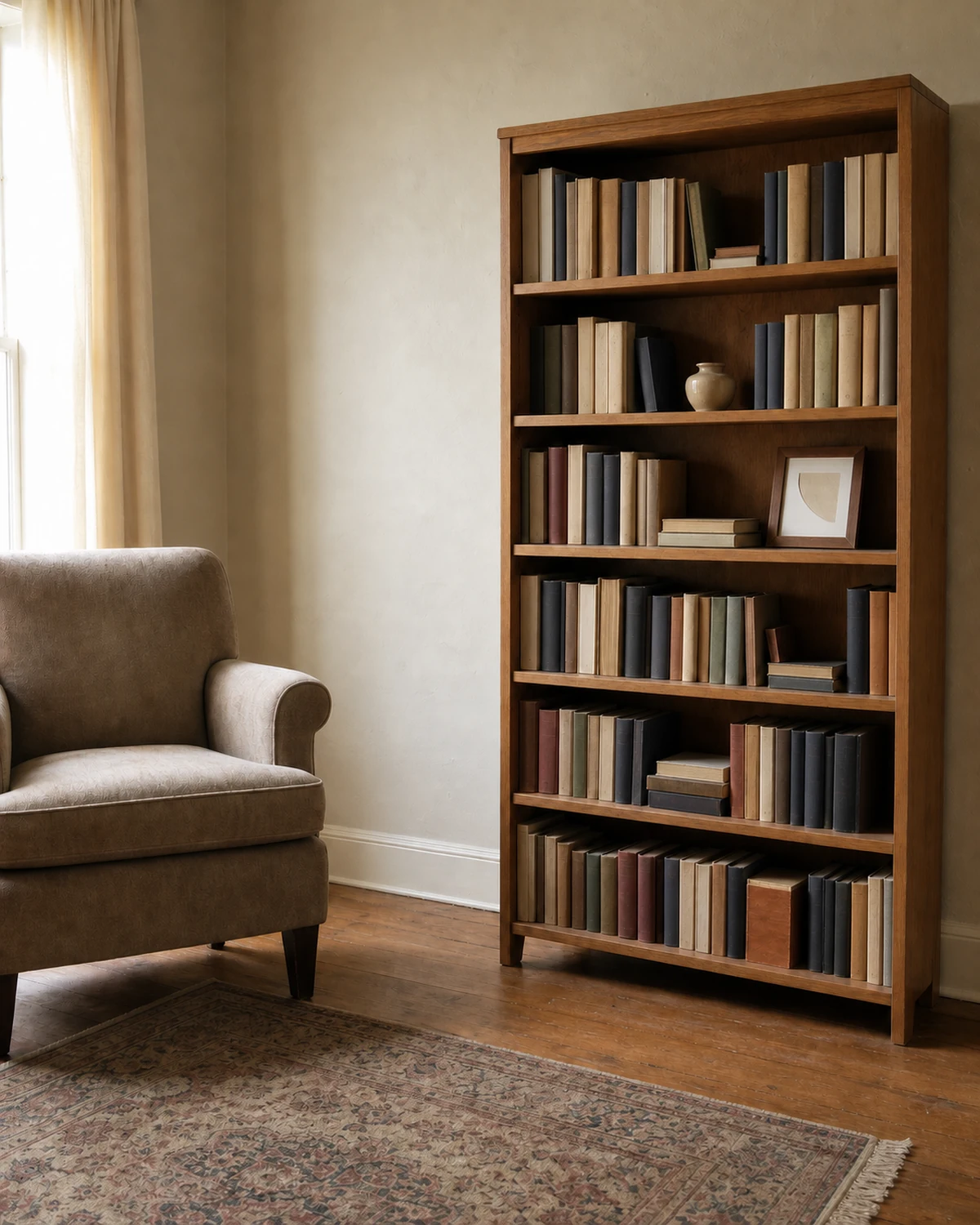
Style the bookshelf around four ordinary actions: finding a book, pulling it out, returning it and adding the next one. When those actions work, the collection’s different heights, worn spines, gaps and meaningful objects provide the composition—without asking the books to behave like décor.
A beautiful bookshelf can be surprisingly hostile to reading. The plant must move before a hardback can come out. A horizontal stack collapses when the bottom title is wanted. The rainbow arrangement is memorable as an image but useless to the reader who remembers an author, not a spine colour. The case looks calm because half the books are still in boxes.
The fix is not to abandon style. It is to stop treating use as visual noise. A missing book creates a gap. A reading queue changes from week to week. Old paperbacks sit differently from new art books. Those irregularities are the evidence that the shelf belongs to a reader; they are also a richer design material than a repeated formula of plant, vase and two books laid flat.
Before rearranging, give every shelf three tests: find, change and settle. Can someone locate a title using a logic they understand? Can it leave and return without rebuilding a vignette? Can the furniture support ordinary use safely, with the collection placed within the manufacturer’s limits and the case secured where required? Then add a fourth question: where can the next book go?
Start with the find, change and settle test
F Find
Ask for one title, one author and one subject. Can the household locate all three without scanning every spine?
C Change
Remove a book from each shelf, leave it out, then return it. Does the arrangement survive the movement?
S Settle
Check ratings, sag, joints, stability, anchoring and the approach. Styling starts only after the furniture is sound.
Audit the collection before composing the case
Take a quick census, not a perfect catalogue. Pull out the groups that physically or behaviourally differ: tall art books, small paperbacks, frequently consulted references, fragile or sentimental volumes, children’s books, borrowed books and the current reading queue. Note what is still elsewhere in the home. A shelf cannot be planned honestly around 120 displayed books if another 60 are waiting in cartons.
Physical shape matters. Small and medium books usually browse well upright, supported by neighbours or a bookend. Very large volumes may be safer and kinder to their bindings when stored flat in short stacks. Deep cases invite a second row, but a hidden rear row makes finding and returning harder. A collection of uniform novels needs a different arrangement from cookbooks, magazines and oversized monographs sharing one unit.
Reading behaviour matters more. A reference shelf can be dense if its categories are obvious and every spine remains accessible. A child’s shelf needs an approach and order the child can use, not a top-down colour display maintained by an adult. A shared collection may need boundaries by person or subject. A sentimental shelf may be handled rarely but still deserves protection from light, heat and moisture.
| Group | How it is found | How often it moves | Physical need | Likely growth |
|---|---|---|---|---|
| Fiction | Author, then title | Weekly | Mostly upright | High |
| Cookbooks | Subject or use | Several times a month | Tall and deep formats | Low |
| Art volumes | Artist or theme | Occasional | Large, heavy; short flat runs if needed | Medium |
| Reading queue | Current / next / return | Daily | One-hand access | Bounded, not stored indefinitely |
These sample entries illustrate the questions. Profile the collection that is actually in the room.
Once the profile is visible, decide what the bookcase is for. Is it the household’s main library, a working reference shelf, a children’s collection, or a smaller display case for favourites? A single unit can do several jobs, but each shelf should have a clear primary job. “Looks balanced” is not enough to guide the next person returning a book.
Choose an organising logic that a reader can retrieve
There is no single correct domestic classification system. Use the memory cue that actually brings someone to the shelf.
- By author suits fiction collections and readers who follow writers.
- By subject helps when someone browses a task, era or interest.
- By household reader gives shared cases clear responsibility and reach zones.
- By active, reference and archive suits a changing working collection.
- By room of use can keep cookbooks near cooking and reference books near a desk rather than forcing every book into one heroic wall.
Hybrid systems are normal. Fiction can run by author while nonfiction runs by subject. The reading queue can sit outside both. The boundary needs only to be understandable and stable enough that a book has a return address.
Colour may be a secondary compositional cue. Within a subject run, moving two similar jackets together can quiet a patch of visual noise. But a full rainbow is a trade-off, not an upgrade: use it only if the people retrieving books genuinely remember them that way. Turning every spine inward sacrifices identification and, for many editions, useful protection from handling; it is a display manoeuvre, not a library system.
Labels should name a choice point. “History,” “garden,” or a family member’s name may help. “Books” does not. Use readable text, not colour alone, and place the cue where it stays visible after a title leaves.
Give active reading an address
Books in progress migrate to the coffee table, bed and floor because the main bookcase often functions as an archive. The answer is not to hide the evidence of reading. Reserve a small, easy-to-reach run for three states: currently reading, next to read and ready to return elsewhere.
Keep the queue bounded. A bookend-defined run, one shallow tray or a short horizontal stack can work. If it expands beyond its boundary, review it: move finished titles home, return borrowed books, and decide which “next” title is actually next. The queue should make a decision easier, not become a second unsorted library.
A return marker helps a shared household. Place a slim, blank card or temporary book-shaped spacer where a borrowed title came from. This is not necessary for every paperback. It earns its keep in a dense series, a research shelf or a category used by several people.

Place the active run near the chair, desk or route where reading begins, if the furniture layout permits. If the case is part of a reading corner, the guide to a window reading nook without built-ins can help arrange seat, surface and light without blocking the lower shelves.
A five-shelf case for 180 changing books
Consider a hypothetical freestanding case with five adjustable shelves, roughly 180 mixed books and a few objects with genuine meaning. The unit’s exact dimensions, shelf ratings, wall construction and anchoring method are unknown, so this is a use map—not a load calculation or installation plan.
The case file: five shelves, five jobs
The central shelf serves the fastest action; growth gaps sit beside the categories that will use them.
The top shelf is not “the décor shelf”; it simply receives lighter, infrequently moved material. The middle earns the reading queue because it sees the most action. The bottom receives larger, heavier books only after the furniture instructions and shelf condition are checked. If bending is difficult for the intended user, weight may need to be divided into smaller groups at a different height. No arrangement overrides the actual user or the product.
Notice what is absent: a decorative object in every gap. Open shelf length has already been assigned to collection growth. One object can still separate categories, support books as a proper bookend, or connect the case to the room’s materials. It does not get automatic custody of every empty 20 centimetres / 8 inches.
Distribute growth instead of reserving one decorative void
A large empty cube looks generous but may be nowhere near the category that expands. Give likely-growth groups several modest gaps. Fiction might receive 10 cm / 4 in on two shelves; a small art-book group might receive one book’s width. These are examples, not recommended allowances. Use recent buying, borrowing and keeping patterns to estimate the next six to twelve months.
Growth-gap allocator
- Count books added to each group in the last six months.
- Measure the average spine width of a few typical additions.
- Reserve that approximate length beside the group, not on a remote shelf.
- Hold a short row upright with a stable bookend while it grows.
Example: six 3 cm / 1.2 in novels suggest roughly 18 cm / 7 in of nearby capacity. It is a planning estimate, not a guarantee.
Reference · some room
Cookbooks · one-book gap
Test the gap with a book, not a ruler alone. A row packed so tightly that fingers cannot grip a spine has used its nominal capacity but lost its function. Remove one volume with one hand and return it without shoving the whole row. If that move requires force, release a little more space.
Horizontal stacks also consume growth. Keep them short and give the bottom title a low-use role. If a weekly reference book sits under five others, the stack is a prop. Tall books can have their own bay if shelves adjust; do not lay them flat purely to create a pedestal for a candle or vase.
If the collection already exceeds the case, styling cannot solve the arithmetic. Decide which books need this room and which can live at another point of use. A cookbook consulted in the kitchen and a manual used at the desk have not been “split from the collection”; they have moved closer to their work. Boxed overflow is reasonable during a move or renovation, but give it an inventory and a review date. Otherwise, the visible case becomes a polished sample while the actual library remains unfindable.
A new bookcase is one possible answer, not the first. Before buying, measure the room approach, skirting or baseboard, door swing and the retrieval space in front. Plan the load and securing method from the chosen product’s instructions. More shelves help only when the furniture can be placed, used and secured appropriately.
Let objects punctuate the collection
An object belongs when it performs a specific job: it is a stable bookend, separates two classifications, holds a small item used with the books, or carries enough personal meaning to deserve the shelf length. “There was a gap” is not a job.
Try the subtraction pass. Remove every non-book object, then return only the pieces whose purpose you can name. Repeat a material or room colour two or three times across the whole case rather than constructing a miniature vignette on each shelf. A ceramic form, a dark timber frame and the brass base of a nearby lamp can create continuity without replacing fifty books.
Plants require actual light and care. Keep watering away from books and electrical items, and use a watertight saucer appropriate to the pot. Decorative light strings add cords and can complicate cleaning or book removal; follow the product instructions and do not route a cable where it is pinched, stretched or used as a substitute for fixed room lighting.

Sunlight, heat and moisture deserve more attention than shelf colour. The U.S. National Archives’ guidance on preserving books advises storing books away from heat and moisture and notes that prolonged sunlight can fade covers and spines. It also recommends supporting small and medium books upright with similarly sized neighbours and storing large volumes flat. This is preservation guidance, not a claim that an ordinary paperback requires museum conditions.
Check the room over a full day. Direct sun may strike only for twenty minutes in late afternoon. A radiator, supply vent or damp exterior wall may sit close enough to matter. Move vulnerable or valued books away from the source rather than expecting a decorative box to correct the environment.
If the case’s visual language feels disconnected from the rest of the room, solve that at room scale. The guide to mixing interior styles without looking random uses shared materials, shapes and eras; the whole-room colour-palette guide can turn one loved jacket or cover into a broader scheme without sorting every book by hue.
Stability is part of styling
A full bookcase concentrates weight. Do not borrow an internet load allowance or assume solid-looking shelves can carry any collection. Find the furniture’s model and instructions when possible, respect the stated shelf and total ratings, and inspect for sagging, loose joints, damaged hardware or movement. If instructions are missing or the unit is questionable, reduce the load and seek manufacturer or qualified advice.
Anchoring is not interchangeable between wall types. A generic fastener may be wrong for masonry, plaster, drywall or a wall with concealed services. Renters should obtain required permission. If the correct fixing or wall construction is uncertain, use a qualified installer rather than improvising.
Accessible placement also depends on the person. The U.S. Access Board’s ADA standards apply to specified covered facilities, not as a blanket rule for a private living-room bookcase. Their storage and reach provisions are nevertheless a useful design reminder: a shelf is not functionally available if the intended reader cannot approach and reach it. Give frequent-use books a clear, comfortable band and do not ask a chair, drawer or the case itself to become a step.
The missing-book stress test
A bookshelf should survive movement. Remove one book from every shelf and live with the gaps for a day. Do objects spread into them? Do neighbouring books fall? Does the classification remain understandable? Can another reader return the titles without being coached?
Five moves, one useful diagnosis
- Choose one title from each shelf.
- Remove each with one hand.
- Leave the five gaps overnight.
- Ask a reader to return them.
- Fix only the first failed move.

If the failure is find, clarify the classification or cue. If it is change, remove an obstacle, shorten a stack or add a stable bookend. If it is settle, stop styling and address condition, load or anchoring. If every book returns but the next purchase has no address, redistribute the growth gaps.
Do not use the test as a disguised order to reduce the collection. A dense library can be beautiful and useful when it has a legible map, sound furniture and enough working clearance to retrieve a title. Conversely, a sparse shelf can fail if each gap is occupied by an obstacle.
If the composition still feels flat after function works, use scale rather than filler. Let a run of short paperbacks meet one tall volume. Place a short horizontal group where format genuinely benefits. Allow new glossy jackets and worn cloth spines to sit together. Slight asymmetry is not a defect; it is how a changing collection records time.
Your next action: give one shelf a reading job
Do not restyle the entire wall this afternoon. Choose the shelf you touch most. Name its job in plain language—current fiction, household reference, children’s nightly choices, or books to return. Remove one obstacle. Leave enough space to take a book out and enough nearby capacity for the next one.
Then pull a title, read it and put it back. If the shelf still looks good after that small disturbance, the design has passed the test that matters. It is not merely displaying the idea of a reader; it is serving one.
Sources and limits
- U.S. CPSC: Anchor It — securing top-heavy furniture, removing climb temptations and following manufacturer instructions.
- U.S. CPSC: Military Consumer Safety, furniture and TV tip-overs — bookcase anchoring and placing heavier items lower.
- U.S. National Archives: Preserving Books — storage away from heat, moisture and prolonged sunlight, plus upright support and large-volume handling.
- U.S. Access Board: ADA Accessibility Standards — covered-facility scope and accessible-storage concepts, used here only as a private-home design lens.
Editorial disclosure: This article does not report personal furniture or product testing and contains no affiliate links. The 180-book case and all measurements are hypothetical. Furniture ratings, manufacturer instructions, wall construction, property permission and applicable local requirements govern.
About the visuals in this guide
These are original Dealsmaster visual studies made with AI-assisted image tools and art-directed for this article. They illustrate planning examples, not photographed reader homes, product tests, or guaranteed outcomes.