
A wet-boundary measurement lab
Measure the curtain as a moving water-control layer, not as a rectangle of bathroom decor. Record the opening width, actual rod span, hook-to-hem drop, end overlap and lower containment position. Then watch one normal shower: where does spray hit, where does the curtain pull inward, and which wet surfaces stay folded together afterward? Choose the material and pattern only after those facts are known.
This prevents the most expensive kind of small mistake: replacing an attractive curtain with another attractive curtain while the real escape route remains open. A curtain cannot repair a leak, failed seal, damaged wall, unsuitable shower layout or ventilation problem. It can only perform the job the product and geometry allow.
Follow one splash before touching the rod
Leave the existing setup in place for one observation. From a safe, dry position outside the spray, watch the shower in its normal configuration. Do not reach across a wet floor or stand in the tub for the sake of the test. Notice what changes between still and running water.
The shower head may aim toward one end. Moving air can draw a lightweight liner inward. A caddy may stop the wet layer from closing against the wall. A hook may catch at the centre. The lower edge may sit correctly when dry, then ride outside the tub after somebody reaches for shampoo.
Separate curtain failures from building failures. Water emerging beneath trim, around plumbing penetrations, from a damaged joint or through a wall is not a textile-selection problem. Persistent leakage, soft or damaged surfaces, significant recurring mold, or an uncertain waterproofing condition belongs with the property owner or an appropriately qualified local professional.
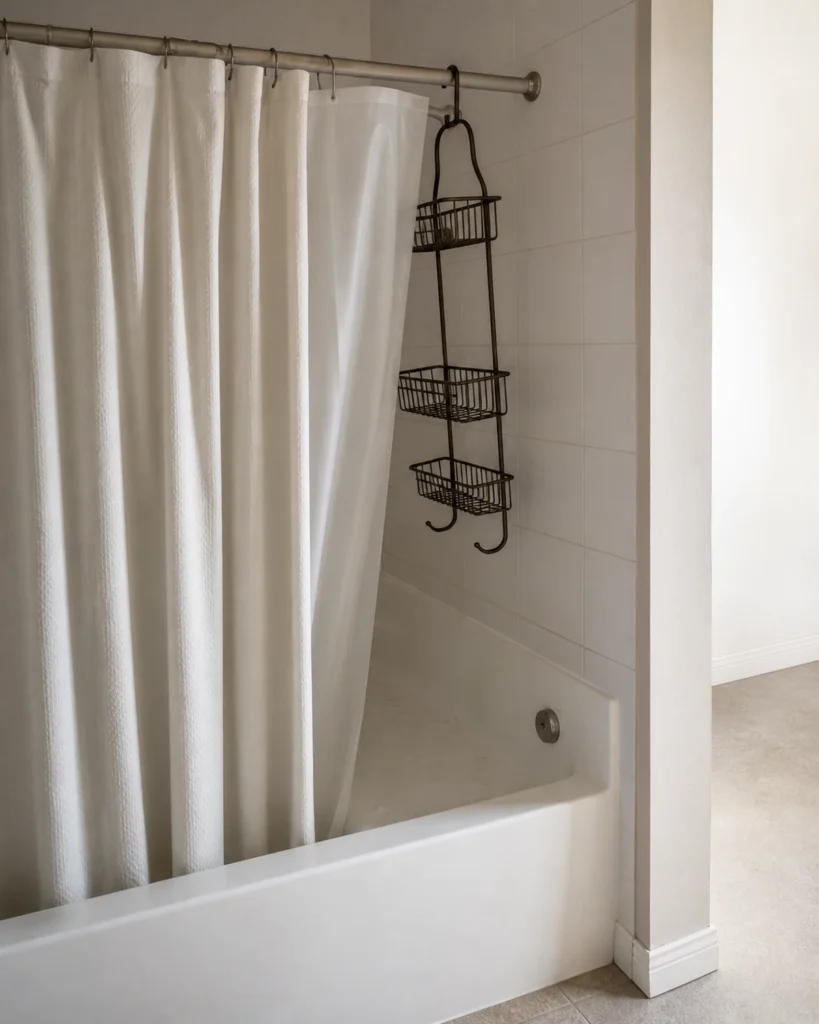
Direction and reach
Inner wet layer
Down folds and seams
Hem and end overlap
Inside the designed wet boundary
If the path jumps from stage four to the room floor, identify why before shopping.
Photograph the dry setup and the post-shower position from the same angle. The second image is often more useful than a product listing because it shows how your curtain actually moves. Do not create a deceptive “before and after”; keep the camera and room conditions comparable.
Record five measurements—and name their reference points
A naked number is easy to misuse. “72 inches” could describe an opening, a product width, a rod span or a drop measured from the ceiling. Write what each dimension connects.
Measure the installed hook or ring position, not an imagined line at the top of the rod. Hooks, grommets and header styles change the finished drop. A curved rod changes the path and the amount of material needed across the span. If the rod position is moving, test the proposed position and then remeasure; do not calculate a curtain around a rod that exists only in a product photograph.
Check the full path of the curtain. Can it close past a shelf? Does the stack block a control or grab bar? Can the leading edge be reached by the person who uses the shower? Accessibility and safe support take priority over visual symmetry. Do not move a grab bar or alter an accessible shower arrangement for a curtain style.
Decide which layer gets wet
A decorative curtain and an inner liner can divide the jobs: one contributes colour or pattern; one is designed to stay inside the wet boundary. Some products are intended for single-layer use. Neither arrangement is universally better. The exact product description, care label, hook system and room geometry decide.
When two layers share a rod, account for their combined movement and weight. Confirm the rod and fixings are suitable under their instructions. Check whether both layers can be removed without dismantling the whole setup and whether the decorative layer remains clear of the wet inner edge.
Layer decision table
| Question | Single working layer | Decorative outer + wet liner |
|---|---|---|
| Water role | Product must be intended to contain water in this installation. | Identify the inner layer that stays inside the wet boundary. |
| Care | Whole visible surface follows one care label. | Each layer may have a different removal and cleaning route. |
| Movement | Less combined bulk, but material behaviour still matters. | Check that layers slide without dragging each other outside. |
| Appearance | Wet-use material is also the main visual field. | Outer material can be chosen for appearance only within its stated use and care limits. |
| Failure to watch | Assuming “fabric” or “water-resistant” means suitable without reading the product details. | Letting the outer layer wick water or pinning a wet liner into dense folds. |
Lace and openwork can make a distinctive outer layer; openwork does not establish water containment. An absorbent vintage textile may also have unknown fibre content, care needs or colourfastness. Treat it as decoration only if it can stay where its condition and the wet layer permit, and do not sacrifice closure at the ends to display a scalloped edge.

Mock up fullness instead of copying a ratio
More width creates folds. It can also create a thick stack, obscure a control, reduce end contact, hold wet surfaces together and distort a large motif. A curtain the exact width of the opening may look taut and expose gaps as it moves. The useful amount is the one that closes the real span with reliable end coverage and still opens, stacks and dries in that room.
Clip a clean sheet, inexpensive fabric or paper strip to the existing rings. Mark the proposed product width with safety pins or removable clips. Distribute the folds, close it fully, then slide it open. This is a geometry test, not a recommendation to use the mock-up in a running shower.
Pattern reads clearly; little tolerance if an end pulls inward.
Both ends overlap; centre remains inside; stack clears controls.
More texture, but test bulk, closure, wet contact and pattern loss.
Judge the pattern while pleated. A small repeat can tolerate changing folds. A large face, landscape or centered motif may become fragments. A vertical stripe can emphasize height but will advertise uneven hanging. Product images commonly show fabric spread wider and more evenly than it will sit in a compact bathroom.
Set the lower edge to return water, not collect it
For a conventional tub-and-curtain arrangement, the designated wet layer needs to stay inside the tub during use, in the position the product and installation require. A hem too high may let spray escape below it. A hem that piles on a wet floor or tub base can remain bunched and difficult to clean. Test the centre and both ends while the water runs.
A shower stall, low threshold or level-access shower is not a short bathtub. The floor slope, drain position, opening and accessibility needs change the water path. Do not copy a tub measurement or place a weighted hem where it creates a trip, snag or access problem. Use the exact shower-system and curtain instructions, and obtain appropriate local advice if the containment design is uncertain.
Magnets, suction attachments and weighted hems are features, not universal cures. Confirm that the mating surface, material, care instructions and user access suit the feature. Do not add a makeshift weight, puncture the curtain or attach something that the product was not designed to carry.
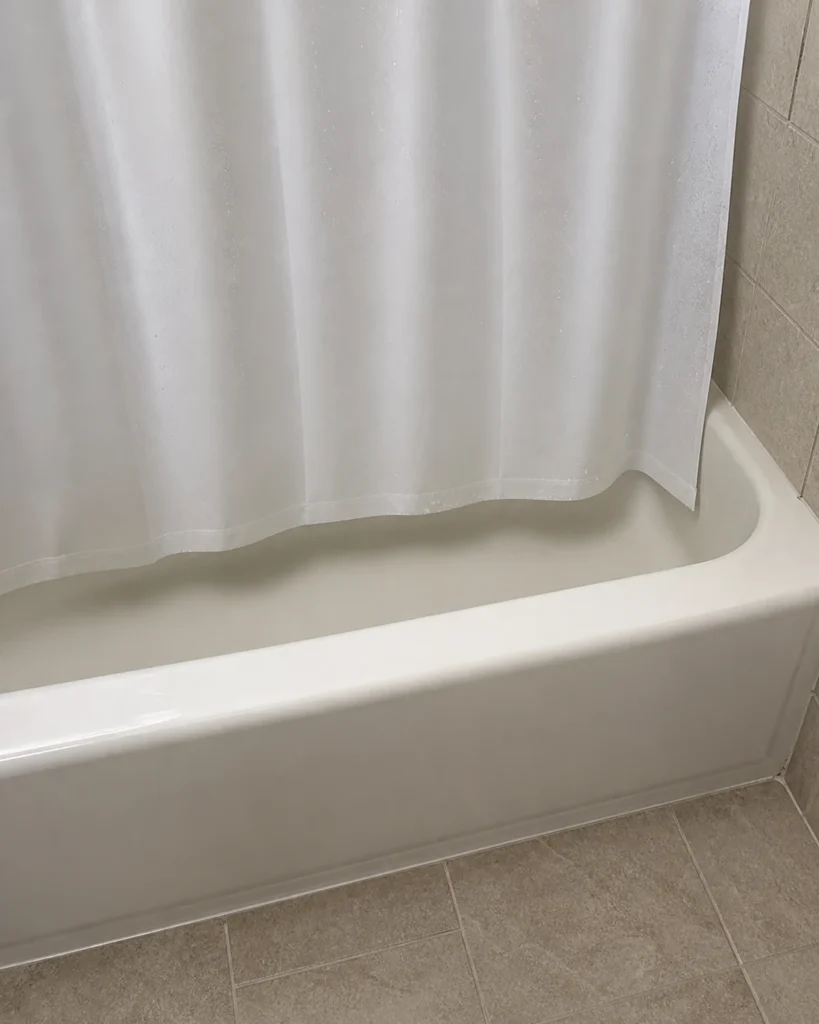
Design the position after the water stops
The shower is not finished when the tap closes. Damp material, folds, the tub ledge and room air still need a credible drying route. The U.S. EPA’s mold and moisture guide calls moisture control the key to mold control, advises fixing water problems and drying wet materials, and specifically recommends bathroom ventilation when recurring shower mold is an issue.
That does not turn a curtain into a mold-remediation project or establish an exact drying time. It does support a simple room-planning principle: do not deliberately hide standing water or compress wet surfaces without considering how they will dry.
- Return the liner or designated wet layer fully inside the boundary.
- Extend it enough to expose damp faces rather than leaving a tight stack, if the product instructions allow.
- Use the bathroom’s exhaust or window as the property and local conditions permit.
- Clear standing water and investigate its source; do not simply cover a recurring puddle with a mat.
- Clean and launder each layer according to its care label.
The EPA’s biological-contaminants guidance also says a bathroom fan should vent outdoors, or a window may be opened when conditions safely allow, during and after a shower. If an installed fan seems ineffective, noisy, blocked or does not exhaust as intended, report or assess that system rather than assuming a new curtain will compensate.
A decorative tieback can wait until the material is dry. The small habit of pulling a wet curtain into a photogenic knot defeats the point of giving its surfaces air.
Worked comparison: a 152 cm tub opening and a narrow stall
Consider a hypothetical tub opening measuring 152 cm / 60 in. That number does not determine the product. The installed rod extends beyond the visible opening. The ring-to-hem distance is shorter than the ceiling-to-ledge distance. A wall-mounted caddy at the control end prevents the liner from closing, and the shower head sends its strongest spray toward that same gap.
The household first relocates the obstruction if it can be moved safely and legitimately. It clips a dry mock-up to the rod to test width and stack. The plan preserves useful overlap at the control end, keeps the designated wet layer inside the tub and measures the finished drop from the real hooks. Only then does it compare product dimensions and care labels.
Now move the same curtain to a 91 cm / 36 in hypothetical shower stall. It creates a dense stack, the lower edge no longer meets the same containment condition, and the stack competes with the entry. Nothing about “standard shower curtain size” answers those differences. The stall requires a separate measurement and manufacturer-guided plan.
These dimensions are examples to show method, not recommended sizes. A curved rod, sloped ceiling, freestanding tub, accessible shower, window, rental tension rod or fixed glass panel changes the problem.
Style the rectangle that survived the lab
Once width, drop, layers and drying position are known, the decorative decision gets easier. The curtain is one of the bathroom’s largest fields. It can quiet busy tile, repeat a colour from a small object, or introduce texture without requiring a shelf full of accessories.
- Quiet solid: gives patterned tile and fittings room to remain distinct.
- Small repeat: stays understandable through changing folds and partial opening.
- Large motif: needs a pleated mock-up so its important area does not vanish.
- Openwork or lace outer: can soften light, but needs a separately verified wet layer where required.
- Dark or dense field: may alter the bathroom’s daytime brightness; view a sample in the actual room.
Bring the bathroom into the colour decision. A bright online image cannot reproduce a small room’s window direction, bulb, tile undertone or reflected colour. Compare the sample when the bathroom is normally used, both open and in folds.
If the room also struggles with floor clutter, solve that as a separate route. The curtain should not be shortened just to clear a storage basket. Use the small-bathroom floor-clear storage guide to move the basket instead.
Test the curtain with the person who moves it
A wet boundary can be geometrically correct and still fail in use. The leading edge may be hard to reach. Small rings may snag. Dense fabric may require more grip than expected. A tieback may sit exactly where a shoulder or mobility aid needs room. The best test is the ordinary sequence performed by the actual user, without running water at first.
Stand outside the dry shower. Open the curtain completely, enter as normally as the setup allows, close it, reach the controls without leaning on the rod, reopen it and leave. Do not use the curtain or tension rod as a grab surface. If support is needed, preserve the approved grab bars and accessible arrangement; a curtain is not structural support.
Watch the stack at both ends. A stack that blocks controls may invite the user to leave a gap during every shower. A header that catches may encourage pulling hard enough to disturb a tension rod. A lower edge that tangles around feet or equipment is not fixed by prettier fabric. Change the layer, attachment or layout within the manufacturer and property rules.
Now practise the after-shower reset. Can the wet layer be returned inside and extended without reaching across a slippery floor? Can the outer layer stay clear? Can the exhaust control be used as intended? If the “correct” drying position requires a complicated routine nobody will repeat, simplify it.
Households with different users may need two observations. A tall adult and a child, or a standing user and someone using a shower chair, encounter different reach and splash conditions. Do not force a vulnerable person to perform a wet test. A caregiver, occupational therapist, accessibility professional, property manager or installer may need to guide changes when support and access are involved.
Cleaning is another movement test. Can each layer be removed and rehung without standing on a tub edge or unstable stool? Can hooks be handled from a safe floor position? If not, choose an attachment and care plan that reduces risk, or arrange appropriate assistance. A machine-washable label is not useful if getting the curtain down is unsafe.
Finally, keep one small end-of-life plan. Record the product name, dimensions and care instructions. When the liner is damaged or the curtain is replaced, you will know which part of the geometry worked and which did not. This prevents the next purchase from resetting the whole experiment to zero.
Searchable limits: stop treating it as a curtain problem
Stop the styling test if water is coming from an unidentified source, surfaces are damaged, the floor is unsafe, mold is extensive or repeatedly returns, or the installed shower arrangement appears unsuitable. Contact the property owner or an appropriately qualified local professional as the situation requires.
- This guide does not cover plumbing repair, waterproofing, mold remediation, structural fixing or accessible-shower design.
- Follow the rod, hook, curtain, liner and shower-system instructions for load, installation, compatibility, use and care.
- Renters should report leaks and moisture problems promptly and obtain permission before changing fixed hardware.
- Do not move grab bars, block controls, narrow a required entry or create a trip hazard to improve the curtain’s appearance.
- Local building, tenancy and accessibility requirements override a decorative layout.
Audit seven showers, not seven product photos
| Shower | Floor wet where? | End gap? | Hem position? | Drying obstruction? | Change before next use |
|---|---|---|---|---|---|
| 1 | |||||
| 2 | |||||
| 3 | |||||
| 4–7 | Record only repeated patterns |
Change one variable at a time where safe: clear the caddy, redistribute hooks, reset end overlap or change the drying position. If water persists outside the boundary or the source is uncertain, stop experimenting and escalate the underlying issue.
Your next action: write the five numbers on one photograph
Take a straight-on photograph of the current dry setup. On a separate note, record the opening, rod span, real hook-to-hem drop, overlap at each end and intended lower containment position. After the next normal shower, take the same photograph again and mark the first place water left the planned path.
Bring that sheet—not a guessed “standard size”—when comparing curtains. Style becomes much more satisfying once the room has stopped surprising the floor.
Sources and scope
- U.S. Environmental Protection Agency: A Brief Guide to Mold, Moisture and Your Home — moisture control, drying, leak response and bathroom ventilation boundaries.
- U.S. Environmental Protection Agency: Biological Contaminants and Indoor Air Quality — source control and bathroom exhaust/window guidance.
Sources were checked 30 July 2026. Manufacturer instructions, the property’s shower design and local requirements control installation and care. This article contains no affiliate links and reports no personal product test.
About the visuals in this guide
These are original Dealsmaster visual studies made with AI-assisted image tools and art-directed for this article. They illustrate planning examples, not photographed reader homes, product tests, or guaranteed outcomes.