Coffee-station planning
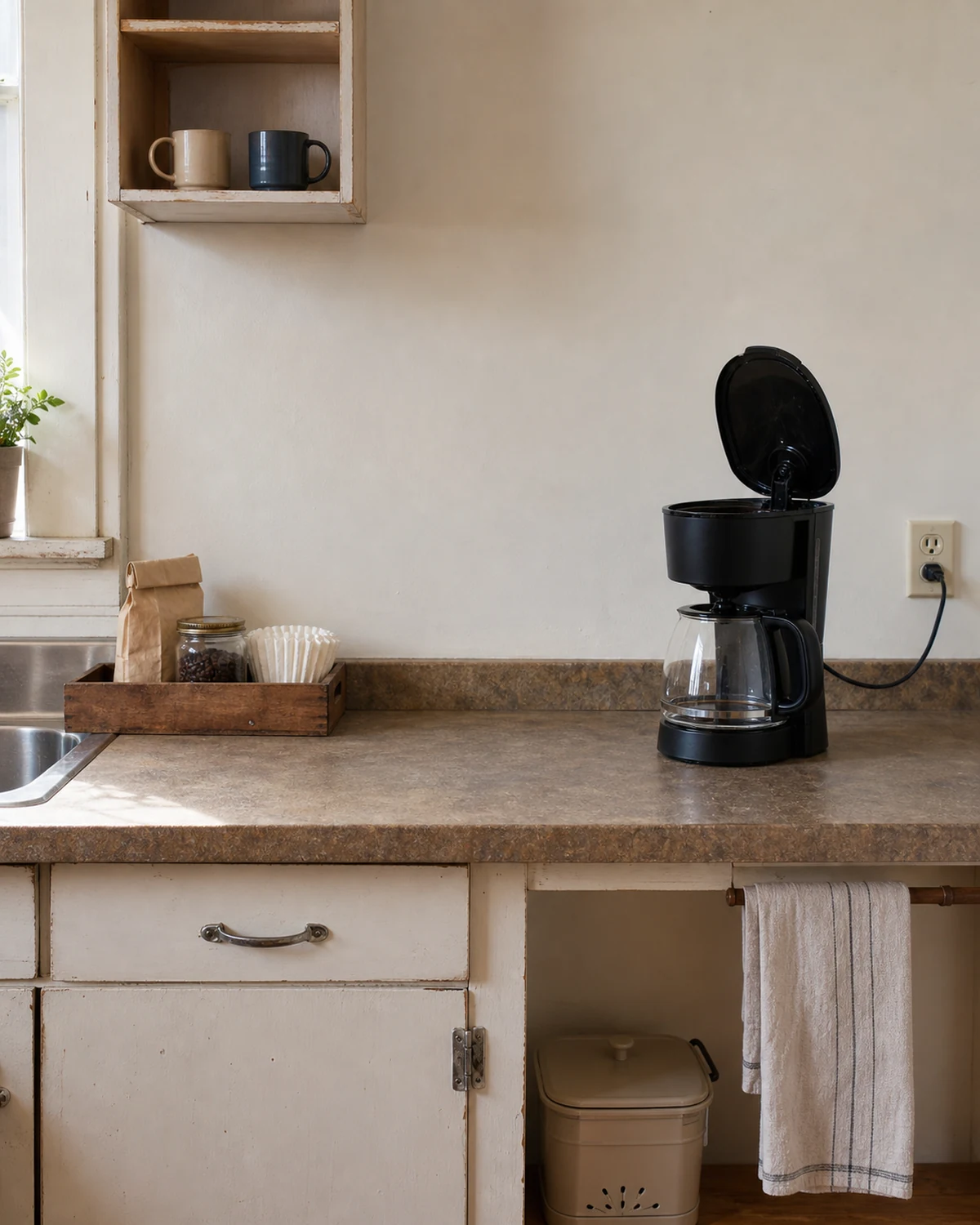
The best place for a coffee station is not the prettiest empty corner. It is the smallest safe work zone that lets you fill, brew, serve, discard and wipe without carrying water over clutter or moving the same object every morning. Before buying a cart, tray or mug tree, make one ordinary drink and follow it all the way to a clean counter.
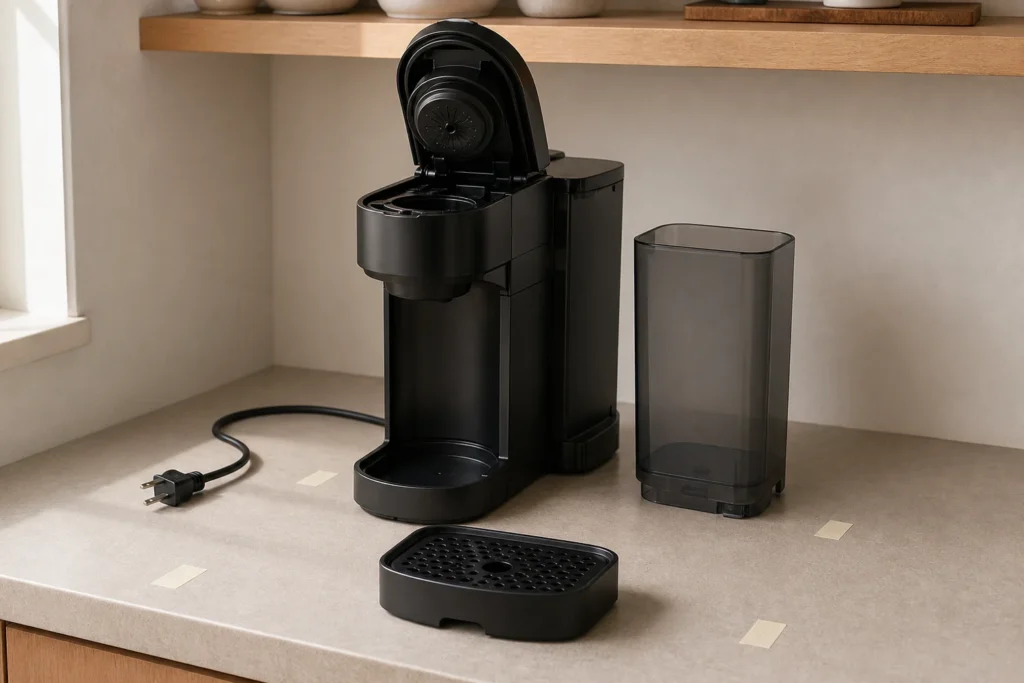
A coffee machine can occupy less than a sheet of paper and still require half a counter to use. The reservoir lifts. The lid swings. A portafilter travels sideways. A hot carafe needs somewhere to land. Then come the less photogenic parts: a damp cloth, grounds, empty pods, milk splashes and the open bag that must be closed before the coffee goes stale. A station that makes no room for those actions is a still life, not a working corner.
This guide treats the station as a route. You will map one cup, measure the equipment while it moves, choose a layout that suits the drink made most often and separate active supplies from reserves. The worked 76 cm / 30 in example is a planning exercise, not a standard dimension. Your appliance manual, outlet arrangement, property rules and local electrical requirements always control.
Start with one cup, not a shopping list
Use the drink you make on a rushed weekday. A weekend pour-over ritual may be delightful, but it should not dictate the counter if five mornings out of seven begin with a pod machine. Put a small note beside each place you stop and each unrelated item you move.
The one-cup route
- Water
Fill a reservoir, kettle or carafe. - Dose
Reach beans, grounds, a pod or tea. - Brew
Operate the machine with clear hand space. - Serve
Land the cup; add milk or sugar if used. - Discard
Move grounds, filter, pod or packaging. - Wipe
Clear drips and let the cloth dry. - Reset
Refill what the next drink will need.
Useful observation: count crossings, object moves and two-handed bottlenecks. Do not count an ordinary step to the sink as failure; count the needless return trip for the filter stored above the fridge.
Now draw the route as it exists. If the sink is two steps away, the water leg may already be sensible. If the refill bag is in a pantry, that can also be sensible; unopened stock does not need counter space. Concentrate on repeated friction. A spoon in the wrong drawer matters more than an infrequently used cake plate above the station.
The route also reveals whether the station belongs where you imagined. A freestanding cart without a suitable outlet may create a cord problem. A bedroom coffee corner may sound convenient but adds hot water, food residue and cleaning to a room that may lack an appropriate sink and washable work surface. A corner beside the hob may have power and water nearby yet conflict with meal preparation. Sometimes the correct coffee “station” is simply one disciplined stretch of the existing kitchen counter.
Measure the machine while it is working
Measure more than width, depth and closed height. Put the appliance where you propose to use it, unplugged, and perform every normal movement. Open the lid. Remove the reservoir and drip tray. Insert the largest everyday mug. Move a steam wand through its range. On an espresso machine, mimic locking and removing the portafilter without forcing your wrist against a wall.
Operating-footprint record
| Action | What to measure | What commonly collides |
|---|---|---|
| Fill | Tank or kettle route, lifted height, grip space | Shelf underside, tap, decor, cabinet door |
| Load | Lid, pod drawer, filter basket or portafilter travel | Wall, utensil crock, another appliance |
| Brew | Cup height, hot surfaces, steam path specified by maker | Low shelf, paper goods, hanging rail |
| Clean | Drip tray, carafe and waste removal path | Tray lip, cable, mug stand, sink queue |
| Service | Access required by the manual | Fixed riser, boxed-in sides, heavy objects above |
Add the plug and cord exactly as supplied. Do not stretch the cord, pinch it behind the appliance or route it across a wet or busy path to make the furniture choice work. The U.S. Consumer Product Safety Commission explains that extension cords missing specified safety characteristics can present shock or fire hazards. That is not a universal wiring code, but it is a useful reason to reject an improvised layout and follow the appliance maker’s power instructions and the electrical rules where you live. If a suitable outlet is not in the right place, relocate the station or ask a qualified local professional about a compliant solution.
Leave every clearance the manufacturer requires. There is no responsible universal gap for “a coffee maker” because machines vent, open and shed heat differently. The closed appliance fitting beneath a shelf proves only that it can be stored there. It does not prove that it can brew there.
Choose the shape that matches the drink
A household may own several brewing methods, but the active counter should be biased toward the one used most. Less frequent equipment can live in a nearby cabinet and come out deliberately. A station fails when it gives equal billing to every mug, syrup and gadget while leaving no empty patch for the cup.
Filter-brewer line
Order: coffee and filters → measure → brewer → cup → grounds or bin.
Keep the carafe route to the sink open. Store spare filters upright where one can be taken without lifting the coffee bag. The finish end needs a place for the used filter and a cloth, not another row of mugs.
Espresso work bay
Order: grinder → dosing patch → machine → knock/waste → milk-tool wash.
This route needs elbow room and a stable, washable surface. Keep the portafilter’s turning arc clear. Milk jugs and tools used daily may stay close; decorative bottle ranks should not occupy the tamping or cup-landing patch.
Pod-machine loop
Order: water → pod → brew → empty-pod destination → wipe.
Check whether the pod drawer or bin blocks the drip tray. Display only a modest active selection. If local recycling or return rules apply, design the used-pod route around them rather than assuming every pod belongs in one waste stream.
Kettle pair
Order: fill → heat → brew vessel → cup → leaves/grounds → rinse.
Give the kettle the operating position required by its instructions and keep its cord out of pull routes. Tea and manual coffee can share the water end, but separate tiny tools in one shallow container so the counter does not become a loose-teaspoon reserve.
For mixed households, make the routes overlap at their useful points: water, cups and the wipe end. Do not duplicate sugar, spoons and cloths for each appliance. If two people regularly make drinks at once, stagger the equipment so one can fill while the other lands a cup. If simultaneous use is rare, plan for the common solo route rather than sacrificing the whole counter to a hypothetical café rush.
When the station has to disappear after breakfast
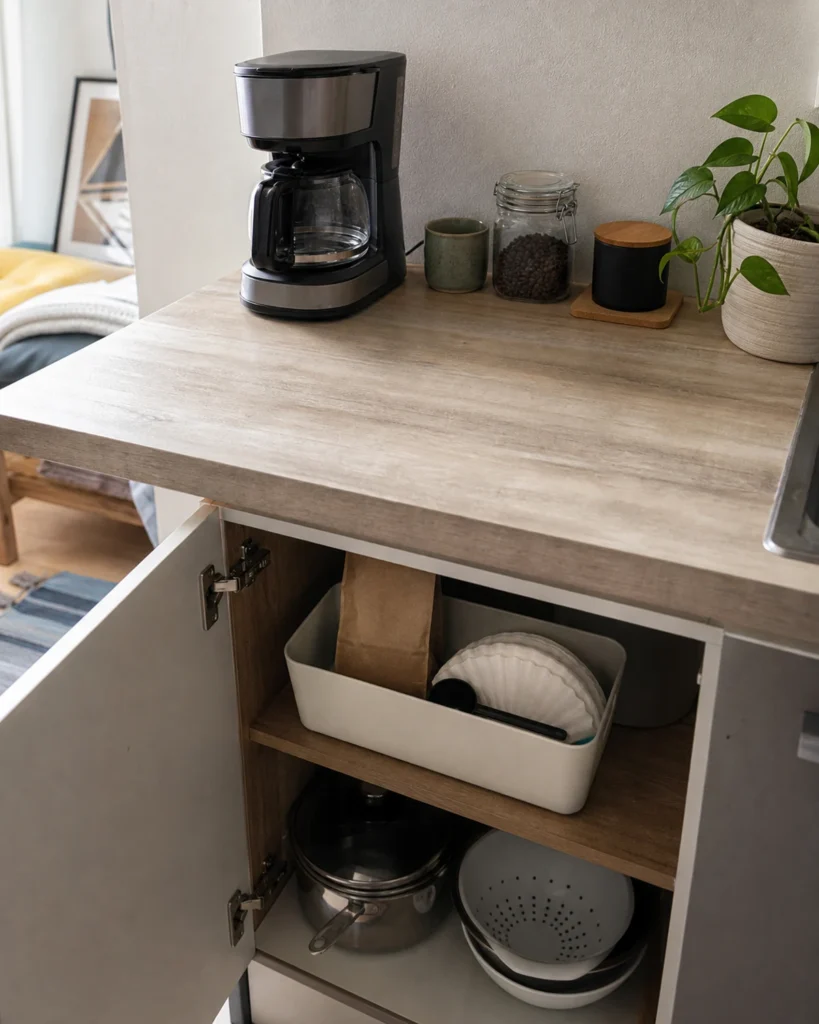
In a studio, first apartment or kitchen with one preparation counter, a permanent display may cost more function than it gives. Build a closing route as well as an opening route. The machine stays only if it can operate in the approved position without taking the work patch needed for lunch; everything else should return in one or two easy moves.
Put the active coffee, filters and measure in one shallow washable box. It should be light enough for the intended user, small enough for its cabinet address and simple to open without unpacking layers. Keep the cup outside that box if it already has a sensible cabinet home. The aim is not a portable café kit; it is a clean handover from breakfast to food preparation.
Before choosing a cart as the escape route, park a cardboard outline of it for two days. Open nearby doors, carry shopping past it and clean the floor around it. A cart that narrows the only route or becomes overflow shelving has not freed the kitchen. For a new home still finding its daily pattern, the first-apartment 24-hour setup helps decide which functions deserve permanent addresses first.
Worked example: a 76 cm / 30 in counter run
Consider a hypothetical renter with a filter brewer that is 20 cm / 8 in wide, a removable top reservoir and an outlet at the right end of a 76 cm / 30 in counter. The sink is one step left. The household makes two cups each morning, adds milk from the fridge and empties grounds into a kitchen compost caddy.
The first draft puts the brewer in the middle, mugs on a tree to the right and coffee in a decorative canister to the left. It photographs neatly. In use, the mug tree crowds the plug, the canister occupies the best cup-landing space and the open reservoir hits the shelf above. The plan has styled the stationary footprint and ignored the route.
The revised order is less symmetrical:
- Brewer at the outlet end, only if its supplied cord reaches without tension and the manual permits that operating position.
- Open patch beside it, wide enough for the everyday mug, coffee measure and brief carafe landing.
- Shallow active box at the back of the open patch for roughly a week’s filters and coffee. It can lift away as one unit for wiping.
- Two everyday mugs in the cabinet above or on one accessible shelf, not twelve mugs on the counter.
- Waste and cloth at the exit: the compost caddy remains in its existing under-counter position; the cloth hangs where it can dry rather than staying folded wet beneath the brewer.
The top-opening conflict is not solved with a shorter canister. It changes the machine position: the brewer moves beyond the low shelf or the shelf contents move, subject to lease and installation limits. The point of the example is the order of decisions. Equipment operation and safe power come first; open hand space comes next; containers and decoration arrive last.
Give the counter only active stock
Retail packaging makes reserve supplies look like active supplies. A large pod carton, kilogram bag of beans or multipack of filters may be economical, but the full purchase rarely deserves the easiest reach. Split stock by the moment in which it is needed.
The three-level refill ladder
- Daily
The dose, filter or pod touched for one drink. Keep it in the active zone and easy to identify. - Next refill
Enough to replenish the active container without opening every reserve package. A nearby cabinet is close enough. - Reserve
Unopened back stock. Keep it with pantry inventory and record what is already there.
Choose a visible trigger, such as the bottom of a label or a marked scoop depth. “Refill when low” is vague at 6:30 a.m.; a visible line can be acted on.
Decant only when it improves use and preserves required information. Keep expiry, allergen or preparation information where relevant, and do not pour an unidentified refill over old contents indefinitely. If coffee freshness matters to you, follow the roaster’s storage guidance rather than choosing a clear jar for appearance alone.
Reserve storage can borrow the same logic as a good pantry: one open package visible, back stock behind it, duplicates limited. The small walk-in pantry food-flow guide expands that system without turning the coffee counter into a miniature shop.
Design the dirty end in plain sight
Coffee stations make fine debris and small wet messes. Both are easy to underestimate because neither looks dramatic. Grounds lodge beneath a textured tray; a drip dries behind the machine; the cloth stays wet because it has no hanging place. The remedy is not a larger decorative tray. It is an exit route.
Ask where each by-product goes immediately after the drink:
- grounds, filters, leaves or pods;
- milk tools and used spoons;
- drip-tray water and rinse water;
- empty packets and refill packaging;
- the cloth after it is used.
Make the machine movable according to its manual and your physical ability; do not trap it inside a lip-sided tray that makes leaks invisible or cleaning awkward. A thin washable mat may help define the area, but inspect underneath it. Keep paper, art and porous baskets away from splash and steam paths. A framed print is not worth preserving if it prevents the reservoir opening or turns every wipe-down into a small removal job.
For descaling and internal cleaning, use the method and products named by the appliance manufacturer. Do not improvise chemical mixtures. The U.S. Environmental Protection Agency advises following product directions and warnings, ventilating when products may release indoor pollutants and storing household chemical products according to their instructions. That is broad U.S. indoor-air guidance, not a coffee-machine cleaning formula.
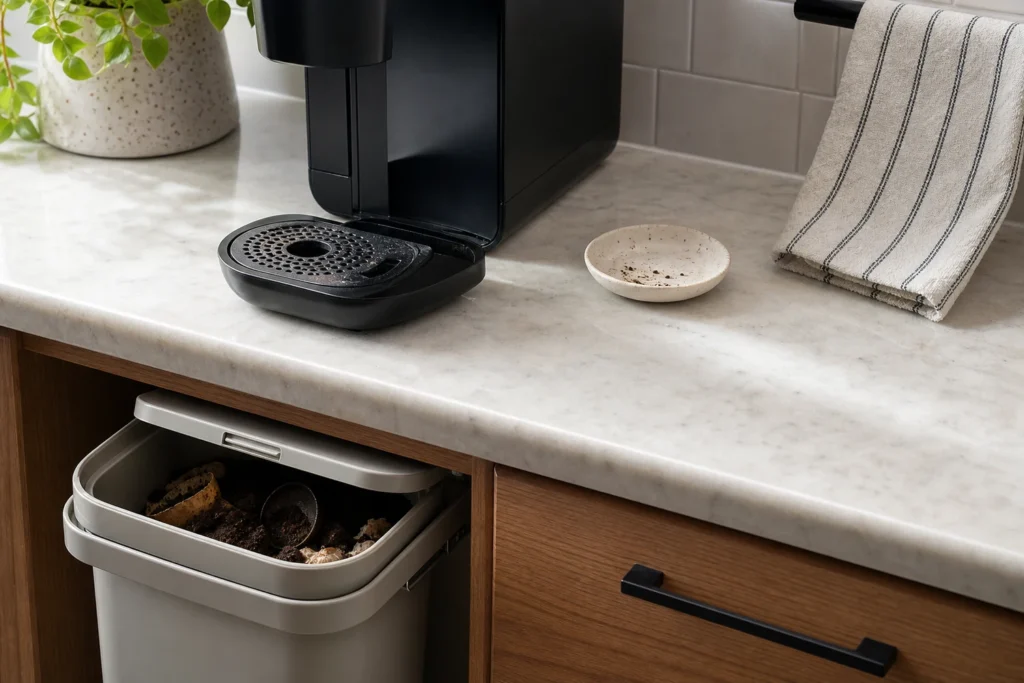
Style what survives the wipe test
Once the route works, the station can look deliberate without dressing as a fictional café. Choose a small set of visible objects that earn their place: the two mugs used most, a good-looking hand grinder that is actually used, a spoon pot that can go through the dishwasher, perhaps one durable tray that lifts in a single motion.
Repeat a material already in the kitchen instead of importing a theme. A timber board can echo chopping boards; a dark metal scoop can relate to existing handles; one coloured mug can supply the accent. Leave the open work patch visibly open. Negative space is not unfinished decorating here. It is where the cup lands.
Lighting should help you see water and grounds without adding a trailing cable or glare. Existing under-cabinet lighting may be enough. If the corner is dim, the guide to indirect LED lighting without glare can help you assess light placement, but power and product instructions still come before the visual effect.
Renters can build the system without mounting a rail or buying a special cabinet. Use the existing counter, one washable active-stock container and a cabinet shelf for refills. A compact cart is useful only if it is stable, has a suitable work surface and can stand where the appliance may be operated according to its instructions. Wheels do not make an unsuitable outlet or a crowded route suitable.
Searchable safety and limits
- Appliance instructions control. Required clearance, ventilation, filling, descaling, shut-off and servicing differ by model. Check the exact manual and recall information for the model and country of use.
- Do not plan around improvised power. Keep the supplied cord unpinched and away from wet work and pull routes. Use only arrangements the manufacturer and local requirements allow.
- Hot water and steam need a protected route. Keep children, pets, sleeves and crowded passing paths out of the operating zone. A machine that can be bumped while someone cooks is in the wrong position.
- Do not hide leaks. Investigate unexpected water, heat, smell, noise or damage and stop using equipment when its instructions or an applicable recall require it.
- Accessibility is personal, not decorative. Put the heaviest frequently lifted item where the actual user can grip it securely. If lifting a full reservoir overhead is difficult, choose a filling route or machine position that avoids it.
- Global readers: the linked CPSC and EPA pages are U.S. sources. They illustrate risk boundaries, not law for every home; product, property and local rules apply.
The seven-trip audit
Tomorrow, make the usual drink before changing the station. Add one mark in the last two columns each time it happens.
| Moment | Destination | Crossed the kitchen? | Moved an unrelated object? |
|---|---|---|---|
| Water | __________ | □ | □ |
| Coffee / tea | __________ | □ | □ |
| Cup / additions | __________ | □ | □ |
| Waste | __________ | □ | □ |
| Wipe / rinse | __________ | □ | □ |
Decision: fix the first trip or object move that repeats on two mornings. Do not reorganise the entire kitchen to solve a rare task.
Tomorrow’s next action
Do not buy the tray tonight. Put a note beside the machine, make the normal drink tomorrow and record the route without correcting it as you go. Then change one address: the filter that causes a return trip, the cloth with nowhere to dry or the mugs occupying the only landing patch. Make another drink the following day. A coffee station earns its counter space when the cup, the refill and the cleanup all have somewhere honest to go.
Sources and scope
- U.S. Consumer Product Safety Commission: Extension Cords — observable safety characteristics and shock/fire risk; U.S. product-safety scope.
- U.S. Consumer Product Safety Commission: Recalls & Product Safety Warnings — searchable model-specific recall records; not evidence that every machine is hazardous.
- U.S. Environmental Protection Agency: Care for Your Air — following product directions, ventilation and household-product storage.
Editorial disclosure: Dealsmaster did not test a coffee machine, cleaning product or room for this guide and makes no product recommendation. No affiliate links are included. Measurements are worked examples. Exact appliance instructions, recalls, property conditions and local requirements take precedence.
About the visuals in this guide
These are original Dealsmaster visual studies made with AI-assisted image tools and art-directed for this article. They illustrate planning examples, not photographed reader homes, product tests, or guaranteed outcomes.