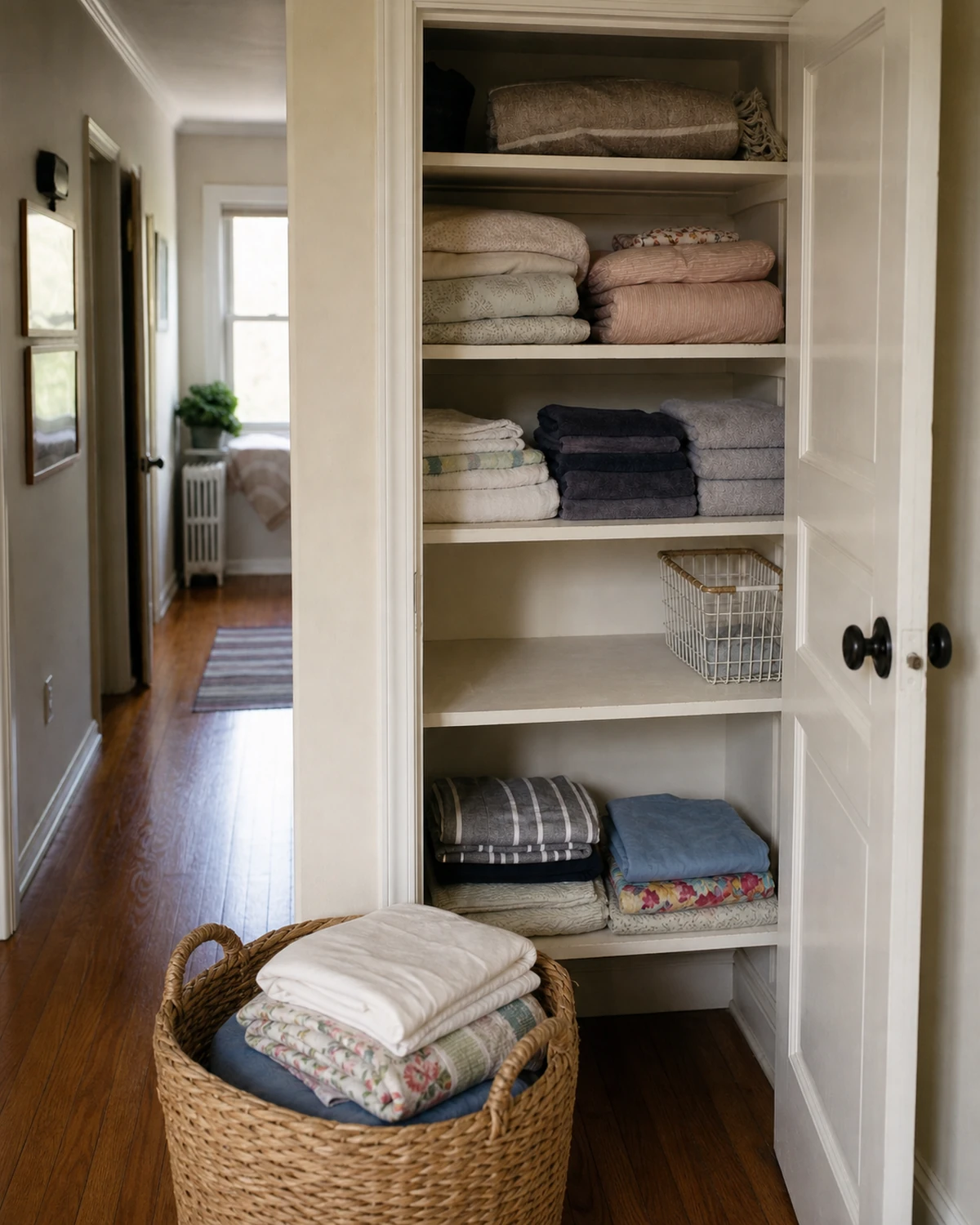
The laundry-return field guide
A linen closet stays organised when the next clean load has an obvious place to land. Begin with that return trip—not with baskets—and give towels, bedding and guest stock enough identity, reach and spare capacity to come home without a shelf-wide reshuffle.
The revealing moment happens before the closet door closes. A stack of clean towels arrives. The towel shelf is already full, so half the stack is pushed on top of fitted sheets. A pillowcase has lost its partner. The duvet cover will fit only if someone removes the guest blanket first. Nothing is dramatically wrong, but put-away now requires six small decisions. On a busy wash day, those decisions become a pile on a chair.
This is why an immaculate reset can fail within a fortnight. It was arranged around the inventory at rest, with every space filled, rather than around linens in motion. The useful question is not “How many matching containers fit?” It is “Can the largest ordinary clean load return in one pass?”
You can answer that without buying anything. Follow one load from bed or bath to hamper, wash, drying, folding, storage and use. Count complete changes rather than impressive towers of individual pieces. Give the easiest shelves to the fastest-moving returns. Then leave deliberate rebound space—the modest gap that receives what is currently in the machine.
First, map the trip a clean sheet actually makes
Organisation advice often begins with an emptied closet. Begin one room earlier. Where does a clean load finish: on a folding counter, the bed, a dining chair, or inside the dryer while someone looks for space? How many doors and turns sit between that surface and the closet? Who usually puts the load away, and what do they need to recognise at a glance?
Trace one real towel and one real bedding change. The route may reveal that the closet is not the only problem. Perhaps fitted sheets are folded upstairs but stored downstairs. Perhaps clean bath towels must pass the hamper that is already blocking the closet floor. Perhaps the household sorts by “sheets” even though the person making a bed needs to know size, room and whether the pillowcases are present.
The clean-linen service loop
Mark the first step that causes a pause. That is the best place to improve first.
- Leave bed or bath
- Reach hamper
- Wash
- Dry fully
- Fold or group
- Return to closet
- Find as a set
The closet controls the final two steps directly, but a poor return route makes them harder. If folding happens far away, use a basket that carries one category at a time or fold complete sets together. If several people put laundry away, make identity visible at the shelf edge. If linens are returned warm or not completely dry, fix that handoff rather than designing a tighter container for it.
A route with fewer hesitations is more durable than a complicated folding rule. The aim is not to produce a retail display; it is to make the correct action the easy action when the load is ordinary, mixed and slightly late.
Count service changes, not loose pieces
Seven pillowcases, four fitted sheets and two duvet covers do not describe what the closet can do. Convert the inventory into the units in which the household uses it.
For a bed, one service change might mean a fitted sheet, a flat sheet if used, the correct pillowcases and a cover appropriate to the season. For a bathroom, it could mean the towel combination normally issued to one person. A guest set has a different rhythm from daily stock. A spare blanket kept for illness, pets or a cold snap has a different job again.
This count makes incomplete sets visible without turning decluttering into a morality play. An unmatched pillowcase may still be useful. A worn bath towel may be exactly right for a muddy dog or a plumbing spill. Give those items a named job or move them to the place where that job occurs. What causes trouble is not imperfection; it is material whose purpose has become unknowable.
The one-load capacity worksheet
| Service unit | Normally in use | Largest return at once | Reserve genuinely needed | Shelf landing required |
|---|---|---|---|---|
| Main-bed change | 1 set | 1 complete set | 1 set | Space for 2 folded sets |
| Bath towels | 4 towels | 4 towels | 2 towels | One returning stack plus reserve |
| Guest bedding | Usually 0 | 1 set after a visit | 1 ready set | One complete labelled group |
The entries are examples, not recommended quantities. Replace them with your household’s beds, laundry timing, guests, care needs and climate.
Now look for the peak return, not the average. If almost every bath towel is washed together, the towel shelf must receive almost the whole category together. If bedding is washed one bed at a time, each bed category needs room for one returning change. Capacity that ignores the peak load guarantees overflow even when the total volume technically fits.
Do not discard useful linens solely to create empty space. But name the trade-off honestly. Keeping five changes for a bed that uses two may require a back-stock shelf, a different storage location or a slower put-away routine. The worksheet turns “too much” into a decision about service, rather than a generic instruction to own less.
Assign shelves by return speed and handling effort
The best shelf is the one the intended user can approach, see and use without lifting another category. That is not always eye level. A short adult, a seated user, a child who helps with towels and a person with limited shoulder movement experience the same closet differently.
Start with frequency. Daily towels and frequently changed bedding usually deserve the clearest, easiest band. Put light, infrequent stock higher only when the user can retrieve it safely. Place heavy, bulky pieces lower, where lifting starts from a more stable position and a dropped item has less distance to travel. Keep the floor approach clear; a hamper parked in front of the closet can make every otherwise sensible shelf harder to use.
Worked example: a five-shelf hall closet
This 61 cm / 24 in deep closet serves two beds and one bathroom. The dimensions and assignment are illustrative, not standards.
Change the map when the people or routine change. If guest beds turn over every week, guest linens move inward. If a child returns hand towels, that category comes down. If bending is difficult, the bottom shelf may be inappropriate even for weighty stock; use smaller, lighter groups or relocate them. Frequency is a starting rule, not a substitute for watching the user.
The example also protects an entire landing area for towels. A shelf packed edge to edge on reset day has no operating capacity. Treat the air beside the stack as part of the system.
Keep a complete set legible at the moment of return
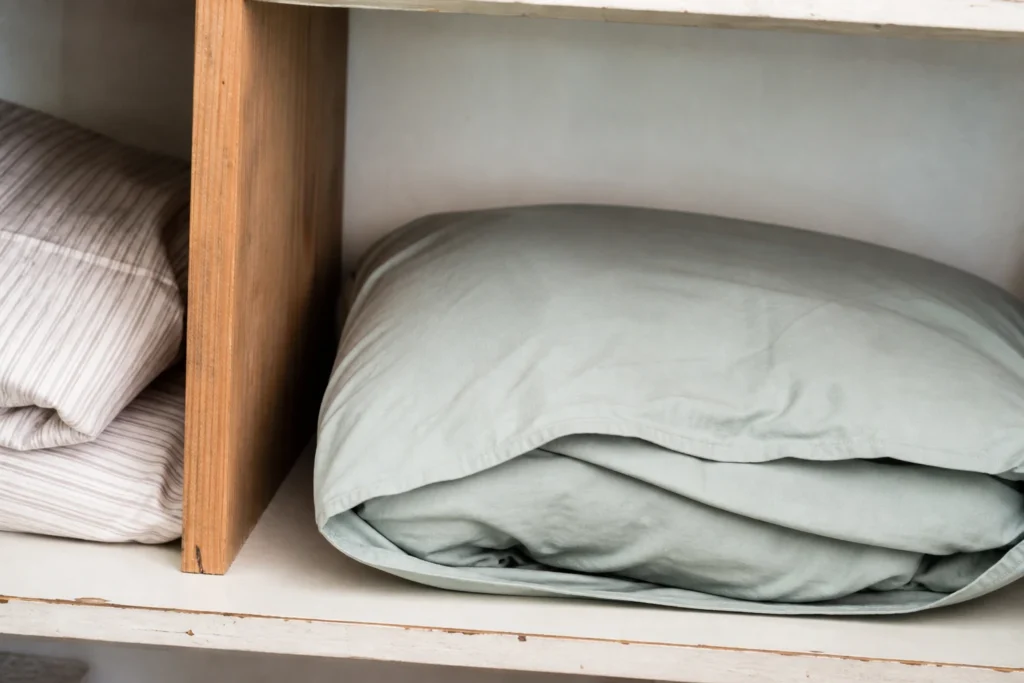
A label should answer the question the hand is asking. “Linens” says nothing inside a linen closet. “Main bed,” “single guest bed,” “bath,” and “pool” can prevent a search. Put the cue where it remains visible when the stack changes: at the shelf edge, on a divider, or on the front of a container. A tag against the back wall disappears as soon as the first pile lands.
Complete bedding sets can stay together without becoming tiny folded parcels. A loose pillowcase wrapper, a breathable fabric bag, a divided shelf or a simple strap can preserve identity. Choose the least elaborate method the laundry-doer will repeat. If refolding a fitted sheet into a perfect rectangle is required to make the container close, the container is setting a maintenance standard the household may not want.
Colour cues can help, especially when words are hard to read at a distance, but do not make colour the only cue. A written size or room name remains useful when lighting changes, a textile fades or a user does not distinguish the chosen colours easily.
Store task linens where the task begins. Cleaning cloths do not need to occupy prime bedding space if they are always carried to the kitchen. The same principle appears in the guide to building a small laundry room around one load: storage works better when it follows the action rather than an abstract room label.
Give a deep shelf one honest depth policy
A 61 cm / 24 in shelf looks generous until a front stack hides a back stack. Depth is useful only when the rear can be identified and retrieved without dismantling the front.
Choose one deep-shelf strategy per category
Pull the full depth
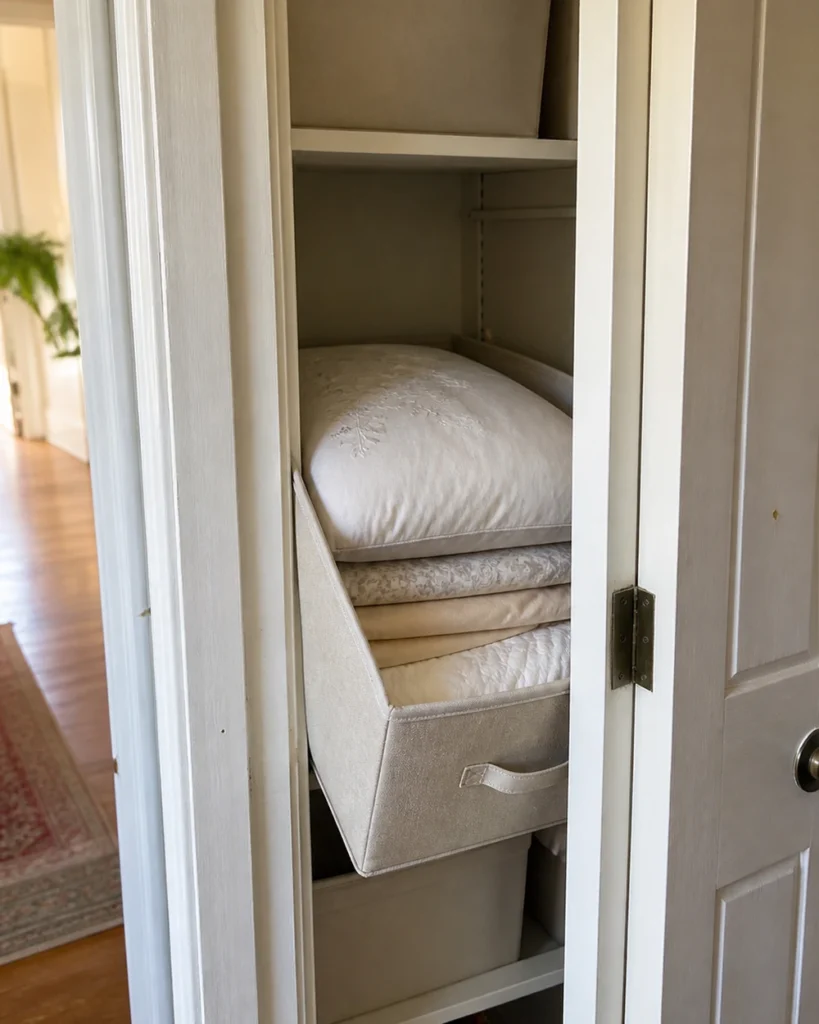
Use one category in a tray or bin that can pass through the clear door opening and be lifted at its loaded weight.
Best for: small, loose items or a contained guest set.
Reveal the rear
Raise or separate a deliberate back row so its top and identity remain visible over the front.
Best for: light, low-frequency back stock.
Use only the front
Accept that inaccessible depth is not practical capacity and leave it clear rather than filling it by reflex.
Best for: high shelves or users with limited reach.
What rarely works is two loose piles with the same visual height. The front hides the back, so duplicates accumulate and the rear turns into an archive.
Measure more than the shelf. Record the clear opening with the door in place, the hinge projection, the frame, the distance between shelves and the space needed to tilt a container out. A bin can fit the internal width and still fail at the doorway. Test a cardboard mock-up or an existing box before purchasing a full set of organisers.
Also test the loaded move. A large basket full of towels may be too heavy or wide for one person to control. Two smaller groups can be more usable than one perfect full-depth bin. If a pull-out needs both hands, make sure the approach does not require one hand to hold a door.
Rebound space is capacity, not a styling gap
The shelf must hold what is stored and receive what is temporarily away. That second requirement is easy to miss because reset-day photographs show the entire inventory at rest.
Define rebound space in a physical unit: the width of one towel stack, the height of one bedding change, or the remaining third of a basket. Do not rely on a vague promise to “leave room.” Then test it with the category’s peak return. If four bath towels normally arrive together, place four folded towels into the landing space. If they fit only after compressing the stack or moving guest items, the gap is decorative rather than operational.
There are four ways to recover rebound space: reduce surplus, split a category by service, use a different shelf, or choose a container that wastes less internal space. Buying a taller basket does not create capacity if the shelf above prevents it from being lifted out.
The same logic helps a small bathroom. Keep daily supply close to use, then route true reserve elsewhere; the floor-clear bathroom storage guide shows how to separate those jobs without filling the walking area.
Use accessibility guidance as a lens, not a private-home rule
For covered U.S. public and commercial facilities, the U.S. Access Board’s ADA standards scope accessible storage and reach. Its illustrated reach guidance shows a principle worth borrowing at home: an obstruction can reduce usable high reach, and corner approaches can be difficult. These federal dimensions are not a blanket legal requirement for a private linen closet, nor do they describe every person’s ability.
Plan three reach bands for the actual user
Light items only; no routine climbing or blind lifting.
Approachable, visible and operable with the user’s comfortable reach.
Use only when the user can bend or reach safely; keep floor access open.
This is a household planning tool, not an ADA compliance diagram. If accessibility is essential, design with the user and obtain qualified local advice for alterations.
Ask practical questions instead of adopting a universal “prime shelf” height. Can the user get close enough, or does a hamper obstruct the approach? Can they see the label from their normal position? Can the item come forward without pinching, twisting or a two-handed balancing move? Would a side-opening door, pull-out or shallow group reduce effort?
If storage must be mounted, follow the system manufacturer’s instructions for the wall type and load. Renters should check their lease and obtain required permission. Do not improvise fasteners when the wall construction or concealed services are uncertain.
Do not organise around dampness or chemicals
Textiles should return only after they are dry. A basket, sachet or solid door cannot solve a leak, condensation or persistently damp surface. The U.S. Environmental Protection Agency’s residential mold guide says moisture control is central to mold control and advises fixing water problems and drying items completely.
If you notice a musty smell, recurring condensation, a stain that returns or visible growth, pause the organising project. Identify and correct the moisture source; renters can report water concerns to the property owner or manager. Do not pack absorbent fabric against an unresolved damp wall or use fragrance to disguise it. Mold cleanup scope depends on the extent and cause, so use the EPA guide and appropriate local professional advice rather than a storage article as a remediation manual.
Strongly scented products can also transfer fragrance to textiles and may not suit every household. They are optional, not an organising requirement. An inventory card and dry, clean shelf do more work than decorative sachets.
Run the “next clean load” audit for two ordinary weeks
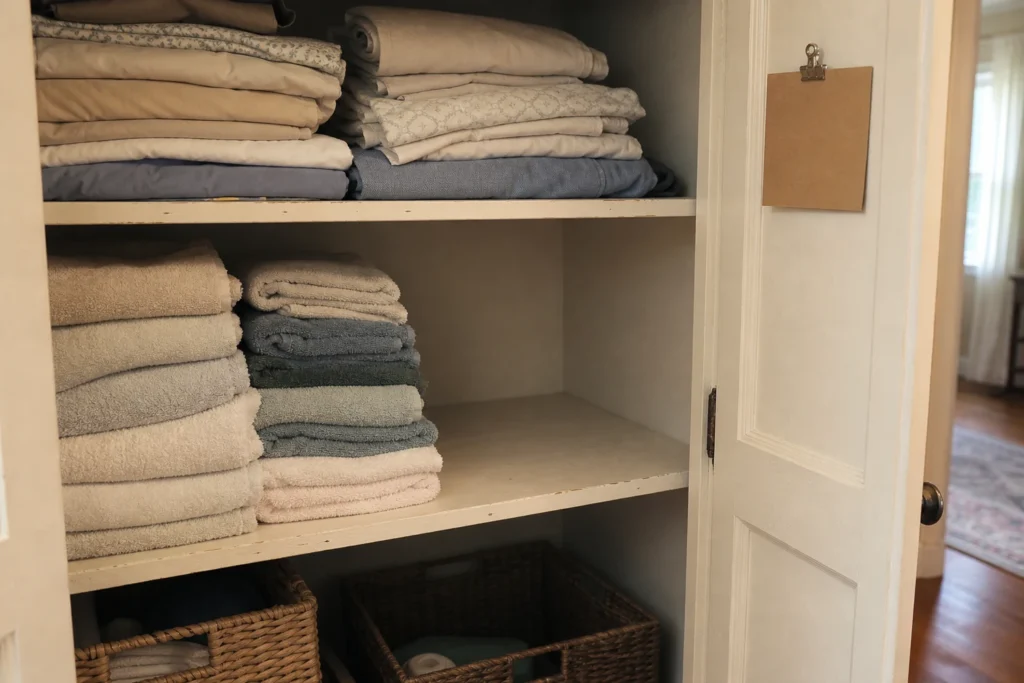
Do not evaluate the closet while it is freshly reset and nobody has touched it. Use it. Laundry should leave, return, get mixed up and be found by more than one person. That is the test.
The 15-minute rebound audit
- Carry in the largest normal clean load.
- Time only the first hesitation, not the whole task.
- Return each category without moving another.
- Pull one complete bed or bath change back out.
- Check whether every label remains visible.
- Note any blind lift, deep reach or blocked approach.
- Confirm dry textiles are not pressed against dampness.
- Make one correction and repeat next wash day.
Keep a note inside the door. Record the category that overflowed, the item nobody could identify, the bin that had to be tilted, the shelf that required two hands, and the piece that never moved. After two weeks, make the smallest useful correction. Move the repeated category inward. Split “bedding” by bed. Shrink the container that consumes the landing gap. Add a divider only where a stack actually falls.
A rarely used item is not automatically clutter. Weather, illness, guests and laundry access all change what a household needs. The audit reveals location and capacity; it does not make the keep-or-discard decision for you. If the deeper problem is deciding what deserves space, use the decluttering mistakes guide to avoid arbitrary quotas and aspirational categories.
And if the closet is carrying multiple decorative bedding combinations that are frustrating to wash and remake, the guide to layering bedding for real sleepers and laundry routines is the more useful next step.
Your next action: wait for one clean load
Do not order a matching set of bins tonight. On the next wash day, place the folded load in front of the open closet and notice the first decision it demands. Is the bed size unclear? Is the daily shelf full? Is the rear row invisible? Is the person returning towels reaching around a hamper?
Fix that single handoff and leave a measured place for the load to land again. A linen closet that survives laundry day will never look untouched—and that is the point. Its order is visible in how easily things leave, return and become useful, not in how long the door can stay closed.
Sources and scope
- U.S. EPA: A Brief Guide to Mold, Moisture and Your Home — residential moisture control, water-source correction and complete drying.
- U.S. EPA: Improving Your Indoor Environment — product-label, mixing and ventilation boundaries for household chemicals.
- U.S. Access Board: ADA Accessibility Standards and Chapter 3 illustrated guidance — U.S. covered-facility scope and the relationship between approach, obstruction and reach. Used here only as an inclusive design lens for a private home.
Editorial disclosure: This guide does not report personal product or household testing and contains no affiliate links. All closet sizes and quantities are worked examples. Follow product instructions, property rules and applicable local requirements.
About the visuals in this guide
These are original Dealsmaster visual studies made with AI-assisted image tools and art-directed for this article. They illustrate planning examples, not photographed reader homes, product tests, or guaranteed outcomes.